The 19th Chinese Urological Association (CUA) Genitourinary Oncology Conference was held in Beijing on July 3–4, 2026, bringing together leading experts from across China under the theme "Advancing Frontiers, Standardizing Care, and Driving Collaborative Innovation." The meeting provided a platform for discussing new directions in urologic oncology research and clinical practice.As one of the birthplaces of modern urology in China, the Peking University Institute of Urology and the Department of Urology, Peking University First Hospital (PKU Urology) has been a pioneer in the management of upper tract urothelial carcinoma (UTUC). During the conference, Professor Xuesong Li, Chair of the Department of Urology, presented a keynote lecture entitled “Development of the PKU Urology UTUC Subspecialty and Major Research Advances,” highlighting the team’s achievements in disease-specific database development, nephron-sparing surgery, and non-invasive diagnostics.
At the meeting, Oncology Frontier – UroStream spoke with Professor Li about the major challenges in UTUC management, the development of subspecialized care, and future directions in translational research.
Oncology Frontier – UroStream: PKU Urology was one of the first centers in China to establish a dedicated UTUC subspecialty. What has this subspecialty model changed most for patients?
Professor Xuesong Li:
When discussing subspecialization, we should first define what it truly means.
In my view, a mature subspecialty requires three essential components.
The first is a dedicated clinical team, with at least two physicians specializing in the disease area.
The second is a disease-specific database, prospectively designed to systematically collect, analyze, and manage both historical and ongoing patient data.
The third is a dedicated research team.
Only by integrating clinical care, scientific research, surgical innovation, and academic leadership can a program truly be considered a subspecialty.
Our team at PKU Urology began exploring this model as early as 1999, and around 2012 established a dedicated UTUC database in the true sense of the term.
After more than a decade of continuous development, we have accumulated data from nearly 6,000 UTUC patients, including almost 5,000 retrospective cases. In 2024, we also launched a prospective disease-specific registry.
These multicenter real-world data have become an invaluable research resource, generating numerous clinically meaningful research questions. We have investigated surgical techniques, pathological characteristics, epidemiology, and the appropriate indications for different operative approaches. The database supports both retrospective analyses and prospective study designs, including bidirectional cohort studies.
Building upon this foundation, we have collaborated with dozens of institutions nationwide through the CUDA UTUC Working Group to conduct multicenter studies.
These efforts ultimately led the Chinese Urological Association (CUA) to invite our team to update the national CUA Guidelines for UTUC.
This represents not only recognition of our expertise but also an opportunity to bring together many outstanding young and mid-career specialists across China. Together, we systematically reviewed high-quality Chinese and international literature, critically evaluated the evidence supporting each recommendation, and sought to produce guidelines that are objective, practical, and evidence-based—ultimately helping clinicians provide better care for patients.
Oncology Frontier – UroStream: Your team has published numerous influential studies on UTUC. Which findings have had the greatest impact on clinical practice, and what research directions remain to be explored?
Professor Xuesong Li:
Over the past decade, our team has published more than one hundred papers related to UTUC, most of them in international journals.
It is difficult to single out one study as the most influential because the field has advanced through a series of important contributions.
One landmark study was our 2017 multicenter investigation, published in the Chinese Journal of Urology, involving nine centers across China. It was the first study to comprehensively characterize the epidemiological features of UTUC in the Chinese population. We demonstrated that Chinese patients are more likely to be female, more frequently present with low-grade tumors, have a higher proportion of ureteral tumors, and commonly have coexisting chronic kidney disease (CKD). These findings established an important foundation for subsequent clinical decision-making.
Another major contribution came from our collaboration with the Department of Radiation Oncology, in which we analyzed recurrence patterns among 389 patients who underwent radical nephroureterectomy (RNU).
We found that bladder recurrence, regional lymph node recurrence, and distant metastasis represent the major patterns of disease recurrence following RNU. Overall, 25.45% of patients developed bladder recurrence, most of which were non-muscle-invasive bladder cancers. Among 115 patients who experienced extravesical recurrence, 63.5% developed regional lymph node metastases. We also defined the regional lymphatic drainage patterns associated with different primary UTUC locations.
Since 2022, these findings have been incorporated into the NCCN Clinical Practice Guidelines, underscoring the importance of regional lymph node recurrence after surgery and providing a framework for selecting appropriate postoperative treatment strategies while emphasizing prevention whenever possible.
We have also made important contributions to intravesical chemotherapy and ureteroscopic practice.
International evidence has clearly demonstrated that a single postoperative intravesical instillation reduces the absolute risk of bladder recurrence by approximately 14% and the relative risk by roughly 40%. However, the optimal number of postoperative instillations remains uncertain. We are currently working through professional societies to promote standardized treatment protocols.
Perhaps even more importantly, we have sought to optimize the use of diagnostic ureteroscopy.
Before our standardized recommendations were introduced, many hospitals routinely performed ureteroscopy before definitive surgery. Although this approach provided pathological confirmation, it also significantly increased the risk of subsequent bladder recurrence.
We therefore proposed that patients with definitive imaging findings and positive non-invasive urinary diagnostic tests can proceed directly to surgery without undergoing diagnostic ureteroscopy.
This strategy reduces unnecessary invasive procedures while minimizing the risk of tumor seeding and procedure-related injury. Although it requires greater clinical confidence and decision-making expertise, increasing numbers of hospitals have begun adopting this approach following recommendations from professional societies, subspecialty groups, and clinical guidelines.
Ultimately, all of these studies have improved clinical practice and delivered tangible benefits to patients.
Oncology Frontier – UroStream: What are the most pressing challenges currently facing UTUC management in China?
Professor Xuesong Li:
UTUC, which includes renal pelvic carcinoma and ureteral carcinoma, is considered a relatively uncommon—or even rare—malignancy in Western countries.
In China, however, its incidence is substantially higher, and it exhibits distinct etiological characteristics. This is why PKU Urology has made UTUC one of its principal research priorities for many years.
At present, three major clinical challenges remain.
The first is diagnosis.
Unlike bladder cancer, which can be readily diagnosed using cystoscopy, UTUC generally requires ureteroscopy, an invasive procedure. Developing accurate non-invasive urinary biomarkers capable of replacing invasive diagnostic procedures therefore remains one of our highest priorities.
The second challenge is preserving renal function.
Traditional radical surgery removes both the affected kidney and the entire ureter. However, approximately 50% of Chinese UTUC patients have chronic kidney disease, compared with roughly 10% in the general population.
Further deterioration in renal function after radical surgery prevents approximately 25% of patients from receiving full-dose cisplatin-based chemotherapy, significantly limiting subsequent treatment options.
The third challenge is the lack of standardized management.
Because UTUC remains relatively uncommon worldwide, high-level evidence is limited, and international guidelines are supported by relatively weak evidence.
We therefore need more high-quality clinical research capable of generating stronger evidence to guide future practice.
Oncology Frontier – UroStream: With the rapid emergence of antibody-drug conjugates (ADCs), immunotherapy, and other novel treatments, nephron-sparing strategies for UTUC are evolving rapidly. Based on your team’s experience, what are the key elements required to successfully preserve the kidney?
Professor Xuesong Li:
That is an excellent—and challenging—question.
The key lies in multidisciplinary treatment, integrating surgery, systemic therapy, radiotherapy, and other treatment modalities to achieve two equally important goals: effective tumor control and organ preservation.
UTUC carries a risk of bilateral disease, and many tumors arise in the middle or distal ureter. Through precise tumor excision combined with reconstructive techniques, it is often possible to preserve the kidney while completely removing the malignancy.
Maintaining good renal function is essential not only for long-term survival but also for ensuring that patients remain eligible for future systemic therapies.
Achieving this balance requires careful risk stratification based on tumor biology, tumor location, and each patient’s overall clinical condition. Such individualized decision-making depends on large, well-designed clinical cohort studies.
Leveraging our disease-specific database, our team is actively advancing several translational projects, including non-invasive urinary diagnostic tests, laser ablation technologies, and cryoablation for UTUC.
Encouragingly, collaborative innovation between Chinese clinicians and industry partners has already produced promising early results, and we look forward to validating these approaches in larger patient populations in the years ahead.
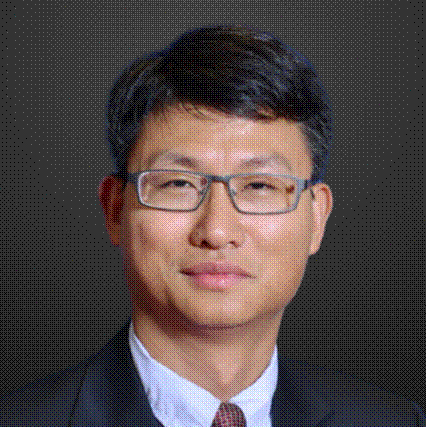
Professor Xuesong Li
Department of Urology
Peking University First Hospital / Peking University Institute of Urology