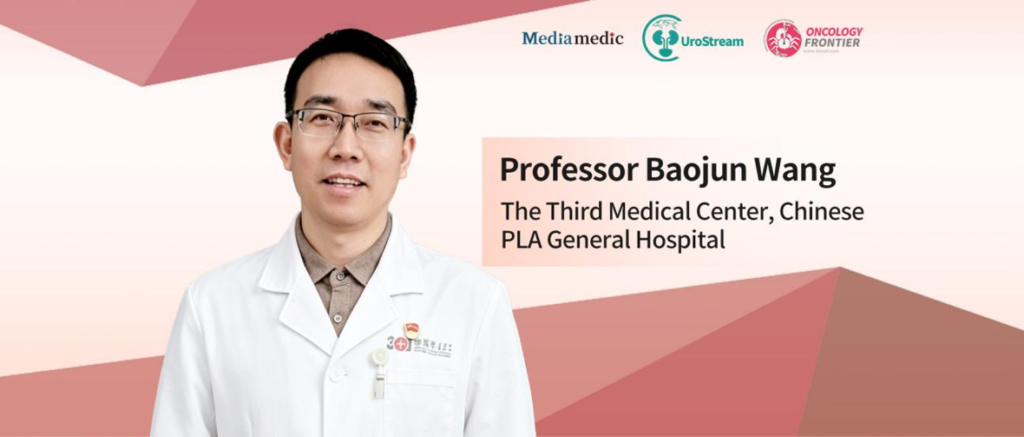
The 19th Chinese Urological Association (CUA) Genitourinary Oncology Conference was held in Beijing on July 3–4, 2026, under the theme "Advancing Frontiers, Standardizing Care, and Driving Collaborative Innovation." The meeting brought together leading experts in urologic oncology from across China to examine the current challenges facing the field and explore future directions for clinical research and patient care.During the conference, Oncology Frontier – UroStream interviewed Professor Baojun Wang of the Chinese PLA General Hospital. The discussion focused on two major topics: overcoming therapeutic resistance in prostate cancer and achieving the right balance between clinical innovation and evidence-based, standardized practice. Below are the highlights from the interview.
Oncology Frontier – UroStream: Novel immunotherapies and other emerging treatments are developing rapidly, yet therapeutic resistance remains a major clinical challenge. Looking ahead, where do you believe the next major breakthroughs will come from?
Professor Baojun Wang:
Today, clinicians have an increasingly broad range of treatment options for prostate cancer, particularly with the availability of multiple next-generation androgen receptor-targeted therapies. However, over the past two to three years, the pace of progress has slowed somewhat, and the field appears to have reached a temporary plateau.
Much of the recent research has focused on combination therapy, but relatively few studies have demonstrated a genuine synergistic benefit where the combination clearly outperforms either treatment alone.
A good example is the Phase III trial presented at ASCO evaluating enzalutamide combined with radium-223. The principal investigators spent an entire decade completing patient follow-up before the final data became available. During that time, many young investigators who joined the project eventually became senior researchers themselves. This study represents one of the few landmark trials demonstrating a significant survival benefit from combination therapy. By contrast, most other combination strategies have produced only modest or inconclusive improvements.
These experiences suggest that simply combining existing agents is unlikely to provide the next major leap forward in prostate cancer treatment. Instead, we need to explore entirely new therapeutic pathways.
Promising examples include B7-H3-targeted antibody-drug conjugates (ADCs), CTLA-4-based bispecific T-cell engagers, and lutetium-177 radioligand therapy, which has already demonstrated the potential of targeting disease through a completely different biological mechanism.
Ultimately, overcoming treatment resistance will require investment in therapies with fundamentally new mechanisms of action and novel treatment technologies. Relying solely on combinations of existing drugs is unlikely to produce truly transformative advances.
Oncology Frontier – UroStream: With new drugs and incremental technological innovations emerging at an unprecedented pace, how should clinicians balance innovation with adherence to standardized treatment guidelines?
Professor Baojun Wang:
This is an extremely important issue for the future of urologic oncology.
Under the leadership of pioneers such as Academician Xu Zhang, China’s urologic oncology community has consistently pursued both clinical standardization and technological innovation. Importantly, these two goals are not in conflict. On the contrary, standardization is the foundation upon which meaningful innovation is built.
Innovation that departs from established standards of care can expose patients to unnecessary risk. We should not encourage innovation for its own sake or promote the idea that every clinician should pursue novel techniques without sufficient preparation.
If physicians have not yet mastered the principles of evidence-based, standardized management, it is difficult for them to produce meaningful clinical innovations. Worse still, premature experimentation may lead to unfavorable patient outcomes.
In my view, medicine cannot simply be regarded as a pure natural science. It is built upon a combination of accumulated experience, continuous exploration, and scientific evidence. Every innovation must grow out of a mature framework of standardized clinical practice.
Ignoring the lessons learned by previous generations and repeating unsuccessful approaches ultimately places unnecessary burdens on patients. This is particularly true in clinical research involving human participants, where scientific rigor and standardized methodology must always take priority. That is precisely why translating new drugs and technologies into routine practice inevitably requires lengthy and rigorous validation.
One excellent example is the pioneering work on remote robotic surgery led by Academician Xu Zhang. The team’s research was ultimately published in The BMJ, one of the world’s leading general medical journals, and perfectly illustrates how innovation should be driven by standardization.
Before performing any clinical procedures remotely, the team completed hundreds of operations in animal models. They deliberately created intraoperative bleeding scenarios to evaluate whether complications could be safely managed during remote surgery.
Only after these preclinical studies did they proceed to single-center clinical trials, systematically addressing every major technical challenge, including network latency, packet loss, transmission stability, and backup communication systems. Rather than assuming uninterrupted connectivity, they designed contingency plans for unexpected technical failures.
During one of Academician Zhang’s remote robotic procedures performed from Rome, I was specifically assigned to remain in the operating room with the patient, ready to intervene immediately should any unexpected situation arise.
Only after completing rigorous validation through both single-center and multicenter studies was the technology introduced into broader clinical practice.
This is the pathway every new medical technology should follow. Before moving from the laboratory to routine patient care, it must undergo a comprehensive process of standardized validation. Scientific innovation requires patience, careful evaluation, and sufficient time—it cannot be rushed.

Professor Baojun Wang
Chinese PLA General Hospital