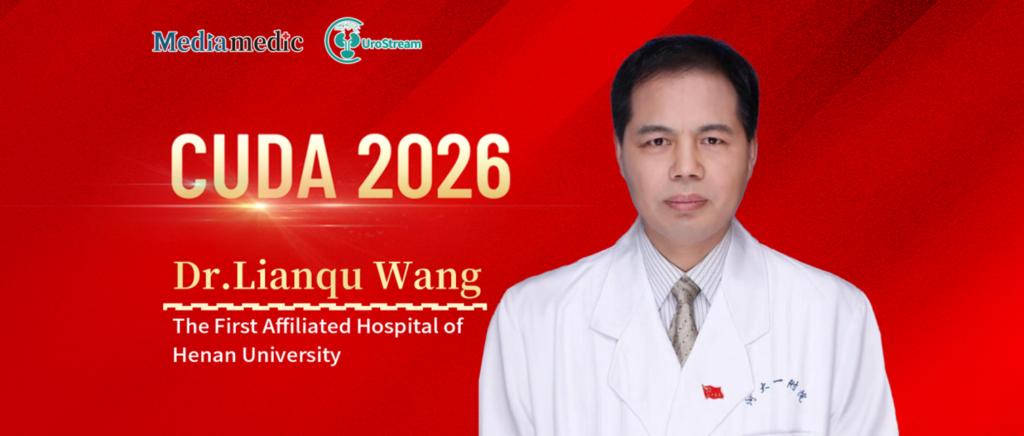
Hosted by the Chinese Medical Doctor Association (CMDA) and the Chinese Urological Association of the CMDA (CUDA), the 2026 CUDA Annual Meeting was held in Zhengzhou, Henan Province, from June 11–14, 2026. The meeting was jointly organized by The First Affiliated Hospital of Zhengzhou University, Henan Provincial People's Hospital, and The First Affiliated Hospital of Henan University, with additional support from Henan Cancer Hospital, The First Affiliated Hospital of Henan University of Chinese Medicine, and The Second Affiliated Hospital of Zhengzhou University.During the conference, Oncology Frontier – UroStream interviewed Professor Lianqu Wang, Executive Chair of the meeting and a urologist at The First Affiliated Hospital of Henan University, to discuss the academic heritage of Henan University’s urology program, its clinical strengths, and the integration of basic research with translational and clinical practice.
Oncology Frontier – UroStream: As one of the principal organizing institutions for CUDA 2026, how did The First Affiliated Hospital of Henan University showcase the academic heritage and clinical expertise of the Henan University system during this meeting?
Professor Lianqu Wang:
Thank you very much for the interview.
It has been a great honor to serve as one of the Executive Chairs of this year’s CUDA Annual Meeting. We are delighted to welcome distinguished experts and scholars from across China and around the world to Henan for this important academic gathering.
Henan is one of the birthplaces of Chinese civilization, and Kaifeng, the site of our institution, served as the capital of eight dynasties. The city possesses a rich historical and cultural heritage, and I hope our colleagues will have the opportunity to experience its unique character while attending the conference.
As one of the meeting’s host institutions, The First Affiliated Hospital of Henan University has contributed to the successful organization of the conference by building upon Henan University’s long-standing academic tradition and more than a century of medical education, while also drawing on the hospital’s strong clinical foundation.
Henan University has a long history of medical education and is known for its rigorous academic culture. Our hospital has consistently pursued an integrated model that combines clinical practice, medical education, and scientific research, with patient care serving as the foundation for advancing both research and teaching.
CUDA has provided an outstanding platform to showcase our department’s strengths in clinical practice, education, and scientific research. More importantly, it highlights the academic heritage of university-based urology programs in Henan while reinforcing our responsibility to serve the region. We also value this opportunity to exchange ideas with colleagues from across the country and continue learning from one another.
Oncology Frontier – UroStream: How do you envision the future integration of basic research and clinical translation within urology departments at university-affiliated hospitals?
Professor Lianqu Wang:
Within today’s environment of integrated clinical care, education, and research, university-affiliated urology departments possess unique advantages because they combine strong basic research capabilities with extensive frontline clinical experience.
Transforming discoveries from the laboratory into better surgical care is not only an inevitable trend but also the direction in which our field is moving. In the future, basic science and clinical surgery will become even more closely connected.
First, research priorities will become increasingly patient-centered. Basic research should focus on solving real clinical problems, including complex surgical procedures, difficult diseases, postoperative complications, and precision treatment for urologic cancers. We must move away from research conducted solely for academic purposes and instead pursue investigations that directly address patients’ needs and clinicians’ challenges.
Second, translational research will become more efficient. University innovation platforms will enable new discoveries—including therapeutic targets, biomaterials, novel technologies, and surgical innovations—to move more rapidly from the laboratory into clinical practice. These advances can support preoperative assessment, intraoperative navigation, postoperative rehabilitation, and improvements in minimally invasive surgery. In return, clinical data will provide essential validation for basic research, creating a mutually reinforcing cycle between laboratory science and patient care.
Finally, the integration of research and clinical practice will become increasingly comprehensive. As robotic surgery, artificial intelligence, and big data continue to expand throughout healthcare, computational methods and bioinformatics will become embedded in every stage of clinical decision-making.
Our department is therefore committed to cultivating physician-scientists who are equally proficient in clinical practice and scientific research, creating a positive cycle in which research drives improvements in patient care, while clinical challenges inspire new research questions.
Our hospital president and the Honorary Chair of this conference, Professor Liqun Zhou, a distinguished expert in urology, often reminds us that:
“Clinical practice and scientific research are the two wings of a modern physician. Only by developing both can one truly fly higher and farther.”
Neither can be neglected.
Ultimately, the future of urology should be built upon a simple principle: clinical practice must remain at the center, supported by strong basic research. Clinical challenges should generate scientific questions, scientific discoveries should rapidly translate back into patient care, and clinical practice, research, and education should develop together as a unified whole.
Professor Lianqu Wang
The First Affiliated Hospital of Henan University