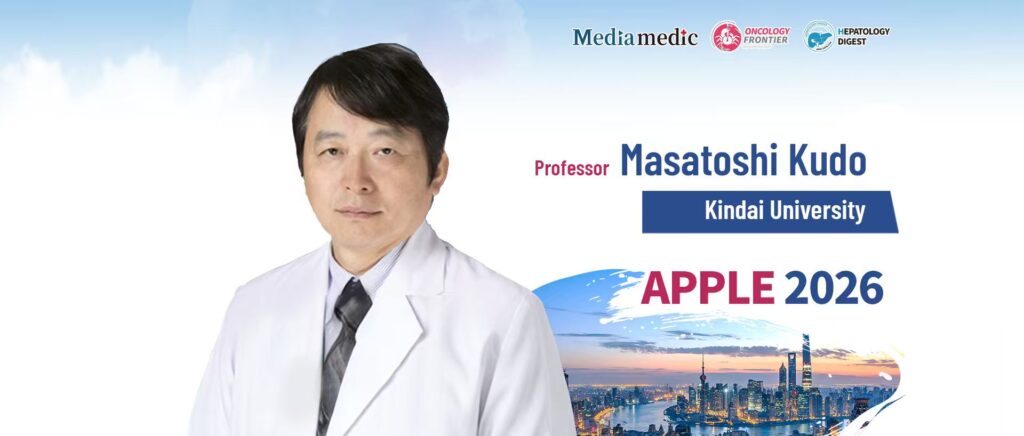
Editor’s Note: As hepatocellular carcinoma (HCC) treatment enters the wave of immuno-oncology (IO) combinations, the paradigm of combining systemic therapy with locoregional treatments (LRT) is undergoing a qualitative leap—evolving from incremental gains to a fundamental reconstruction. Held from July 3–5, 2026, the 16th Asia-Pacific Primary Liver Cancer Expert (APPLE) Meeting convened in Shanghai, bringing together leading experts from across the Asia-Pacific, Europe, and North America to discuss novel strategies for liver cancer prevention and management. During the conference, Prof. Masatoshi Kudo of Kindai University, Japan, delivered a featured lecture on systemic-locoregional combination strategies in the IO era, which garnered significant attention. Seizing this opportunity, Oncology Frontier conducted an exclusive interview with Prof. Kudo. Drawing on groundbreaking data from the EMERALD-3 trial and other pivotal studies, he elucidated the current evidence base for “systemic + local” therapies. Furthermore, he provided pragmatic yet forward-looking insights into two critical clinical dilemmas: the expansion of TACE eligibility criteria and the interpretation of overall survival (OS) endpoints in the era of prolonged post-progression survival (PPS). His perspectives chart a clear course for the future evolution of HCC management.
Q1.Prof. Kudo, moving from your pioneering work on TACE plus targeted therapy to today’s era of IO-based combinations with LRT, what do you see as the most fundamental shift in the “systemic plus locoregional” treatment paradigm?
Prof. Kudo: During the TKI era, we encountered significant challenges; five pivotal trials—including sorafenib plus TACE, sorafenib plus brivanib, and sorafenib plus orantinib—all failed to meet their primary endpoints. The exception was the TACTICS trial, which successfully met its primary endpoint by prolonging PFS and demonstrated a clinically meaningful OS benefit.
However, the landscape has been fundamentally reshaped by immunotherapy. Regimens like atezolizumab plus bevacizumab, or other ICI combinations with anti-VEGF TKIs, achieve something single-agent TKIs could never accomplish: significant tumor shrinkage. This profound reduction in tumor volume not only facilitates complete response with TACE but, crucially, enables conversion therapy—making curative surgery possible for initially unresectable patients. This shift from mere disease control to tumor eradication represents the most significant advancement over the TKI era.
Q2. With a growing array of LRT modalities and potent IO agents—as highlighted by trials like EMERALD-3—how do we identify which patients truly require dual or even triple combination strategies? Looking ahead, can biomarkers help us define a “minimum effective” approach tailored to individual biology?
Prof. Kudo: Dual IO combinations are currently indicated for advanced-stage HCC, specifically in patients presenting with vascular invasion or extrahepatic spread. Consequently, IO plus IO as a monotherapy regimen is not intended for patients who are TACE-eligible. However, for this specific TACE-eligible population, the combination of dual IO plus TACE represents a viable strategy. The EMERALD-3 trial, through its pre-planned exploratory analysis, provided compelling evidence: while exploratory in nature, the data clearly demonstrated a nominally significant prolongation of both PFS and OS with the dual IO plus TACE approach. Furthermore, the combination of dual IO plus lenvatinib has also yielded significant survival benefits.
These findings are crucial. In my view, the definition of TACE-eligibility should be broader. Even among patients with advanced HCC and extrahepatic spread—provided we exclude those with Vp3 or Vp4 portal vein invasion—TACE remains a powerful prognostic modifier. Therefore, I believe that in the future, dual IO plus TACE will be indicated not just for intermediate stages, but potentially for a selected subset of advanced HCC patients with extrahepatic spread.
Q3. Looking forward 3 to 5 years, what do you consider the most pressing scientific question in the field of LRT plus systemic therapy?
Prof. Kudo: Indeed, when we look at the intermediate-stage or TACE-eligible population—drawing from BCLC A, B, and even select C patients—their tumor burden is generally lower than that of typical advanced-stage HCC. The EMERALD-3 data is striking: with the STRIDE regimen plus lenvatinib and TACE, the median OS reaches approximately 40 months. This is a substantial improvement compared to the roughly 20-month median OS we typically see in unselected advanced-stage populations.
While dual IO plus TACE, or other IO plus anti-VEGF/TKI combinations, have clearly demonstrated PFS benefits and a strong trend toward better OS, proving statistical significance for OS has become challenging. Due to the availability of highly effective subsequent therapies post-progression—both in the experimental and control arms—post-progression survival (PPS) is now remarkably long. This prolonged PPS tends to dilute the OS difference between arms.
Therefore, I believe that demonstrating a positive trend in OS is clinically sufficient in the modern era. Over-emphasizing statistical significance for OS in the face of such long PPS is misleading. This is perhaps the most critical nuance we must consider when interpreting current trial data.