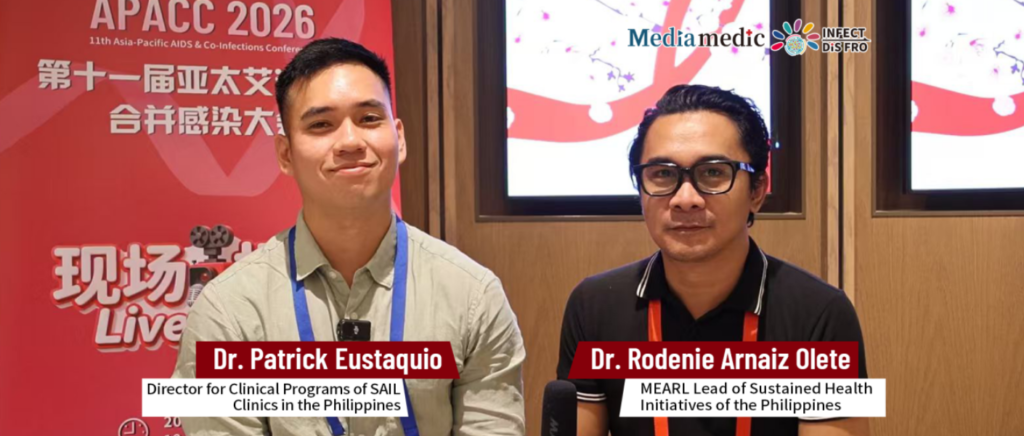

Editor's Note: The 2026 Asia-Pacific AIDS and Co-infections Conference (APACC 2026) was successfully held in Tokyo, Japan. Focusing on core public health issues such as continuous care for people living with HIV (PLHIV) and co-infection management, the conference gathered frontline clinical researchers from multiple countries to share local prevention and control practices and research findings. Infectious Disease Frontier specially invited Dr. Rodenie Arnaiz Olete, MEARL Lead of Sustained Health Initiatives of the Philippines, and his colleague, Dr. Patrick Eustaquio, Director for Clinical Programs of SAIL Clinics in the Philippines, for an in-depth interview. Combining real-world clinical data from the Philippines, the two discussed practical challenges including factors associated with HIV care disengagements, innovative intervention models in community clinics, and integrated diagnosis and treatment of hepatitis B and HIV co-infection. Integrating research conclusions with frontline clinical practical experience, they provide localized reference ideas for low- and middle-income countries to optimize the continuum of care for PLHIV. Infectious Disease Frontier: Your study identified delayed ART initiation, education level, employment status, and viral hepatitis as important predictors of disengagement and re-engagement in HIV care. Could you share your key findings and explain their significance?
Rodenie: Our study shows that lower educational attainment, being employed, and co-infection with viral hepatitis are predictors of care disengagements among PLHIV. This finding carries important reference value, as it differs from the conclusions of most previous international studies: previous international literature generally regarded unemployment as a risk factor associated with loss to follow-up, while our study indicates that being employed may instead be a potential barrier to PLHIV adhering to standardized treatment. Particularly for groups with lower educational levels, their jobs are often unstable, making it difficult to take time off to visit clinics for treatment, which leads to interrupted follow-up.
Based on these important findings, we need to translate research conclusions into implementable clinical intervention programs. That is why I invited the clinical program director to participate in this discussion — he can share relevant practical experience from a frontline clinical perspective.
Patrick: This is precisely the value of integrating clinical work and research: we can directly address practical problems at the frontline. In response to your question, in our healthcare facility, all PLHIV who disengage from care are automatically enrolled in enhanced adherence counseling services.
We deliver enhanced adherence counseling using a standardized framework covering four core dimensions: behavioral, emotional, cognitive, and sociocultural. We communicate thoroughly with PLHIV to identify, from their personal perspective, which specific factors across these four dimensions undermine their ability to adhere to treatment and remain engaged in care.
By covering these four dimensions, we can comprehensively address the various influencing factors identified in Rodenie’s study and effectively tackle the practical issue of loss to follow-up. This intervention model essentially provides holistic care for PLHIV — it focuses not only on biomedical clinical treatment but also accounts for social-level factors such as socioeconomic status and employment background, through our CARE Funds.
Infectious Disease Frontier: In response to these drivers of loss to follow-up, what unique advantages or mechanisms do community clinics have in promoting patients’ re-engagement in care? Does your study propose any specific strategies, such as peer navigation and flexible clinic hours?
Rodenie: A large body of research has confirmed that community organizations play a critical role in the HIV prevention and control system, especially in low- and middle-income countries like the Philippines. Their core advantage is that community organizations are deeply rooted in local communities and run by community members with shared lived experiences, so they can more accurately grasp the actual needs of PLHIV. This is vital for recalling people who have disengaged from care.
In addition, the case management model of SAIL Clinic is distinctive: it establishes a collaborative working mechanism among case managers, peer navigators, and community service providers. Patrick can elaborate on the specific on-the-ground practices.
Patrick: As Rodenie noted, the core of our service is not to force PLHIV to fit into established clinical workflows, but to break the divide between service providers and recipients and proactively deliver support aligned with PLHIV’s real-life circumstances. Our service team is made up of community members with diverse backgrounds: practitioners across different age groups, members of sexual minority communities, and both PLHIV and HIV-negative individuals who are members of key populations. All team members have first-hand lived experience in the community, can fully empathize with the needs of service users, and can match each person with the most suitable provider for their needs.
In terms of service delivery, we improve access to care through a range of targeted measures. For example, we operate “sunset clinics” with extended daily opening hours, allowing PLHIV to attend appointments after work or at other convenient times. We also offer a comprehensive set of online services, including remote pre-exposure prophylaxis (PrEP) guidance and remote counseling, supported by dedicated Return-to-Care (RTC) programs.
For those requiring in-person visits, we have set up fast-track channels that complete the entire consultation process in just 15 minutes. We also provide medication delivery services, shipping drugs to any convenient location specified by the patient.
Infectious Disease Frontier: HBV co-infection is a unique predictor in your study, which is especially relevant given the high prevalence of HBV infection among Asian patients. Do you believe that integrated HBV/HIV services could help improve care retention among co-infected patients?
Rodenie: First, it should be noted that the proportion of confirmed hepatitis B cases among patients at our clinic is relatively low; Patrick can share more details on this later. As for service integration, I believe holistic management is the inevitable path forward: not only HIV and HBV, but all forms of viral hepatitis, other comorbidities, and even mental health services should be incorporated into the overall care plan to address the full spectrum of PLHIV’s needs. That is the core value of service integration.
Specifically, integrated care for HIV and hepatitis B has been in practice for many years. Given the local context in the Philippines, we believe greater investment is needed in hepatitis B and C diagnosis and treatment, particularly to reach people who use drugs and people who inject drugs. This remains a key priority for ongoing improvement in HIV prevention and control. That is why our organization, Sustained Health Initiatives of the Philippines (SHIP), has been an active collaborator of the Philippines Department of Health in developing guidelines and policy advocacy.
Patrick: I fully agree with Rodenie’s views. From a national health planning perspective, there is still significant room to increase investment in hepatitis prevention and control. At the clinic level, however, providing hepatitis B and C diagnosis and treatment is a mandatory requirement. All clinical staff have received specialized training, and integrated care is delivered as standard practice. National-level investments in training resources, and the supply of essential intervention tools such as medicines and test kits, fall outside the clinic’s control — and we have consistently advocated for improvements in these areas.
Additionally, as Rodenie mentioned earlier, the prevalence of hepatitis B in our follow-up cohort is low. The underlying reasons for this remain to be fully explored, and this will be a key focus of our research in the coming months.
Professional Information:
Rodenie Arnaiz Olete, PhD, MSc, RN
- Early-career implementation scientist focused on behavioral, social, clinical, and public health research
- Role in SHIP: Monitoring, Evaluation, Accountability, Research, and Learning (MEARL) Lead
Patrick Eustaquio, MPH, MD
- Physician and public health researcher focused on epidemiology and healthcare systems
- Role in SHIP: Director for Clinical Programs