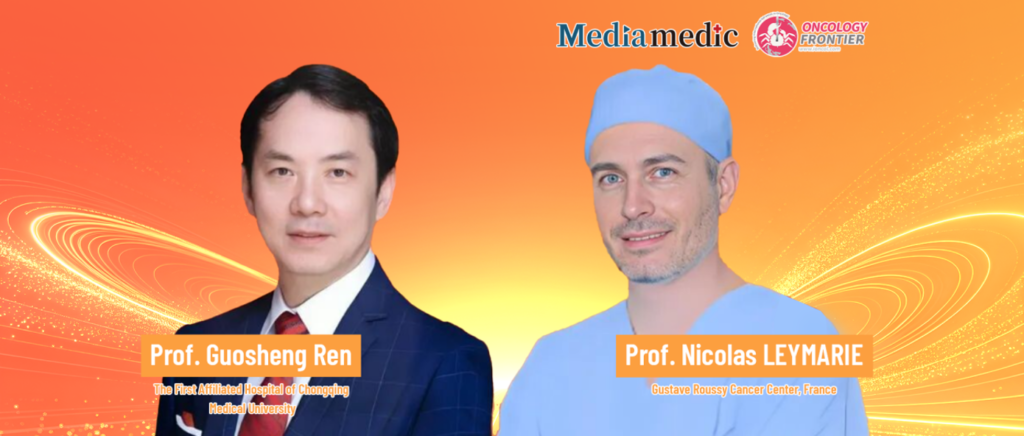
Editor’s Note: The 15th Sino-French Breast Reconstruction Congress and the 13th Sino-French Breast Cancer Academic Conference recently concluded successfully in Chongqing. As one of the long-standing academic meetings in the field of breast cancer, this year’s congress brought together leading Chinese and French experts in breast cancer treatment for live surgical demonstrations and in-depth discussions focused on oncoplastic breast-conserving surgery and breast reconstruction techniques.During the meeting, Oncology Frontier invited two key representatives of the Sino-French collaboration—Professor Guosheng Ren from The First Affiliated Hospital of Chongqing Medical University and Professor Nicolas Leymarie from Gustave Roussy Cancer Center in France—to discuss the progress and current status of breast reconstruction in both countries.
Professor Guosheng Ren reflected on the remarkable two-decade transformation of breast reconstruction in China, from its early beginnings to a level now comparable with that of Western countries. Drawing on the French experience, Professor Nicolas Leymarie emphasized that although reconstructive techniques have become increasingly sophisticated, equal access to care, patient-informed decision-making, and standardized surgeon training remain essential long-term priorities.
The following article summarizes the key points from their discussion.
Oncology Frontier:
Could both of you reflect on the development and current status of breast reconstruction in China and France?
Professor Guosheng Ren:
“More than 20 years ago, breast reconstruction in China was still in its infancy, and there was a considerable technical gap compared with Western developed countries.
After returning from France in 1996, I performed the first bilateral TRAM flap breast reconstruction surgery in western China in Chongqing in 1997. At that time, only a very small number of hospitals nationwide were capable of performing such procedures.
However, over the past two decades, the treatment philosophy for cancer patients has undergone profound changes. At the same time, through the collective efforts of breast surgeons across China, breast reconstruction in our country has made extraordinary progress.
In the past, our primary goal when treating cancer patients was simply to help them survive and prolong life. Today, our goal is to help patients live well and maintain a high quality of life.
Breast surgeons throughout China have worked together continuously to advance this field. This progress has not only been driven by the sustained efforts of The First Affiliated Hospital of Chongqing Medical University through initiatives such as the Sino-French Breast Reconstruction Congress, but also by the contributions of Professor Jiong Wu’s team at Fudan University Shanghai Cancer Center and many other dedicated breast surgeons across the country.
Thanks to these collective efforts, breast reconstruction techniques in China have developed tremendously, allowing increasing numbers of women who have lost their breasts because of breast cancer to preserve or restore their breast shape.
Today, we can proudly say that, from a technical perspective, there is no major gap between China and Western developed countries in the field of breast reconstruction.
Of course, moving forward, we must continue to focus on high-quality development and standardized clinical practice in order to provide every breast cancer patient with the best possible care.”
Professor Nicolas Leymarie:
“In recent years, breast reconstruction techniques in France have also advanced significantly.
Currently, it is estimated that approximately 30% of women requiring mastectomy undergo immediate breast reconstruction at the time of surgery. Even so, there remains substantial room for improvement in the field of breast reconstruction.
Unfortunately, there are still considerable disparities in healthcare resource distribution depending on where patients live, the city they are treated in, and the type of hospital they attend.
Nevertheless, the overall trend toward increasing breast reconstruction rates is extremely encouraging because reconstruction profoundly changes patients’ lives. It allows women to regain bodily harmony and balance and to live long-term with the support of high-quality reconstruction. That is why this work is so important.
French patients are generally very well informed about the different reconstructive options available. During consultations, many patients already have a clear understanding of their own expectations and are familiar with the proposed techniques, including implant-based reconstruction—such as prepectoral reconstruction—as well as autologous tissue reconstruction techniques, including flap procedures and fat grafting.
We strive to offer patients a comprehensive range of reconstructive options and allow them to freely choose the approach that best aligns with their expectations regarding reconstructive outcomes.
At the same time, we still have a great deal of work to do. We must continue training surgeons and mentoring younger physicians who are beginning to perform these technically demanding procedures.
Technological innovation is enabling us to offer patients increasingly minimally invasive surgical approaches, which can reduce scarring and pain while improving both aesthetic and functional outcomes.
Overall, things are moving in a very positive direction, but we must not become complacent. We need to continue disseminating these techniques to ensure that every patient has access to breast reconstruction opportunities.
At Gustave Roussy Cancer Center—Europe’s largest oncology research center—breast reconstruction is always considered whenever we treat breast cancer patients. This includes oncoplastic reshaping following breast-conserving surgery or lumpectomy, as well as full breast reconstruction after mastectomy.
Of course, reconstruction should never be imposed upon patients. Every patient has the right to decide freely whether or not to undergo reconstruction. However, physicians have the responsibility to present these options so patients can make informed decisions based on a complete understanding of their choices.
I believe that moving forward, collaboration between our countries in these areas will become even stronger.”
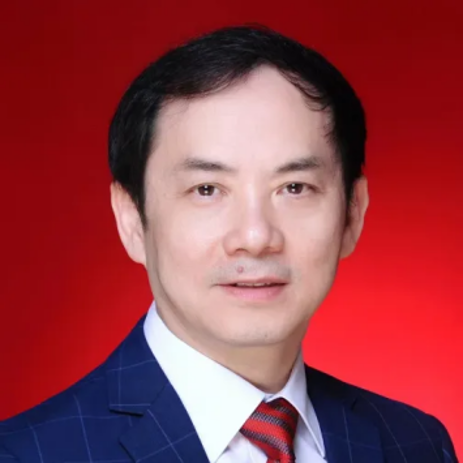
Professor Guosheng Ren
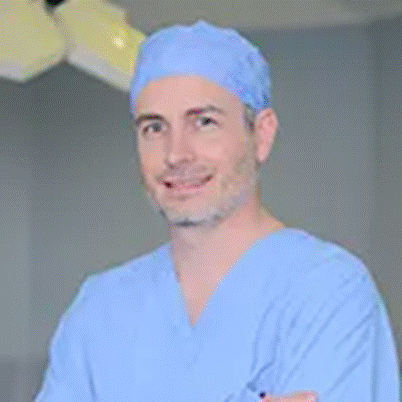
Professor Nicolas Leymarie