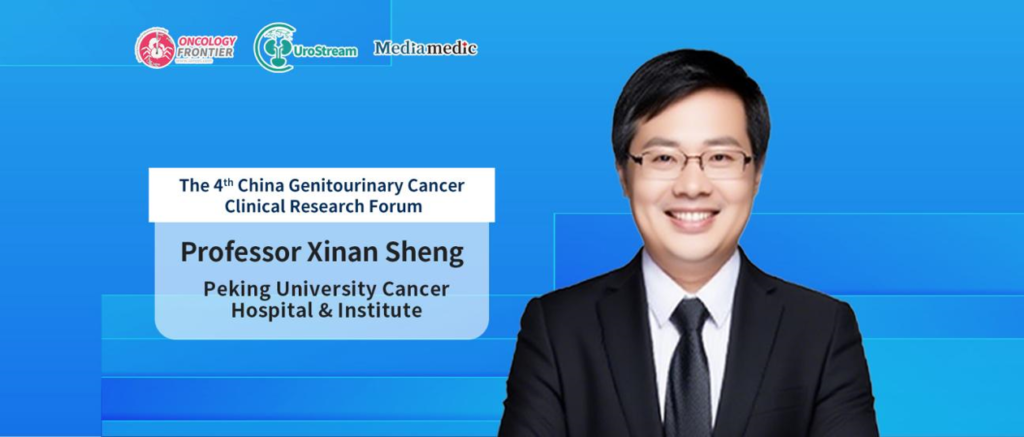
At the 4th Urologic Oncology Clinical Research Conference, UroStream invited Professor Xinan Sheng from Peking University Cancer Hospital to discuss the evolving landscape of urologic oncology, the core principles behind impactful clinical research, and the future direction of precision treatment strategies in prostate, renal, and urothelial cancers.From the rapid evolution of systemic therapies to the emergence of ADCs, TCEs, and novel immunotherapeutic approaches, Professor Sheng shared his perspective on how Chinese clinical research is increasingly shaping global practice.
Clinical Research Is Redefining Urologic Oncology
UroStream:
This year’s conference covered topics ranging from research methodology and AI applications to organ-preserving therapy and immunotherapy innovation. What practical value do these discussions bring to clinicians and researchers, particularly young physicians and primary-care practitioners?
Professor Xinan Sheng:
Since the launch of the first Urologic Oncology Clinical Research Conference in 2023, the treatment landscape in urologic oncology has changed dramatically.
Kidney cancer has evolved from an era dominated by targeted therapy into one centered on targeted-immunotherapy combinations. Urothelial carcinoma has moved beyond chemotherapy and monotherapy immunotherapy toward combination immunotherapy approaches. In prostate cancer, treatment strategies have progressively shifted earlier—from metastatic castration-resistant disease to hormone-sensitive stages.
These advances are fundamentally driven by high-quality clinical research. New evidence continuously reshapes treatment guidelines and clinical decision-making.
At the same time, the diversification of treatment options has made clinical questions more complex. The unmet needs today are increasingly nuanced, requiring more sophisticated trial designs and more precise patient selection strategies.
That is why this conference was designed around the full spectrum of modern clinical research—from methodology and AI-driven innovation to organ-preserving strategies and emerging therapies such as bispecific antibodies, CAR-T, and T-cell engagers (TCEs).
The ultimate goal is to encourage deeper thinking across the field and translate those ideas into meaningful clinical research and real-world practice improvements in China.
A Decade of Transformation in Prostate Cancer
UroStream:
You presented a report comparing ten years of prostate cancer treatment evolution in China and the United States. What major trends have emerged, and where has China made the greatest progress?
Professor Xinan Sheng:
This project was jointly conducted by Tsinghua University, Peking University Cancer Hospital, Peking University First Hospital, and several research partners. By reviewing the evolution of prostate cancer therapy over the past decade, we observed both major progress and important disparities.
Although China has significantly improved in screening awareness and treatment capabilities, overall five-year survival rates still remain lower than those reported in the United States. This gap reflects differences in early screening, treatment accessibility, and disease biology.
Globally, prostate cancer treatment has entered a new era. We have moved from the widespread adoption of next-generation hormonal therapies toward increasingly diversified approaches that now include PARP inhibitors, radionuclide therapy, and targeted strategies.
Importantly, treatment principles between China and the United States are now largely aligned. For metastatic hormone-sensitive prostate cancer (mHSPC), both countries emphasize intensified treatment strategies built around androgen deprivation therapy (ADT), including doublet and triplet combinations.
In metastatic castration-resistant prostate cancer (mCRPC), PARP inhibitors and PSMA-targeted radioligand therapies are becoming increasingly important, particularly in combination approaches.
However, there are still differences. The United States remains ahead in drug development and access to cutting-edge therapies, especially in mCRPC. Emerging approaches such as TCE therapy and novel immunotherapies are progressing faster internationally.
That said, China also has important strengths. In antibody-drug conjugates (ADCs), particularly targeting B7-H3 in prostate cancer, Chinese research is advancing at a globally competitive pace.
What Makes a Study Practice-Changing?
UroStream:
Your team has produced several internationally recognized studies in recent years. What defines a clinical trial that truly changes practice?
Professor Xinan Sheng:
A study that changes clinical practice must meet two essential criteria.
First, it must address a genuine unmet clinical need with meaningful innovation. Second, it must be built on rigorous scientific design and produce robust positive results.
Take the RENOTORCH study as an example. Although it began later than some international studies, it became the world’s first phase III trial to directly compare immunotherapy plus targeted therapy versus standard targeted therapy in intermediate- and high-risk advanced renal cell carcinoma. Because the study answered an important clinical question with strong evidence, it was incorporated into ESMO renal cancer guidelines.
Similarly, in urothelial carcinoma, HER2-targeted therapy had been explored for over two decades without major breakthroughs. Our RC48-C016 study demonstrated for the first time that the HER2-targeting ADC Disitamab Vedotin combined with Toripalimab could achieve remarkable efficacy in HER2-expressing urothelial carcinoma. The findings were ultimately published in The New England Journal of Medicine.
Both studies succeeded because they addressed real clinical problems while introducing innovative therapeutic strategies supported by strong evidence.
Earlier Use of Novel Hormonal Therapy Has Changed Outcomes
UroStream:
Novel hormonal therapies have moved earlier in the disease course, from mCRPC into nmCRPC and mHSPC. How has this changed patient outcomes?
Professor Xinan Sheng:
The development of next-generation hormonal therapy began in chemotherapy-resistant mCRPC, then expanded into first-line mCRPC and eventually into earlier disease states.
In nmCRPC, multiple phase III trials demonstrated that combining ADT with novel hormonal agents significantly prolonged metastasis-free survival compared with ADT alone. Delaying progression into metastatic disease has meaningful survival and quality-of-life benefits for patients.
When these therapies moved even earlier into mHSPC, randomized phase III studies consistently showed significant survival improvement compared with traditional ADT alone.
As a result, the prognosis of prostate cancer patients has improved dramatically. The evolution from ADT monotherapy toward doublet and triplet intensified regimens has fundamentally transformed long-term outcomes.
Choosing Between Doublet and Triplet Therapy
UroStream:
With increasingly complex ADT-based combination strategies, how should clinicians choose between doublet and triplet therapy?
Professor Xinan Sheng:
This is now one of the most important questions in prostate cancer management.
We currently have multiple effective strategies, including ADT combined with novel hormonal therapy, ADT plus docetaxel, and triplet regimens such as those explored in the ARASENS study.
Both doublet and triplet approaches improve survival compared with ADT alone. However, selecting the optimal strategy for an individual patient remains challenging.
At present, there are no head-to-head studies directly comparing all available combinations. Meanwhile, triplet therapy generally comes with greater toxicity and lower tolerability.
Current evidence suggests that patients with high-volume disease derive greater benefit from triplet therapy, whereas patients with low-volume disease may achieve excellent outcomes with doublet therapy alone.
However, tumor burden alone is insufficient for fully personalized decision-making. Prostate cancer patients are often elderly, and treatment tolerance is critically important.
We also need better biomarkers to guide treatment selection. For example, in patients with homologous recombination repair (HRR) mutations, PARP inhibitor-based triplet combinations have already shown promising benefits.
Moving forward, precision medicine will increasingly depend on integrating clinical characteristics, molecular profiling, treatment tolerance, and patient preference into individualized treatment strategies.
Expert Profile

Professor Xinan Sheng Peking University Cancer Hospital Leading Expert in Urologic Oncology and Clinical Research