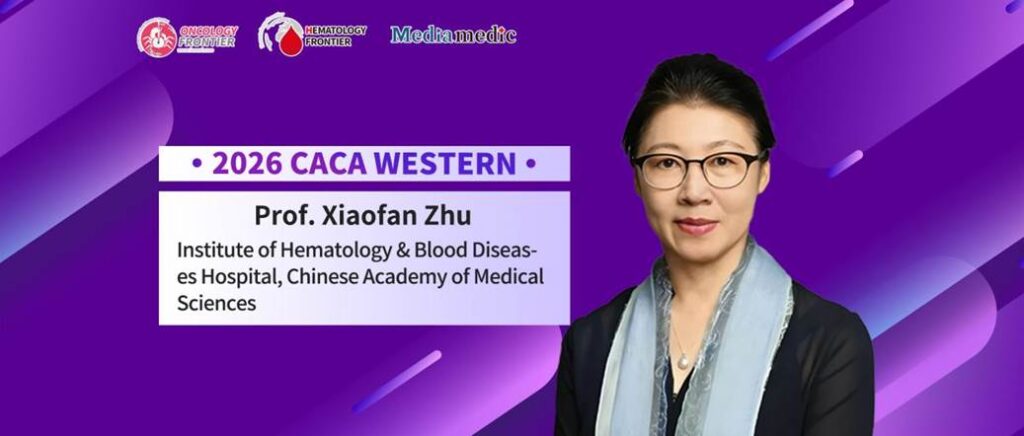
To further expand access to high-quality cancer care resources, promote equitable distribution, and enhance the academic and clinical capacity of oncology care in western China and at the grassroots level, the 2026 CACA Western Integrated Oncology Conference was successfully held in Chengdu on April 18, 2026. The conference provided a high-level platform for academic exchange and translational collaboration in oncology.During the meeting, Professor Xiaofan Zhu from the Institute of Hematology and Blood Diseases Hospital, Chinese Academy of Medical Sciences, was invited for an exclusive interview. She shared in-depth perspectives on the development of multicenter collaboration systems for pediatric leukemia and discussed future directions, offering valuable clinical insights into optimizing comprehensive disease management and systematically improving the quality of care.
Current Challenges and Unmet Needs in Pediatric Leukemia
Oncology Frontier – Hematology Frontier:
You have long been engaged in both clinical and basic research in pediatric leukemia and have played a leading role in advancing precision diagnosis and treatment in China. Given the current high overall treatment standards, what are the main challenges and unmet clinical needs at this stage?
Professor Xiaofan Zhu:
Pediatric leukemia can be broadly divided into two major categories: lymphoid leukemia and myeloid leukemia. Among these, lymphoid leukemia is the most common. There are also chronic forms, such as chronic myeloid leukemia and juvenile myelomonocytic leukemia.
In terms of treatment, three major collaborative groups for acute lymphoblastic leukemia (ALL) have been established in China, achieving widespread implementation of standardized diagnosis and treatment protocols.
However, acute myeloid leukemia (AML) has a lower incidence—approximately one-third that of ALL—and there remains considerable variability in diagnostic and treatment capabilities across regions and healthcare institutions. Moving forward, we aim to build a nationwide multicenter collaborative network for AML, building on the success of ALL collaboration groups, particularly under the leadership of organizations such as the Chinese Anti-Cancer Association (CACA). This represents a key priority for future work.
For specific subtypes such as acute promyelocytic leukemia (APL), national multicenter collaboration has already yielded remarkable success. Since patient enrollment was completed in 2017, cure rates have reached as high as 97%, essentially achieving clinical cure. However, significant gaps remain in the treatment of other AML subtypes. Addressing these unmet needs through strengthened multicenter collaboration will be critical to improving overall outcomes in pediatric leukemia.
Integrating Novel Therapies: Balancing Efficacy, Safety, and Long-Term Outcomes
Oncology Frontier – Hematology Frontier:
With the increasing application of targeted therapy, immunotherapy, and cellular therapy in pediatric leukemia, how should these approaches be used appropriately in children? What key considerations should be prioritized regarding efficacy, safety, and long-term survival?
Professor Xiaofan Zhu:
In recent years, targeted therapies and immunotherapies have profoundly transformed treatment strategies for both leukemia and solid tumors. Large international cohort studies have provided valuable evidence to guide clinical practice. However, multicenter collaboration in China remains insufficient and urgently needs to be strengthened.
For example, the implementation of targeted therapies should be based on rigorously designed clinical trials and introduced progressively. Without robust evidence-based support, widespread off-label use may fail to deliver meaningful benefits to patients.
From a national and organizational perspective, it is essential to strengthen coordination and support for diseases with relatively low incidence, such as pediatric leukemia and certain solid tumors. Without multicenter collaboration, it is difficult to establish standardized treatment systems or conduct meaningful clinical research.
Moreover, while novel therapies are rapidly emerging, standardized guidelines are still evolving. Inappropriate or unregulated use may pose challenges for long-term management. For instance, immunotherapies are highly effective and generally less directly toxic than chemotherapy; however, prolonged or unrestricted use may lead to secondary immunodeficiency, potentially creating new health risks that negatively impact long-term outcomes.
Therefore, the development of treatment strategies must rely on well-designed clinical trials, robust long-term follow-up systems, and continuous data analysis and reporting. Only through such structured approaches can reliable evidence be generated to guide safer and more effective care in pediatric oncology.
Future Directions: Precision Stratification and Comprehensive Management
Oncology Frontier – Hematology Frontier:
Looking ahead, which areas are most likely to achieve major breakthroughs in pediatric leukemia? How can precision stratification, drug development, and comprehensive management further improve cure rates and long-term quality of life, especially for relapsed or refractory patients?
Professor Xiaofan Zhu:
Recent advances in targeted therapy and immunotherapy are fundamentally reshaping the treatment paradigm for leukemia. In China, collaborative groups are actively exploring earlier integration of these therapies into treatment protocols, with the goal of reducing the incidence of refractory and relapsed disease and minimizing the need for hematopoietic stem cell transplantation.
Looking forward, continued efforts by collaborative groups are expected to clarify the optimal timing and sequencing of immunotherapy and targeted therapy across different stages of leukemia treatment. This will help reduce relapse rates and improve overall outcomes.
Although a subset of patients still faces refractory or relapsed disease, ongoing research worldwide is focused on developing novel therapies to address these challenges. With continued progress, we are confident that treatment outcomes for pediatric leukemia—and oncology more broadly—will improve in a systematic and meaningful way, ultimately enhancing both survival and quality of life.
Expert Profile

Professor Xiaofan Zhu
Institute of Hematology and Blood Diseases Hospital, Chinese Academy of Medical Sciences
- Chief Clinical Expert
- Chief Physician, Doctoral Supervisor
- Chief Expert, Pediatric Hematology and Oncology Center
- Recipient of State Council Special Allowance
- Distinguished Expert of Tianjin
Academic Appointments:
- Chair, Pediatric Oncology Committee, Chinese Anti-Cancer Association
- Deputy Head, Hematology Group, Pediatric Branch, Chinese Medical Association
- Deputy Director, National Health Commission Expert Committee on Pediatric Leukemia
- Member, Lymphoma Committee, Chinese Society of Clinical Oncology (CSCO)
- Member, Rare Diseases Committee, Chinese Medical Association
- Chair, CCCG-2025-ALL Scientific Committee
Editorial Roles and Honors:
- Editorial Board Member, Chinese Journal of Pediatrics, Chinese Journal of Hematology, Contemporary Pediatrics, among others
- Recipient of the Second Prize of the National Natural Science Award
- Recipient of the Soong Ching Ling Pediatric Medicine Award
- Recipient of the World Outstanding Women in Science Award
- Recipient of the First Prize of the Tianjin Natural Science Award