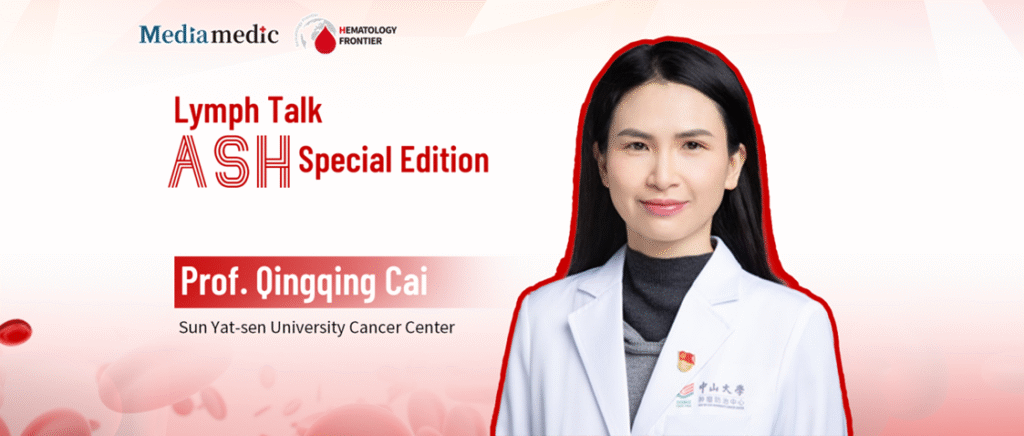
Editor’s Note: The 2025 American Society of Hematology (ASH) Annual Meeting recently concluded in Orlando, USA, showcasing major breakthroughs in lymphoma research and offering new directions for optimizing clinical care. To translate cutting-edge science into clinical insight, Oncology Frontier – Hematology Frontier partners with Professor Qingqing Cai of Sun Yat-sen University Cancer Center to present the “Lymphoma Insights – ASH Special” series, delivering authoritative interpretation of landmark lymphoma studies with practical clinical relevance.As bispecific antibodies (BsAbs) rapidly move into earlier lines of therapy, the first-line treatment paradigm for lymphoma is undergoing a fundamental transformation. In this installment, Professor Cai highlights three major ASH 2025 studies shaping the future of frontline bispecific antibody therapy in aggressive B-cell lymphoma.
Abstract 12999 — R-Pola-Glo as First-Line Therapy in Elderly/Frail Aggressive B-Cell Lymphoma (Phase II)
Title: Phase II frontline chemolight R-pola-glo trial induces high and durable response rates in elderly and medically unfit/frail patients with aggressive B-cell lymphoma Lead Author: Björn Chapuy et al.
Background
Diffuse large B-cell lymphoma (DLBCL) is the most common aggressive lymphoma in adults, with a high incidence among elderly patients. While R-CHOP or Pola-R-CHP remains standard for fit individuals, elderly or frail patients often cannot tolerate full-dose chemotherapy and experience suboptimal outcomes.
The R-Pola-Glo regimen combines:
- Rituximab (anti-CD20)
- Polatuzumab vedotin (anti-CD79b ADC)
- Glofitamab (CD20×CD3 bispecific antibody)
This study evaluated a chemotherapy-free frontline strategy in elderly or unfit patients.
Key Results
- 80 patients enrolled, median age 80 years
- ORR: 96% (cycle 2), 94% (cycle 6), 90% (end of treatment)
- CR rate at end of treatment: 81%
- 1-year PFS: 85%
- 1-year OS: 90%
- CRS incidence: 31% (mostly grade 1–2)
- ICANS: 4% (rare, manageable)
- Grade 3–5 infections: 22%
Conclusion
R-Pola-Glo demonstrated highly durable responses, superior survival outcomes, and manageable safety, representing a promising chemotherapy-free frontline option for elderly or frail aggressive B-cell lymphoma patients.
Professor Qingqing Cai’s Commentary
This study addresses a major unmet need in elderly or frail aggressive B-cell lymphoma patients who cannot tolerate R-CHOP. The 81% CR rate and 85% 1-year PFS exceed historical benchmarks in this population. Although infections and CRS require vigilance, toxicity remained manageable, and treatment completion rates were high. These encouraging findings justify larger comparative trials against R-mini-CHOP and support further development of chemotherapy-free frontline regimens.
Abstract 4514 — Subcutaneous Mosunetuzumab Monotherapy in Elderly/Unfit DLBCL (MorningSun Phase II)
Title: Fixed treatment duration subcutaneous mosunetuzumab monotherapy in elderly/unfit patients with previously untreated diffuse large B-cell lymphoma Lead Author: Jeff Sharman et al.
Key Results
- 49 patients enrolled, median age 82.5 years
- ORR: 73.5%
- CR rate: 59.2%
- 12-month PFS: 68.8%
- MRD negativity: 68.8% (in evaluable patients)
- CRS incidence: 12.2%, all grade 1–2
- No ICANS reported
- Subcutaneous outpatient administration improved feasibility
Conclusion
Fixed-duration subcutaneous mosunetuzumab monotherapy achieved durable efficacy, low neurotoxicity, and favorable tolerability, offering a chemotherapy-free outpatient frontline option for elderly or unfit DLBCL patients.
Professor Qingqing Cai’s Commentary
This trial explores a fully chemotherapy-free, fixed-duration, outpatient strategy tailored to elderly DLBCL patients. CRS was infrequent and mild, and ICANS was absent, underscoring the regimen’s safety. The durable response rates and MRD negativity suggest meaningful disease control. Larger cohorts and longer follow-up are required, and future combination strategies may further enhance efficacy.
Abstract 8890 — Odronextamab + CHOP as First-Line Therapy in DLBCL (Olympia-3 Phase III, Part 1)
Title: Odronextamab plus chemotherapy in patients with previously untreated DLBCL Lead Author: Jean-Marie Michot et al.
Key Results
- 22 high-risk untreated DLBCL patients enrolled
- CR rate: 66.7% (DL1 dose) 100% (DL2 dose)
- No dose-limiting toxicities reported
- CRS mostly grade 1–2
- No ICANS observed
- Grade ≥3 neutropenia and infections remained notable
Conclusion
Odronextamab-CHOP demonstrated remarkable early efficacy, including a 100% CR rate at the higher dose, with manageable immune toxicity, supporting further dose optimization and randomized trials vs R-CHOP.
Professor Qingqing Cai’s Commentary
This study highlights the frontline potential of bispecific antibody–chemotherapy combinations. While hematologic toxicity and infection risk require careful supportive care, the exceptionally high CR rates are compelling. Future studies should refine dosing and explore sequencing with ADCs, CAR-T, and next-generation immunotherapies, particularly in high-risk DLBCL subtypes.
Overall Perspective: How Bispecific Antibodies Are Redefining First-Line Lymphoma Therapy
These ASH 2025 data collectively demonstrate that bispecific antibodies are rapidly reshaping frontline lymphoma management, enabling:
- Chemotherapy-free frontline regimens
- Deeper and faster remissions
- Improved tolerability in elderly/frail populations
- Potential movement toward functional cure strategies
- Integration with ADCs, CAR-T, and immune-based combinations
Frontline lymphoma treatment is entering an era defined by precision immunotherapy, reduced chemotherapy dependence, and personalized intensity modulation.
Expert Profile

Professor Qingqing Cai
Professor Qingqing Cai Sun Yat-sen University Cancer Center
- Chief Physician, PhD Supervisor
- Deputy Director, Department of Medical Oncology
- Principal Investigator, Lymphoma Program
- Distinguished Yangtze River Scholar (Ministry of Education)
- Chair, Chinese Society of Integrative Lymphoma Committee
- Chair, Guangdong Anti-Cancer Association Lymphoma Committee
- Vice Chair, CSCO Lymphoma Committee
- National leading PI in multiple multicenter clinical trials
- Corresponding author in Blood, Lancet Haematology, Leukemia, Clinical Cancer Research, STTT, and other top journals
- Winner, 2023 Guangdong Provincial Science & Technology First Prize

Qianqian Li, PhD Sun Yat-sen University Cancer Center Department of Medical Oncology, Sun Yat-sen University Cancer Center 2026 PhD Candidate (Academic Track) Supervisor: Professor Qingqing Cai