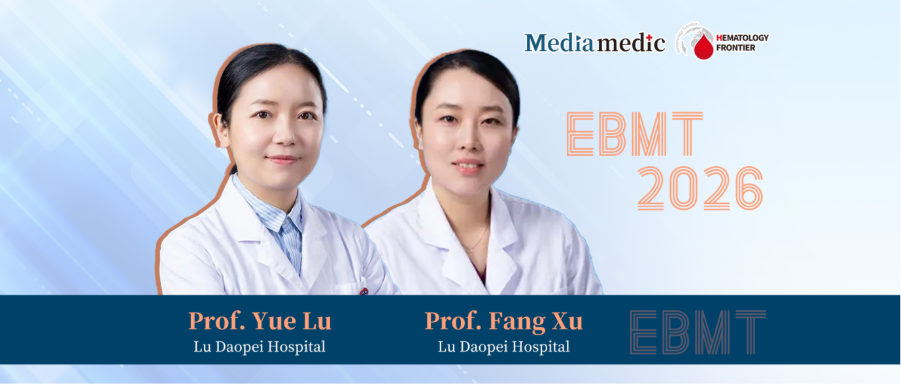
Blinatumomab, a CD19/CD3 bispecific antibody, has demonstrated clear efficacy in relapsed/refractory and MRD-positive B-cell acute lymphoblastic leukemia (B-ALL). Its integration into frontline therapy for newly diagnosed patients is now being actively explored and may reshape treatment paradigms. At the 52nd EBMT Annual Meeting (March 22–25, 2026, Madrid, Spain), a study conducted by the team of Prof. Yue Lu and Prof. Fang Xu from Lu Daopei Hospital was presented as a poster. The study evaluated the use of blinatumomab-based combination regimens during induction or early consolidation in newly diagnosed B-cell acute leukemia, providing valuable clinical evidence from China for optimizing first-line treatment strategies.
This article features an in-depth overview of the study presented by Prof. Fang Xu.
Study Background
For newly diagnosed acute leukemia, intensive chemotherapy is associated with substantial toxicity and a high risk of infection.
Blinatumomab (BLIN), as a novel immunotherapy, has demonstrated favorable efficacy and safety, offering a potential alternative or adjunct to conventional chemotherapy.
Methods
This retrospective study included newly diagnosed pediatric and adult patients with acute leukemia who received BLIN at Hebei Yanda Lu Daopei Hospital between January 1, 2023, and June 30, 2025.
BLIN was administered either as part of induction therapy or early consolidation. Indications for initiating BLIN included poor tolerance to intensive chemotherapy, MRD positivity, or failure to achieve remission after induction.
The study evaluated both efficacy and safety outcomes.
Results
A total of 21 newly diagnosed patients were included:
- 19 with B-ALL
- 2 with mixed phenotype acute leukemia (MPAL, B/myeloid) Among them, 2 cases represented transformation from chronic myeloid leukemia (CML).
The median age was 35 years (range, 6–57), with 11 males (52.4%) and 6 pediatric patients (28.6%).
At diagnosis, 3 patients had white blood cell counts >300 × 10⁹/L. Among pediatric patients, 2 were intermediate-risk and 4 high-risk. Among adults, 6 were standard-risk and 9 high-risk.
BLIN was used as induction therapy in 13 patients and as consolidation therapy in 8 patients.
Before BLIN treatment:
- 7 patients had non-remission (NR) disease
- 14 were in first complete remission (CR1), including 12 MRD-positive and 2 MRD-negative
After BLIN (median treatment duration: 2 weeks):
- Among 7 NR patients, 6 achieved CR1 (CR rate 85.7%), including 5 achieving MRD negativity
- One patient received only 3 days of BLIN due to severe cytokine release syndrome (CRS) and immune effector cell-associated neurotoxicity syndrome (ICANS), yet still achieved morphological remission (MRD-positive)
- Another NR patient discontinued BLIN after 2 days due to ICANS but achieved MRD-negative remission after re-induction with inotuzumab ozogamicin
Among 12 MRD-positive patients:
- 10 achieved MRD negativity (83.33%)
- The remaining 2 showed reduced MRD levels
Adverse events included:
- CRS in 2 patients (grade 1 and grade 3)
- ICANS in 2 patients
All patients proceeded to allogeneic HSCT.
Before transplantation:
- 3 patients developed CNS leukemia, all resolved after intrathecal therapy
- 3 patients remained MRD-positive
Donor types included:
- 20 haploidentical donors (HID)
- 1 matched sibling donor (MSD)
With a median follow-up of 10 months (range, 3–28):
- Estimated 1-year OS: 100%
- 1-year LFS: 83.29% (95% CI: 63.47–100)
Univariate analysis showed:
- WBC >300 × 10⁹/L at diagnosis was associated with lower LFS (P = 0.013; 94.44% vs. 33.33%) and higher relapse risk (P = 0.016; 66.67% vs. 5.56%)
- Presence of extramedullary disease (EMD) before transplant was also associated with lower LFS (P = 0.049) and higher relapse risk (P = 0.016)
Post-transplant:
- 2 patients relapsed at a median of 6 months (one CNS relapse, one ocular relapse)
- 1 patient developed grade II acute GVHD
- 1 patient developed moderate chronic GVHD
A total of 13 patients received post-transplant maintenance therapy:
- 12 with oral targeted agents
- 1 with low-dose BLIN
Conclusion
Blinatumomab demonstrates both efficacy and safety in the treatment of newly diagnosed acute leukemia, particularly when incorporated into induction or early consolidation strategies.
However, the risk of post-transplant extramedullary relapse should be carefully monitored, especially in patients with high leukocyte counts at diagnosis or pre-transplant extramedullary disease.
Expert Profiles

Yue Lu, MD Lu Daopei Hospital
Prof. Lu is a senior transplant physician (vice president level) at Lu Daopei Hospital. She completed clinical training at the Fred Hutchinson Cancer Center in Seattle and has performed over 1,500 allogeneic stem cell transplants. Shzhas published extensively in leading hematology journals.

Fang Xu, MD Lu Daopei Hospital
Prof. Xu is an associate chief physician in the Bone Marrow Transplantation Department at Hebei Yanda Lu Daopei Hospital. She has been engaged in allogeneic HSCT since 2010 and has participated in over 500 transplant procedures. She has published multiple academic articles and frequently presents at international and national hematology conferences.