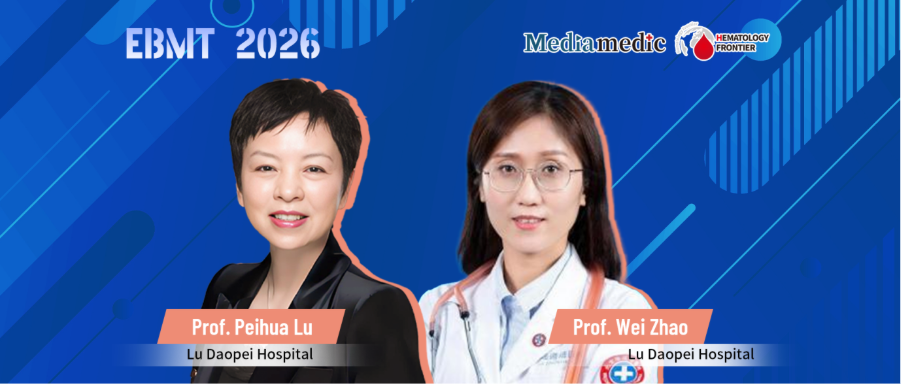
The 52nd EBMT Annual Meeting was held in Madrid, Spain, from March 22 to 25, 2026. As one of the most influential global conferences in hematopoietic stem cell transplantation, the meeting showcased cutting-edge research and the latest clinical advances in the field. At this year’s meeting, a study by Prof. Peihua Lu and Prof. Wei Zhao from Lu Daopei Hospital was selected for poster presentation. The study systematically evaluated the impact of letermovir prophylaxis on early immune reconstitution and viral reactivation dynamics following transplantation, highlighting recent advances by Chinese investigators in transplant infection management and immune modulation.
This article features insights shared by Prof. Wei Zhao.
Study Background
With letermovir (LTV) redefining cytomegalovirus (CMV) prophylaxis strategies in allogeneic hematopoietic stem cell transplantation, its broader impact on early immune reconstitution has become an important yet insufficiently explored question.
Real-world data on how CMV suppression influences lymphocyte recovery remain limited. This study aimed to characterize immune reconstitution patterns associated with LTV prophylaxis.
Methods
We retrospectively analyzed 148 recipients who underwent allogeneic HSCT at Beijing Lu Daopei Hospital between April 2021 and December 2024.
Clinical and virological data were systematically reviewed. Patients were divided into two groups: a preemptive therapy group (PET, n = 67) and a letermovir prophylaxis group (LTV, n = 81).
Peripheral blood lymphocyte subsets were monitored monthly using flow cytometry from pre-transplant baseline through 12 months post-transplant to assess longitudinal immune reconstitution.
Results
1. Survival and CMV/EBV Reactivation
During a median follow-up of 28.1 months (range, 6.5–49.1), there were no significant differences between the PET and LTV groups in 2-year overall survival (83.6% vs. 82.4%) or non-relapse mortality (10.5% vs. 10.1%) (both P > 0.05).
Within 180 days post-transplant, LTV prophylaxis significantly reduced the incidence of CMV infection (61.2% vs. 12.4%, P < 0.001), delayed the time to CMV reactivation (median 25 vs. 122 days, P < 0.001), and shortened the duration of infection (34 vs. 19 days, P = 0.017).
However, no significant differences were observed between the two groups in peak viral load (1200 vs. 1450, P = 0.240) or incidence of CMV-related disease (2.0% vs. 1.2%, P = 0.341).
The LTV group showed a higher incidence of EBV reactivation (14.9% vs. 27.2%, P = 0.083), although differences in infection duration (26 vs. 18 days, P = 0.179), peak viral load (1850 vs. 1600, P = 0.984), and EBV-related post-transplant lymphoproliferative disorder (PTLD) (2.99% vs. 2.47%, P = 0.847) were not statistically significant.
In a Fine–Gray competing risk model, LTV independently reduced the risk of CMV infection (HR = 0.16, 95% CI: 0.08–0.35, P < 0.001). Clinically significant EBV infection was independently associated with rATG exposure (HR = 2.50, 95% CI: 1.04–6.06, P = 0.042) and LTV prophylaxis (HR = 2.63, 95% CI: 1.02–6.77, P = 0.046).
2. Impact of LTV on Early Immune Reconstitution and T-Cell Maturation
Baseline immune status was comparable between the two groups.
From months +2 to +6 post-transplant, the LTV group showed significantly lower levels of total lymphocytes, CD3⁺ T cells, CD8⁺ T cells, NKT cells (both absolute counts and percentages), CD4⁺ T-cell absolute counts, and NK cell percentages compared with the control group (all P < 0.05).
At multiple time points, the proportion of B cells remained consistently higher in the LTV group. These differences diminished after month +6 (Figure 1).
At later time points, LTV recipients exhibited distinct T-cell maturation profiles, characterized by an increased proportion of regulatory T cells (Tregs) within the CD4⁺ compartment and a significantly elevated CD4/CD8 ratio (P < 0.05).
In addition, the proportions of naïve T cells, central memory T cells (TCM), and CD8⁺ TEMRA subsets were significantly increased, while the proportion of effector memory T cells (TEM) in both CD4⁺ and CD8⁺ compartments was significantly reduced (P < 0.05).
Conclusion
Recipients receiving LTV prophylaxis after HSCT exhibit a distinct pattern of immune reconstitution characterized by early suppression of T-cell counts.
However, by preventing CMV-driven immune activation and exhaustion, these patients preserve T-cell receptor (TCR) diversity and maintain a robust T-cell reservoir. This immune profile may ultimately favor more effective long-term immune recovery.
Expert Profiles

Peihua Lu, MD Lu Daopei Hospital
Prof. Lu serves as Medical Director of Lu Daopei Hospital and Director of the Beijing Lu Daopei Institute of Hematology. She graduated from Peking University Health Science Center and completed residency training at the University of Nebraska Medical Center, followed by subspecialty training in hematology and oncology at Stanford University.
She is board-certified in hematology and oncology in the United States and holds medical licenses in both the United States and China. She holds numerous leadership roles in national academic organizations related to hematology, transplantation, and oncology, and has received multiple awards for medical management and clinical excellence.

Wei Zhao, MD Lu Daopei Hospital
Dr. Zhao is an associate chief physician and master’s degree holder at Beijing Lu Daopei Hospital. He joined the Lu Daopei Medical Group in 2012 and has since performed nearly 900 allogeneic hematopoietic stem cell transplants.
He specializes in the diagnosis and treatment of hematologic diseases and has extensive experience in transplantation and post-transplant complications, particularly immune reconstitution.
He has published numerous articles as first or corresponding author in core and SCI-indexed journals and has presented his work at major international conferences including EBMT, EHA, and ASH.