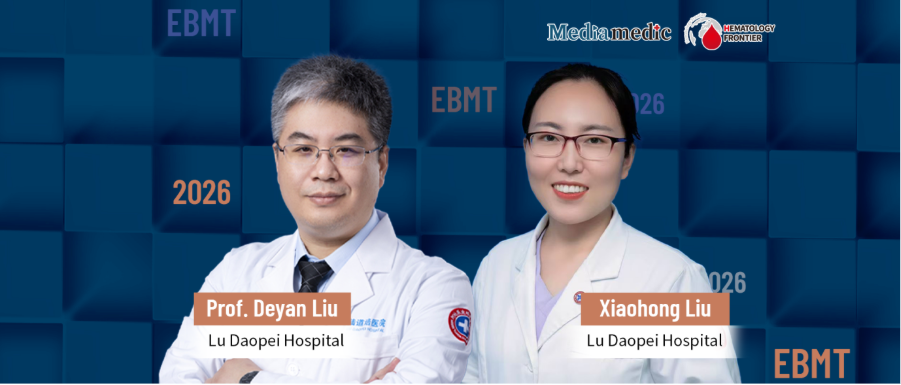
Relapsed acute myeloid leukemia (AML) after allogeneic hematopoietic stem cell transplantation (allo-HSCT) carries an extremely poor prognosis, particularly in patients with high CD33 expression who are refractory to conventional salvage therapies, where treatment options remain very limited. At the 52nd EBMT Annual Meeting held in Madrid, Spain, from March 22 to 25, 2026, a study conducted by the team of Dr. Deyan Liu and Dr. Xiaohong Liu from Lu Daopei Hospital was presented as a poster. The study, entitled “Gemtuzumab Ozogamicin Enables Bridging to 2nd/3rd Allo-HSCT with Favorable Outcomes in CD33-High Relapsed/Refractory AML with Post–Allo-HSCT Relapse,” systematically evaluated the efficacy of gemtuzumab ozogamicin (GO) in CD33-high patients and its feasibility as a bridge to subsequent transplantation, providing new clinical evidence for salvage strategies in this setting.
This article features insights shared by Dr. Xiaohong Liu.
Study Background
Relapse of AML after allo-HSCT is associated with dismal outcomes, especially in patients with high CD33 expression who are resistant to salvage chemotherapy or targeted therapy. Gemtuzumab ozogamicin (GO), an antibody–drug conjugate targeting CD33, has emerged as a potential therapeutic option.
However, whether GO can create an opportunity for subsequent second or even third allo-HSCT in this population remains unclear. This study aimed to evaluate the efficacy of GO in CD33-high relapsed/refractory AML after allo-HSCT that is resistant to conventional chemotherapy, and to assess its role in bridging to second or third transplantation, as well as its impact on long-term survival and safety.
Methods
This retrospective study included patients with relapsed/refractory AML treated between September 2021 and March 2025 at Yanda Lu Daopei Hospital and Beijing Lu Daopei Hospital.
All patients had relapsed after allo-HSCT, had CD33 expression ≥80%, and had failed to achieve complete remission (CR) with conventional chemotherapy.
Patients received either GO monotherapy (≥70% of patients received 3 mg/m² on days 1, 4, and 7; some received 1–2 doses without reaching the standard regimen) or GO in combination with chemotherapy or targeted agents (including selinexor, venetoclax, or CAG regimens). Treatment response was evaluated within 30 days, and patients were bridged to second or third allo-HSCT based on response and patient preference.
Follow-up was conducted until October 1, 2025.
Results
Baseline Characteristics
A total of 36 patients were initially enrolled, of whom 2 were excluded due to lack of post-treatment evaluation, leaving 34 patients for analysis. Among them, 24 (70.6%) were male, with a median age of 38 years (range, 7–68).
In the first transplantation, haploidentical donors were most common (64.7%), followed by matched unrelated donors (MUD) and autologous transplantation (each 11.8%), with a small number of matched sibling donors (MSD) and cord blood transplantation (CBT).
The median time to relapse after transplantation was 6.2 months (range, 1.7–25.9). Before receiving GO, patients had undergone a median of 7 prior chemotherapy regimens. Complex karyotypic abnormalities were present in 65% of patients. TP53 mutations were identified in 5 patients, MLL rearrangements in 7 patients, and FLT3-ITD mutations in 8 patients.
Before GO treatment, the median bone marrow blast percentage was 20.5% (range, 5–79.5%), and the median MFC-MRD blast proportion was 16.9% (range, 0.12–84.9%). Most patients received GO in combination regimens (27/34, 79.4%), while 7 patients (20.6%) received GO monotherapy.
Efficacy
Within 30 days, the overall response rate (ORR) was 61.8% (21/34). Among responders, 20 patients (95.2%) achieved complete remission (CR), and 1 patient (4.8%) achieved partial remission (PR). The non-response rate (NR) was 38.2% (13/34).
Among the 20 patients who achieved CR, 9 (45%) were MRD-negative (MRD-CR), and 11 (55%) were MRD-positive (MRD+CR). No moderate or severe adverse events were observed following GO treatment.
Transplantation Outcomes
After GO treatment, with a median follow-up of 4.8 months (range, 0.2–31.4), 16 of the 20 CR patients (80.0%) proceeded rapidly to second or third allo-HSCT within a median of 7–29 days (haploidentical donors in 13 cases and MUD in 3 cases).
After transplantation, with a median follow-up of 11.8 months (range, 0.4–30.5), the 1-year overall survival (OS) and leukemia-free survival (LFS) were both 60.9% (95% CI, 36.4–85.47). The incidence of grade III–IV acute GVHD at 100 days was 18.75% (95% CI, 6.76–52).
Patients achieving MRD-negative CR had significantly better outcomes than those with MRD-positive CR. The 1-year OS/LFS was 87.5% (95% CI, 64.58–100) versus 30% (95% CI, 0–64.37), respectively (P = 0.041).
Among the 6 deaths (5 MRD+CR and 1 MRD-CR), causes included CD33-positive relapse in 2 patients (at 6.5 months), severe pneumonia or diffuse alveolar hemorrhage in 3 patients, and veno-occlusive disease (VOD) in 1 patient, likely related to GO toxicity.
Among 4 CR patients who did not proceed to transplantation, 3 (75%) died of CD33-positive relapse (at 1 month and 7.5 months), and 1 patient survived for 2.6 months after conventional chemotherapy before being lost to follow-up.
Outcomes in Non-Responders
Among 14 patients with NR/PR after GO treatment, 85.7% (12/14) received conventional therapy. Of these, 11 patients (92%) died of CD33-positive relapse within 100 days after discontinuation of GO, and only 1 patient survived beyond 10 months.
The remaining 2 patients underwent salvage second allo-HSCT on days 10 and 11 after GO treatment and remained disease-free at 3.7 months and 27.5 months, respectively.
Conclusion
In patients with CD33-high relapsed/refractory AML after allo-HSCT who fail conventional therapy, GO is an effective and well-tolerated treatment that can achieve a high complete remission rate.
Bridging to second or third allo-HSCT as soon as CR is achieved significantly improves survival outcomes, particularly in patients who achieve MRD-negative CR. For patients who remain non-responsive after GO, the benefit of proceeding to salvage transplantation requires further investigation in larger cohorts.
Expert Profiles
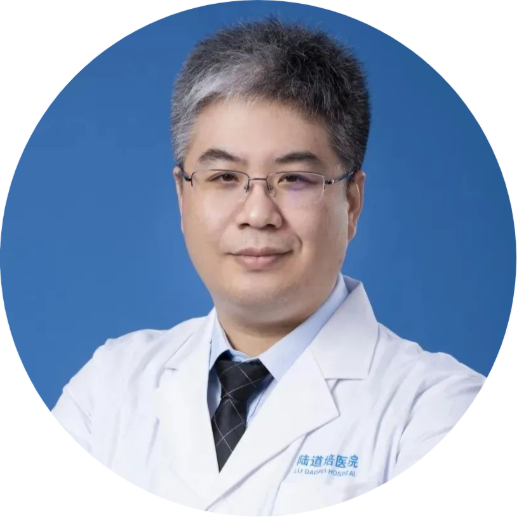
Deyan Liu, MD Director (Vice President Level), Lu Daopei Hospital
Dr. Liu is a senior hematologist specializing in hematopoietic stem cell transplantation. He has over 19 years of experience and has performed more than 1,200 transplants. His expertise includes transplantation for high-risk leukemia and lymphoma, as well as management of severe graft-versus-host disease (GVHD).
He has extensive experience in haploidentical transplantation and transplantation for both malignant and non-malignant hematologic diseases, including rare disorders. He has published multiple articles in international journals such as International Journal of Laboratory Hematology, Annals of Hematology, and Bone Marrow Transplantation, and has presented his work at major conferences including APBMT and EBMT.
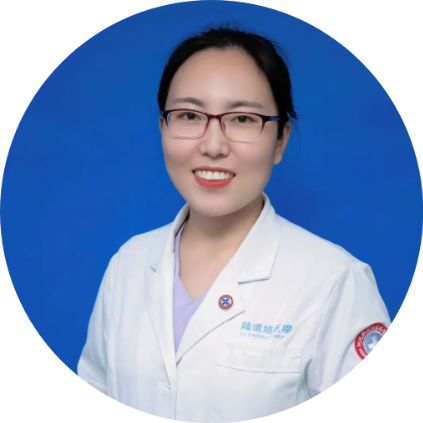
Xiaohong Liu, MD Attending Physician, Department of Hematopoietic Stem Cell Transplantation, Lu Daopei Hospital
Dr. Liu obtained her master’s degree from the Second Hospital of Hebei Medical University in 2018 and has since been working with Dr. Deyan Liu’s transplant team. She is experienced in the management of hematologic diseases such as leukemia, myelodysplastic syndromes, and aplastic anemia, as well as transplantation-related complications including GVHD, TMA, and PGF.