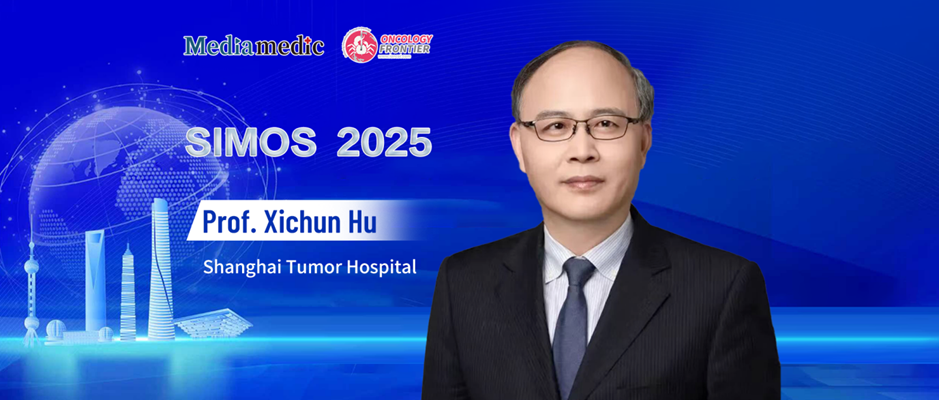
Editor’s note: From its early focus on “standards, safety and standardized practice” to today’s deep integration of clinical, basic, and translational research, the 8th Shanghai International Medical Oncology Symposium (SIMOS) reflects China’s determined progress toward becoming a research-oriented oncology powerhouse. At this year’s meeting, Oncology Frontier invited the conference chair, Prof. Hu Xichun of Fudan University Shanghai Cancer Center, to share his insights.
Prof. Hu noted that SIMOS not only showcased major translational achievements across the hospital’s eight oncology subspecialties, but also offered an incisive analysis of the three major pathways—ER, CDK, and PAM—that are driving therapeutic advances in HR+/HER2– breast cancer. From breakthroughs in oral SERDs and PROTAC technologies, to differentiated development of domestic CDK inhibitors, and the maturing landscape of PI3K/AKT/mTOR pathway therapies, treatment paradigms are being continuously reshaped. Prof. Hu also emphasized the importance of promoting multicenter collaboration through the “C-TALK” platform, with the ultimate goal of enabling China’s innovations not merely to follow guidelines—but to rewrite global guidelines.
01
Oncology Frontier: This year’s SIMOS featured extensive clinical and translational research updates across three major innovation themes, highlighting cutting-edge progress. What was the thinking behind this structure? What do you hope clinicians took away from the meeting?
Prof. Hu Xichun:
When SIMOS was first launched, the central themes were “standards, safety, and standardized practice,” so most content focused on clinical issues. But as China’s drug-development capability and translational research capacity have rapidly advanced, physicians must not only treat patients—they must also embrace the perspective of working in research-oriented hospitals where basic and translational science play vital roles.
The most significant change in the 8th SIMOS is that the agenda now reflects not only clinical progress but also advances in basic and translational research, forming an integrated platform for cross-disciplinary exchange. This year we added more subsessions to allow experts with specific research interests to delve deeper into their topics.
Under the leadership of Prof. Wang Hongxia, Director of our Department of Internal Medicine, our institution has made outstanding contributions across clinical, basic, and translational research. This year, we successfully secured major national funding for a breast cancer project under the “Four Major Chronic Diseases” initiative. Leveraging brain-inspired AI and multimodal data, the project aims to advance early screening and early diagnosis of breast cancer and has received more than 70 million RMB in support.
This reflects a new era: clinicians in China today are not only treating patients but also conducting research and contributing to the nation’s scientific advancement. Together with colleagues across the country, we have already achieved remarkable success in guiding clinical oncology development. SIMOS now attracts leading cancer centers nationwide as well as internationally renowned experts, strengthening domestic academic exchange and enhancing China’s engagement with the global oncology community.
02
Oncology Frontier: As the host institution of SIMOS, Fudan University Shanghai Cancer Center presented its subspecialty system and related research topics. In the field of breast oncology, what were the major highlights your team shared?
Prof. Hu Xichun:
Our presentations covered a broad range of topics, including translational and basic research. I also shared my experience participating in the development of the Advanced Breast Cancer (ABC) International Consensus and discussed the insights gained at this year’s meeting.
We placed particular emphasis on HR+/HER2– breast cancer, highlighting the latest progress in combination strategies targeting the ER pathway, CDK4/6 pathway, and PI3K/AKT/mTOR pathway, as well as approaches to optimizing endocrine therapy in clinical practice—aiming not only to prolong progression-free survival (PFS) but hopefully to improve overall survival (OS).
The forum also provided a high-quality learning and training platform for young physicians. Leading experts from major domestic institutions and scholars across our eight oncology subspecialties engaged in in-depth discussions covering clinical practice, basic science, and translational research across breast cancer and other solid tumors, with the shared goal of advancing future research.
03
Oncology Frontier: You presented on precision therapy for HR+/HER2– breast cancer. Based on the most recent domestic and international studies, what will be the key research directions going forward? And which Chinese innovations show promise for addressing unmet clinical needs?
Prof. Hu Xichun:
The therapeutic landscape of HR+/HER2– breast cancer is being shaped by three major pathways—the ER pathway, CDK pathway, and PI3K/AKT/mTOR (PAM) pathway.
First, the ER pathway.
Because ESR1 mutations often predict poor prognosis, next-generation endocrine therapies have developed rapidly. Beyond the FDA-approved elacestrant, oral SERDs such as giredestrant and camizestrant, as well as the PROTAC degrader ARV-471, are being developed to tackle endocrine resistance.
Second, the CDK pathway.
Research is transitioning from “CDK4/6 inhibition alone” to “multi-target CDK inhibition.” At ESMO, Academician Song Erwei reported encouraging results on the domestic CDK2/4/6 inhibitor Kumociclib, adding new therapeutic options and stimulating deeper inquiry into the respective roles of CDK2, CDK9, and other CDK subtypes in precision oncology.
Finally, the PAM pathway.
Following China’s approval of capivasertib, PI3K/mTOR dual inhibitors such as gedatolisib and the PI3Kα inhibitor inavolisib from the INAVO120 study have demonstrated impressive improvements in both PFS and OS. While adverse-event management remains essential, PAM-pathway inhibitors are now firmly positioned across both first-line and later-line treatment settings.
Overall, coordinated advances across these three pathways are fundamentally redefining therapeutic standards for luminal breast cancer.
04
Oncology Frontier: In your view, what measures can accelerate the translation of oncology research so that scientific findings more effectively guide and transform clinical practice? What successful experiences can you share from your institution?
Prof. Hu Xichun:
A key strategy is to actively promote multicenter clinical research. Our “C-TALK” platform was created specifically for this purpose. Experts at our hospital—including Prof. Wang Hongxia and Prof. Wang Chenzhen—have extensive experience in this area.
Collaboration across institutions is crucial. Once three or more departments join forces, a multicenter research structure can be formed. Such cooperation fosters positive interaction and strengthens the overall quality of breast cancer research in China.
Because of this, C-TALK has become one of our major priorities in recent years. We hope the platform will bring together even more expertise and resources, enabling us not only to shape Chinese clinical guidelines but ultimately to influence international guideline revision, contributing China’s wisdom to the global advancement of breast cancer care.
Prof. Hu Xichun
Fudan University Shanghai Cancer Center