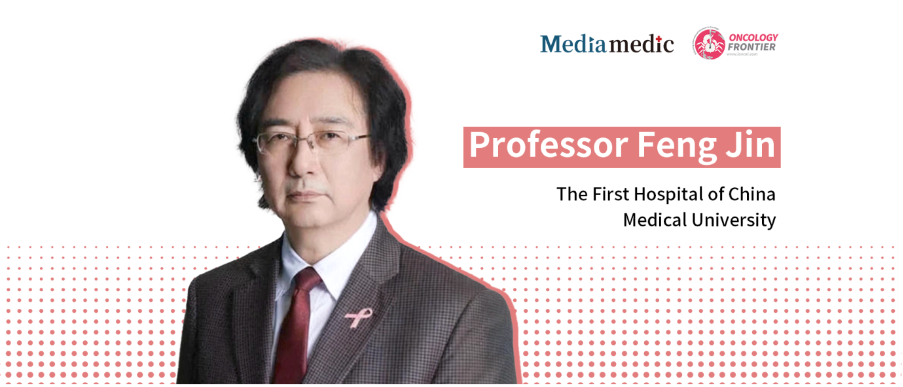
Editor’s Note: The 20th Shanghai International Breast Cancer Symposium (SIBCS), jointly organized by the Shanghai Anti-Cancer Association and the Breast Cancer Committee of the China Anti-Cancer Association, was recently held in Shanghai. Under the theme “20 Years of Progress, a Future of Continuity”, the forum brought together leading experts from China and abroad to reflect on two decades of advances in breast cancer diagnosis and treatment in China. During the “Year in Review” session, Professor Feng Jin of the First Hospital of China Medical University delivered a presentation titled “Key Clinical Trial Achievements in Chinese Breast Cancer Research.” Oncology Frontier invited Professor Jin for an in-depth discussion on China’s breakthrough clinical evidence, its global impact, and China’s future developmental directions in breast cancer research. 01
Oncology Frontier:
Your SIBCS presentation provided a comprehensive overview of important clinical trial achievements in China. Looking back at recent progress, which breakthrough findings in Chinese breast cancer clinical research have made the strongest impression on you?
Professor Feng Jin:
In recent years, we have witnessed several remarkable breakthroughs in China’s breast cancer clinical research, spanning drug innovation, treatment strategy optimization, and more. In preparing content for the “Year in Review” session at SIBCS, our presentation working group (Yinmiao Yu, Zhedong Li, Muyao Li, Zixian Dong) used bibliometric methodologies to systematically review major databases and assess high-impact studies presented at major domestic and international meetings. We identified a series of high-quality clinical trials led by Chinese investigators, with significant progress across multiple treatment stages and molecular subtypes.
First, in the field of domestic innovative drugs, advances in targeted therapy and endocrine therapy stand out. On the targeted therapy side, China’s rapid progress is especially notable in HER2-directed agents—new-generation ADCs featuring optimized molecular design have shown compelling benefit across multiple lines of therapy in advanced disease, and they are now being actively explored in neoadjuvant settings for early-stage disease. On the endocrine therapy side, domestic CDK4/6 inhibitors have expanded rapidly, completing the full treatment spectrum from late-line to early adjuvant therapy, and evolving from combination regimens to treatment-strategy refinement. These developments have given Chinese patients more accessible and effective therapeutic choices.
Second, in treatment-strategy innovation, two important trends have emerged:
- A “de-escalation” movement in chemotherapy-based regimens (e.g., “platinum-free” or “anthracycline-free” combinations), which reduces toxicity without compromising efficacy;
- Optimization of immunotherapy strategies, with strong domestic trial evidence confirming that immunotherapy plus chemotherapy can significantly improve pCR rates with good tolerability.
At the same time, Chinese researchers are exploring new immunotherapy combinations—pairing immunotherapy with anti-angiogenic drugs, metronomic chemotherapy, and precision stratification tailored to Chinese patient profiles—helping drive individualized treatment approaches. Meanwhile, efforts to proactively manage treatment-related toxicities, such as reducing the incidence of hand-foot syndrome, reflect the shift toward improving patient quality of life.
02
Oncology Frontier:
How have these evidence-based findings from China influenced global breast cancer treatment guidelines or clinical practice? What do you see as the key factors that enabled China’s clinical research to achieve these successes?
Professor Feng Jin:
China’s clinical evidence is increasingly influencing global breast cancer practice. For example, domestic CDK4/6 inhibitor trials—whether in early-stage escalation or first-line metastatic settings—consistently align with global findings. As these data mature, they will further reinforce the evidence base for CDK4/6 inhibition. Additionally, strong performance from China’s innovative agents provides meaningful guidance for clinical decision-making. More importantly, exploratory research on precision subtyping and individualized treatment is generating “China-specific solutions” with substantial clinical and translational value.
The success of China’s clinical research is driven by multiple factors:
First, China’s growing academic influence and international engagement. Publication output in breast cancer clinical trials has steadily increased, with China’s global share rising year by year. The median impact factor of Chinese breast cancer clinical trial papers rose from 3.7 in 2016 to 7.1 in 2025.
Second, the maturation of China’s systematic multi-center research infrastructure. Collaboration among research institutions and investigators has intensified. China has developed a well-structured national breast cancer clinical research network led by prominent PIs, with multi-center, cross-regional, multidisciplinary cooperation becoming the norm. This marks China’s transition from isolated breakthroughs to systematic, ecosystem-level innovation.
Third, strategic precision-focused transformation. Research priorities are shifting from traditional treatment paradigms toward precision medicine and intelligent technologies. Keywords from recent Chinese breast cancer trials increasingly reflect AI integration, multi-dimensional management, and translational innovation—signaling China’s movement toward full-cycle, technology-driven research.
03
Oncology Frontier:
From your experience, what are the most critical factors for success in breast cancer clinical trials? And looking ahead, what key areas should China focus on to advance breast cancer research further?
Professor Feng Jin:
The success of breast cancer clinical trials relies on several essential elements:
1. A mature, high-cohesion multi-center network. Cross-regional collaboration significantly improves research efficiency and quality.
2. Precision-medicine–driven design. The shift from traditional therapies to biomarker-guided individualized treatment is essential for scientific and clinical advancement.
3. Full-cycle management philosophy. Beyond efficacy endpoints, modern trials must incorporate proactive toxicity prevention and management to improve adherence, patient experience, and trial quality.
Looking ahead, several areas merit priority focus:
• Continuous optimization of treatment strategies. Examples include de-escalation of chemotherapy combinations, axillary surgery de-escalation, and preoperative radiotherapy—each enhancing quality of life while preserving efficacy.
• Accelerating clinical translation of domestic innovative agents. Drugs such as locally developed CDK4/6 inhibitors are reshaping treatment landscapes, and high-quality evidence is needed to support broader adoption.
• Deepening precision-treatment research. Identifying which patients benefit most and designing optimal combination strategies remain core scientific questions.
• Integrating intelligent technologies. Leveraging big data and AI will enable transition from single-outcome evaluation to multi-dimensional, full-cycle patient management.
These directions align with global scientific frontiers while addressing the practical needs of Chinese patients, and they will be the key drivers of China’s expanding academic influence and clinical impact.
Contributors
Feng Jin, Professor Department of Breast Surgery
The First Hospital of China Medical University
Yinmiao Yu, Professor Department of Breast Surgery
The First Hospital of China Medical University
Zhedong Li PhD Candidate
Department of Breast SurgeryThe First Hospital of China Medical University
Muyao Li PhD CandidateDepartment of Breast Surgery
The First Hospital of China Medical University
Zixian Dong Master’s Candidate
Department of Breast Surgery The First Hospital of China Medical University