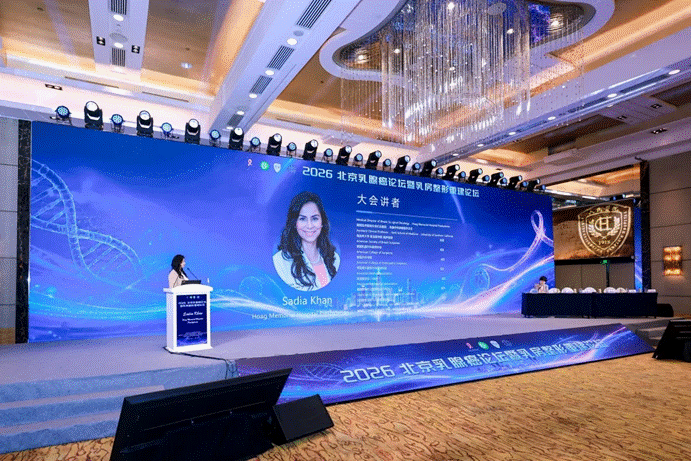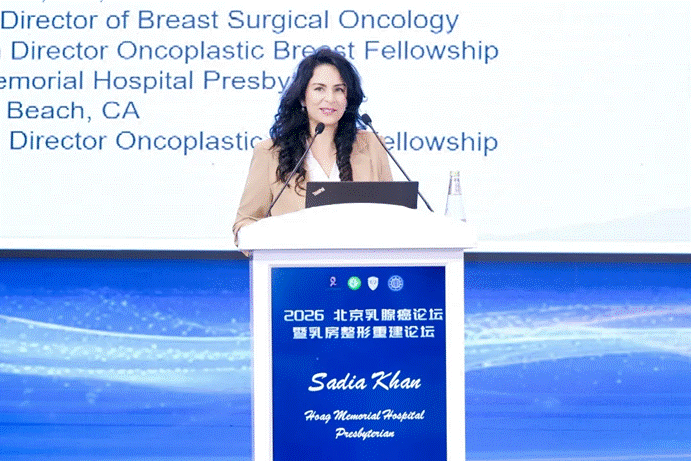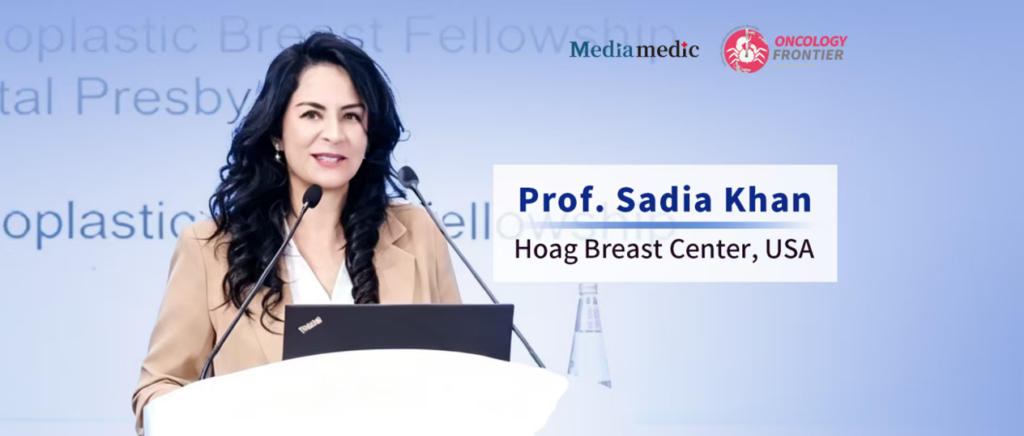
Editor's Note: The 2026 Beijing Breast Cancer Forum and Beijing Breast Reconstruction Forum was held in Beijing from June 23 to 28, 2026. The meeting brought together leading breast surgery experts from China and abroad to discuss advances in breast cancer diagnosis and treatment, breast reconstruction, and oncoplastic breast-conserving surgery. As part of the “International Perspectives · Academic Summit” program, Prof. Sadia Khan from the Hoag Breast Center in the United States delivered a presentation entitled Bridging the Learning Curve: Building a Comprehensive Training Curriculum for Oncoplastic Breast Surgeons, systematically introducing the US experience and ongoing efforts in developing training programs for oncoplastic breast surgeons. In an interview with Oncology Frontier, Prof. Khan further shared her perspectives on the development and training of oncoplastic breast-conserving surgery in China and the United States.Oncology Frontier: Could you give us an overview of the history and development of oncoplastic breast surgery in the United States? Despite differences in demographics and other factors between the US and Asian countries such as China, what experiences and approaches from the US model do you believe are worth adopting?
Prof. Sadia Khan: Oncoplastic surgery actually originated in Europe and was subsequently adopted and developed more broadly there. The United States was somewhat later in embracing this approach. The emergence of oncoplastic surgery was closely linked to a series of clinical trials comparing mastectomy with breast-conserving surgery. Once we recognized that women could achieve comparable oncologic outcomes with less extensive surgery, greater attention began to be paid to postoperative cosmetic outcomes.
Several European surgeons influenced their American counterparts, and Dr. Melvin J. Silverstein is widely regarded as one of the pioneers of oncoplastic surgery in the United States. I also trained with him. He and many other surgeons played an important role in establishing oncoplastic surgery as a core concept in the US.
Over the past decade, I have witnessed tremendous momentum toward training more surgeons to provide oncoplastic breast surgery to patients in community settings, thereby allowing more women to benefit from these techniques. This trend is reflected not only in training programs, which are increasingly incorporating oncoplastic surgery into their curricula, but also in academic meetings, where there are now numerous lectures, workshops, and dedicated courses on the subject. Organizations such as the American Society of Breast Surgeons (ASBrS) and other professional societies are offering training courses that provide surgeons who did not previously receive formal oncoplastic training with opportunities to acquire these skills.
I see a similar situation in China. Major medical centers in cities such as Beijing and Shanghai are already incorporating oncoplastic surgery into clinical practice, but surgeons in many other regions may have fewer opportunities to gain exposure to these techniques. One approach that could help expand the field in China would be to allow surgeons from centers without sufficient surgical volume to train at high-volume institutions. Alternatively, leading experts in the field could organize dedicated training courses to provide surgeons with opportunities to learn and accumulate practical experience.
Ultimately, incorporating oncoplastic breast surgery into formal training programs would be the best way to achieve widespread adoption.
Oncology Frontier: As we know, you place considerable emphasis on developing a comprehensive training curriculum for oncoplastic breast surgeons. Could you introduce the training program you lead? What does the typical training pathway for an oncoplastic breast surgeon look like in the United States?
Prof. Sadia Khan: Currently, there is no standardized oncoplastic breast surgery training program in the United States. The ASBrS has a major breast surgical oncology fellowship that lasts approximately one year. The extent of exposure to oncoplastic breast surgery varies across different fellowship programs, although these techniques are increasingly being incorporated into standardized teaching curricula. However, the amount of oncoplastic training still differs considerably from one institution to another.
To promote greater standardization, we established an independent one-year fellowship in oncoplastic breast surgery for surgeons who have completed their surgical training and obtained board certification. Surgeons with different levels of experience can participate in this immersive one-year fellowship, during which they receive comprehensive training in a broad range of oncoplastic techniques.
Oncology Frontier: Could you share your impressions of this China-US academic exchange? What is your overall assessment of China’s progress in oncoplastic breast surgery? In your view, what are the key areas where China should focus its efforts to achieve further breakthroughs and development in this field?
Prof. Sadia Khan: This is my first visit to China, and I have had a wonderful experience. I visited several local hospitals, met with breast surgeons here, and attended this conference. I have been deeply impressed by Chinese culture and by the kindness and hospitality I have received. I have also been very impressed by the surgical expertise here.
The surgeons are highly trained and appear to be doing a great deal of remarkable work. In some areas, such as robotic surgery and endoscopic mastectomy, I believe some Chinese centers are even more advanced than certain centers in the United States.
I also sense a strong commitment in China to establishing more oncoplastic breast surgery fellowships and training programs and to providing more surgeons with opportunities to learn these techniques. I believe the key priority going forward should be to find a way to standardize training and ensure that more surgeons receive formal education in oncoplastic breast surgery. This would ultimately allow these techniques to become more widely available to women throughout China.