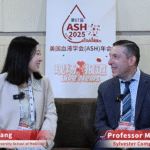

Editor's Note: On December 7th, local time, the highly anticipated session on the "Updated ASH Clinical Practice Guidelines on Acute Myeloid Leukemia (AML) in Older Adults" was successfully held at the American Society of Hematology (ASH) Annual Meeting. This session was chaired by Professor Mikkael Sekeres, the lead expert of the ASH guidelines and Director of the Department of Hematology at Sylvester Comprehensive Cancer Center. To gain deeper insights into the key points of the guideline update and the emerging trends it reflects, Oncology Frontier- Hematology Frontier invited Professor Huafeng Wang from Zhejiang University School of Medicine’s First Affiliated Hospital to engage in a deep dialogue with Professor Sekeres.The discussion focused on the treatment progress, clinical challenges, and the latest updates in the ASH clinical practice guidelines for elderly AML. This conversation aims to provide valuable references and guidance for the treatment strategies and clinical decision-making for elderly AML patients in China.
Key Points of the ASH Guidelines Update for Elderly AML and Its Implications for Clinical Practice in China
Professor Huafeng Wang: It’s a great honor to participate in this conversation, and I would like to thank Hematology Frontier for the invitation. I hope our discussion will provide valuable insights for clinical practice in China. Professor Sekeres, as the chair of this session, what do you consider to be the most significant and impactful changes in the updated ASH guidelines for older adults with AML? How do these changes reflect important trends in the treatment of older adults with AML?
Professor Mikkael Sekeres:Thank you for the invitation; it is a great honor to communicate with you here.In August 2020, we published the first edition of the ASH guidelines for the treatment of acute myeloid leukemia (AML) in older adults. At nearly the same time, the New England Journal of Medicine (NEJM) published the pivotal VIALE-A study showing that the combination of venetoclax plus azacitidine (VEN-AZA) was superior to azacitidine alone, significantly prolonging overall survival, especially in older patients. Although we were already aware of the forthcoming results when finalizing the initial guidelines, the data had not yet been formally published and therefore could not be incorporated.
In this updated version of the guidelines, we have accordingly made venetoclax combined with azacitidine a formally recommended regimen, explicitly stating its clear survival advantage over azacitidine monotherapy. For patients whose tumors harbor actionable genetic mutations, we have added new recommendations that highlight the critical role of targeted therapies in this population. Finally, we have revised the section on allogeneic hematopoietic stem cell transplantation, providing more specific guidance on patient selection and management, particularly for those with high-risk disease or unfavorable prognosis.
Professor Huafeng Wang: Yes, after we learned the results of the VA clinical trial, almost all elderly AML patients in China began to receive VA treatment. However, adverse events such as cytopenias remain a major clinical challenge. Therefore, determining the treatment cycle for the VA regimen becomes a key issue, including how many treatment cycles should be given to patients and how long the treatment should last. What are your thoughts on this?
Professor Mikkael Sekeres:In the ASH guidelines, we discussed the number of
chemotherapy cycles. First, for traditional induction and post-remission therapy, the “7+3” regimen of cytarabine and idarubicin is recommended. After completing one cycle of induction therapy, patients should receive at least one additional cycle of consolidation chemotherapy; completing just one induction cycle is insufficient for optimal results. For patients receiving VA therapy, we recommend continuing the regimen as long as the patient remains in remission or responds to the treatment. I have patients who have been on this regimen for four years and are still in remission with good quality of life. However, clinically, adjustments to the drug dosage are often necessary early in the treatment to manage adverse events.
In the U.S., azacitidine is given for 7 days during each 28-day cycle, and venetoclax is administered for 28 days. For elderly patients (aged 70 and above), a typical regimen is combining azacitidine for 7 days with venetoclax for 7 to 14 days, which can ultimately be adjusted to 7 days of azacitidine plus 7 days of venetoclax. For younger elderly patients (under 70 years), treatment can start with venetoclax for 21 or 28 days, but in subsequent cycles, the duration is often reduced to 21 days, 14 days, or even 7 days to improve tolerability and maintain efficacy.
Treatment Strategies for Elderly AML from a Fit/Unfit Stratification Perspective: Comparison of Practices Between China and the West and Optimization Pathways
Professor Huafeng Wang:First, this is generally the case in China as well, although it’s not very standardized. The update of this guideline will help us do better. Secondly, at our center, we usually divide patients into two groups. The first group consists of elderly patients who are fit for intensive chemotherapy, typically aged between 60 and 75. The second group includes elderly AML patients who are unfit for intensive chemotherapy, particularly those who are extremely elderly, such as patients over 80 or even 90 years old, as you mentioned. For fit elderly patients, we usually base treatment on VA and may add another chemotherapy agent depending on the situation, such as cytarabine or homoharringtonine (HHT). Is the situation similar in the U.S.?
Professor Mikkael Sekeres:For fit elderly patients, current treatment guidelines recommend the traditional “7+3” regimen. Although some centers have started including venetoclax in the regimen, it has not yet become a standard treatment. We are still waiting for more randomized controlled clinical data to be released, comparing the efficacy of “7+3” combined with venetoclax versus “7+3” alone, to further validate its clinical effect.
Professor Huafeng Wang:In this process, do you think it is necessary to reduce the dosage of chemotherapy or Venetoclax?
Professor Mikkael Sekeres:Currently, the optimal dosage and administration schedule for the combination of “7+3” chemotherapy and Venetoclax have not been determined.
A study from France suggests that a regimen of 7 days of Azacitidine plus 7 days of Venetoclax may be comparable in efficacy to the 7 days of Azacitidine plus 28 days of Venetoclax. Our own research also examined the treatment of elderly patients over 80 or 90 years old with Azacitidine and Venetoclax, and the results showed that the majority of patients were adjusted to the 7 days of Azacitidine and 7 days of Venetoclax regimen early in the treatment. Therefore, further dose reduction of the drugs may be necessary, but there is no clear conclusion regarding which drug’s dose should be reduced at this time.

Professor Huafeng Wang:For elderly AML patients who are unfit for intensive treatment, does the current guideline still recommend the combination of Venetoclax and Azacitidine?
Professor Mikkael Sekeres:As you mentioned, in the first version of the guidelines published in 2020, we categorized patients into those suitable for intensive treatment and those unsuitable for intensive treatment. However, after patients received Azacitidine combined with Venetoclax, Decitabine combined with Venetoclax, or low-dose Cytarabine combined with Venetoclax, we observed that the side effects in these patients were similar to those experienced by patients receiving the “7+3” chemotherapy regimen. Based on this observation, we decided to remove the terms “intensive treatment” and “non-intensive treatment” to avoid misleading people into thinking that Azacitidine combined with Venetoclax is easier to administer or does not carry serious complications such as cytopenias and fungal infections.
Advances in Targeted Therapy: Latest Recommendations for FLT3/IDH Inhibitors in Elderly AML
Professor Huafeng Wang:In addition, there are currently many other targeted
therapies, such as FLT3-ITD inhibitors, IDH1 and IDH2 inhibitors, and Menin inhibitors for NPM1 and KMT2A mutations. How do you think these drugs should be used in elderly AML patients?
Professor Mikkael Sekeres:We generally believe that adding more drugs to the treatment regimen could benefit patients, but this is not always the case. For example, in IDH1-mutated AML patients, the combination of Azacitidine and Ivosidenib significantly improved survival, with results three times better than using Azacitidine alone. Therefore, we recommend this combination in the guidelines. On the other hand, for IDH2-mutated AML patients, the combination of Azacitidine and Enasidenib did not show a clear survival advantage, so we suggest continuing treatment with Azacitidine monotherapy.


The use of FLT3 inhibitors is more complex. Clinical data with Quizartinib suggest that combining “7+3” chemotherapy with Quizartinib in FLT3-mutated AML patients leads to a significant survival advantage over using “7+3” alone. Additionally, the study included elderly patients, although the effect in this population was smaller. In the Midostaurin study, elderly patients were not included, which is why we have not previously made a clear recommendation for using FLT3 inhibitors in elderly AML patients.
For elderly FLT3-positive AML patients who are unfit for intensive chemotherapy,
there is currently no clear optimal treatment strategy. We are uncertain whether these patients should receive Azacitidine combined with Venetoclax, Azacitidine combined with FLT3 inhibitors, or a combination of all three. Therefore, based on the current lack of sufficient clinical data, our recommendation is to initially treat these patients with Azacitidine and Venetoclax, and consider adding FLT3 inhibitors when the patients relapse.

Professor Huafeng Wang:A poster presentation at this conference showed that the combination of Ivosidenib and Azacitidine did not demonstrate a survival advantage in elderly patients (for example, those over 65). What is your view on this result?
Professor Mikkael Sekeres:This treatment may be more suitable for younger elderly patients. For those over 80 years old, the treatment intensity may be too high, and their bone marrow recovery capacity is weaker, making it difficult for them to restore hematopoietic function as effectively as younger elderly patients.
Exploring the Feasibility of Three-Drug Induction Therapy Regimens and Clinical Decision-Making on Drug Sequencing
Professor Huafeng Wang:One last question. What is your opinion on the three-drug induction therapy regimen, such as the combination of Venetoclax, IDH1/FLT3-ITD inhibitors with Azacitidine or Decitabine? Do you think it is preferable to start with a two-drug combination and introduce the third drug upon disease progression? In this process, which drug would you prioritize? Should BCL2 inhibitors be used first, or should other specific targeted drugs take priority?
Professor Mikkael Sekeres:We have discussed this issue in our panel. For example, when considering treatment options for IDH1 mutations, we debated between Azacitidine combined with Ivosidenib and Azacitidine combined with Venetoclax. Based on the available data, it is not clear which regimen is more effective.
Therefore, the expert panel concluded that we cannot make a specific recommendation in this area and suggested that the decision be left to the clinician. Both treatment options are viable and have clinical utility.


Expert Profile

Huafeng Wang
Associate Professor, Deputy Chief Physician, Doctoral Supervisor, and Specially Appointed Researcher
Department of Hematology, The First Affiliated Hospital, Zhejiang University School of Medicine
Assistant Director, Department of Hematology, The First Affiliated Hospital, Zhejiang University School of Medicine
Executive Committee Member, Leukemia Expert Committee, Chinese Society of Clinical Oncology (CSCO)
Member, Leukemia Group, Hematology Branch, Chinese Medical Association (CMA)
Member, Targeted Therapy Committee, Chinese Women Doctors Association
Youth Member, Hematology Disease Translational Medicine Committee, Chinese Anti-Cancer Association
Secretary, Hematology Branch, Zhejiang Medical Association
Member, Zhejiang Provincial Leading Innovation and Entrepreneurship Team
Zhejiang Province 551 Talent Program Emerging Talent in Medicine
Postdoctoral Fellow, City of Hope National Medical Center, USA
Visiting Scholar, Brown University, USA, and Royal Free Hospital, UKExpert Profile

Mikkael A. Sekeres, MD, MS
Mikkael Sekeres is Professor of Medicine with Tenure and Chief of the Division of Hematology at the Sylvester Comprehensive Cancer Center, University of Miami Miller School of Medicine. He earned a medical degree and a master’s degree in clinical epidemiology from the University of Pennsylvania School of Medicine.
Dr Sekeres completed his postgraduate training at Harvard University, finishing an internal medicine residency at Massachusetts General Hospital and a fellowship in hematology-oncology at the Dana-Farber Cancer Institute in Boston. He is chair of the medical advisory board of the Aplastic Anemia and Myelodysplastic Syndromes (MDS) Internationand he has been the national and international primary study investigator on dozens of phase I/II/III trials. He is the author or co-author of over 500 peer-reviewed manuscripts and 650 abstracts, with an H-index of 100. He was the inaugural editor-in-chief of the ASH Clinical News magazine; he is on the editorial board of several journals and is Associate Editor for the Journal of Clinical Oncology and a Section Editor for UpToDate. He has written over 100 essays for The New York Times, The Wall Street Journal, The Washington Post, Huffington Post, Slate, and The Hill, among others; and has authored eight books, including When Blood Breaks Down: Life Lessons from Leukemia (The MIT Press, 2020), Drugs and the FDA: Safety, Efficacy, and the Public’s Trust (The MIT Press, 2022), and a book tentatively titled Chasing Truth in Cancer (University of Toronto Press, 2026).al Foundation, chairs the American Society of Hematology (ASH) Treatment Guidelines for Older Adults with Acute Myeloid Leukemia (AML),and he has been the national and international primary study investigator on dozens of phase I/II/III trials. He is the author or co-author of over 500 peer-reviewed manuscripts and 650 abstracts, with an H-index of 100. He was the inaugural editor-in-chief of the ASH Clinical News magazine; he is on the editorial board of several journals and is Associate Editor for the Journal of Clinical Oncology and a Section Editor for UpToDate. He has written over 100 essays for The New York Times, The Wall Street Journal, The Washington Post, Huffington Post, Slate, and The Hill, among others; and has authored eight books, including When Blood Breaks Down: Life Lessons from Leukemia (The MIT Press, 2020), Drugs and the FDA: Safety, Efficacy, and the Public’s Trust (The MIT Press, 2022), and a book tentatively titled Chasing Truth in Cancer (University of Toronto Press, 2026).