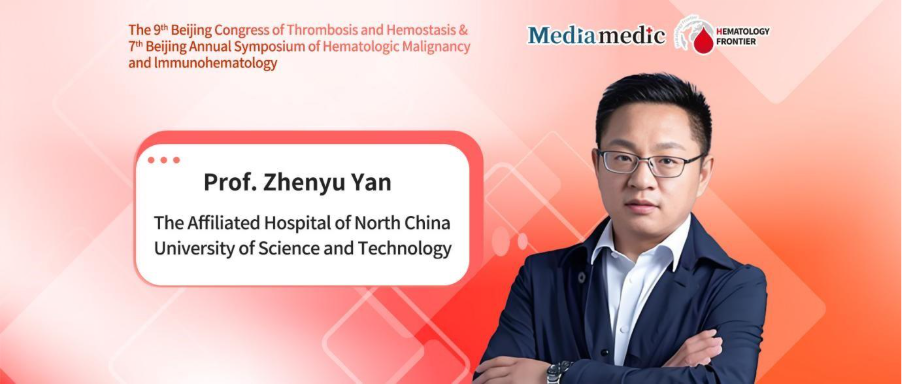
In March, as spring breathes new life into Beijing, the 9th Beijing Conference on Thrombosis and Hemostasis, organized by the Hematology and Immunology Branch of the Chinese Society of Immunology, together with the 7th Beijing Hematologic Oncology and Immunology Summit Forum, was successfully convened from March 27 to 28, 2026. During the meeting, Professor Zhenyu Yan from the Affiliated Hospital of North China University of Science and Technology delivered a keynote lecture entitled “Seven Transformations in the Comprehensive Diagnosis and Management of Hemophilia in China.” Hemophilia, a rare X-linked recessive bleeding disorder, mirrors the broader trajectory of rare disease management in China. In his presentation, Professor Yan reviewed the evolution of hemophilia care nationwide and highlighted how advances in therapeutics, policy frameworks, and clinical management have driven profound transformation across seven key dimensions: awareness, treatment goals, care models, therapeutics, management systems, collaboration, and strategic perspective. The following is a synthesis of the core content of his report.
Transformation in Awareness: From “Fatal and Disabling” to a Manageable Chronic Condition
Professor Yan emphasized that the shift in perception has been fundamental to progress in hemophilia care. Hemophilia is primarily classified into hemophilia A, caused by factor VIII deficiency, and hemophilia B, resulting from factor IX deficiency. Epidemiological data in China indicate that the estimated prevalence has increased from 2.73 per 100,000 between 1986 and 1989 to 3.09 per 100,000 based on projections from the Tianjin population in 2018. Registry data from 2007 to 2019 documented 17,779 cases of hemophilia A and 3,782 cases of hemophilia B, including a small number of female patients.
Historically, limited awareness among both the public and healthcare providers led to significant delays in diagnosis and restricted access to appropriate care. Data from Tianjin prior to 2004 revealed an average diagnostic delay of 13.3 years. With the establishment and expansion of Hemophilia Treatment Centers, this delay has been dramatically reduced to approximately 0.4 years between 2014 and 2018. This transition—from poor recognition to timely diagnosis—has fundamentally reshaped the perception of hemophilia, transforming it from a condition associated with inevitable disability into one that can be effectively managed.
At the same time, increasing attention has been directed toward patients’ quality of life. Health-related quality of life scores among Chinese patients have generally lagged behind international benchmarks. In response, domestically adapted assessment tools have been developed, including the HEAD-US-C joint evaluation system and the Chinese version of CHO-KLAT 2.0, enabling more accurate and culturally appropriate assessment of disease burden.
Transformation in Treatment Goals: From Bleeding Control to Comprehensive “Four-Zero” Management
With continuous advances in therapy and clinical management, treatment objectives have evolved substantially. The focus has shifted from ensuring survival to enabling patients to achieve normal hemostatic function and a quality of life comparable to that of the general population.
Professor Yan proposed a contemporary framework summarized as the “Four Zeros”: zero bleeding, zero joint damage, zero pain, and zero treatment burden. These goals reflect a more ambitious and holistic vision of care. By preventing both clinical and subclinical bleeding, joint damage and chronic pain can be avoided. Meanwhile, innovations such as subcutaneous therapies and gene-based interventions aim to reduce treatment frequency, invasiveness, and overall burden.
Achieving these outcomes not only improves physical health but also liberates patients from the psychological constraints associated with the disease, allowing them to live with greater confidence and autonomy.
Transformation in Treatment Models: Toward PK-Guided Individualized Prophylaxis
The evolution of treatment strategies in China has been marked by a gradual shift from insufficient on-demand therapy to preventive approaches. Earlier data indicated that only a small proportion of patients—approximately 16%—received prophylactic treatment. Initial efforts, such as low-dose prophylaxis introduced by centers including Beijing Children’s Hospital, demonstrated significant reductions in joint bleeding. Subsequent multicenter studies conducted between 2017 and 2021 showed that intermediate- and high-dose prophylaxis could further reduce annual bleeding rates, with some patients achieving complete elimination of bleeding episodes.
Current national guidelines strongly advocate for pharmacokinetics-guided individualized therapy. Advances in PK modeling, particularly Bayesian-based tools such as myPKFiT and WAPPS-Hemo, have made it possible to estimate individual pharmacokinetic parameters using only a limited number of blood samples. This enables clinicians to tailor prophylactic regimens to each patient’s lifestyle, physical activity, economic circumstances, and venous access, thereby optimizing efficacy while minimizing unnecessary resource utilization.
Transformation in Therapeutics: From Factor Replacement to Non-Factor Therapies and Gene Therapy
The therapeutic landscape of hemophilia has undergone a remarkable transformation. Early reliance on plasma-derived products was associated with substantial risks of viral transmission. The introduction of recombinant clotting factors in the 1990s and 2000s significantly improved safety. More recently, extended half-life products and non-factor therapies have further expanded treatment options.
Among these innovations, emicizumab—a bispecific monoclonal antibody that mimics the function of activated factor VIII—has represented a major breakthrough. Clinical trial data, including results from the HAVEN 5 study, demonstrated substantial reductions in bleeding rates among Asian patients with inhibitors. Real-world studies in China have corroborated these findings, with a notable proportion of patients achieving complete bleeding control.
In 2025, China approved its first gene therapy for hemophilia B, marking the transition into a new era of treatment. Developed domestically over a six-year period, this therapy has progressed from early research to clinical application, with results published in leading international journals such as The Lancet Haematology and The New England Journal of Medicine. Clinical data indicate that endogenous clotting factor levels can be restored to near-normal ranges, offering the possibility of a functional cure. The therapy has received strong recognition from the international scientific community for its potential global applicability.
Transformation in Management: Digital Health and Shared Decision-Making
The introduction of shared decision-making tools by the World Federation of Hemophilia in 2023 has marked a significant shift in clinical practice. Pilot studies are currently underway in multiple treatment centers across China to evaluate their feasibility and effectiveness. This transition from a physician-centered model to a collaborative approach enhances patient engagement and promotes more individualized care.
At the same time, digital technologies are reshaping disease management. Artificial intelligence is being applied to assist in joint imaging analysis, while mobile applications enable real-time tracking of bleeding events and treatment administration. Telemedicine platforms facilitate continuous follow-up and rehabilitation, overcoming geographical barriers and supporting long-term disease management. Together, these innovations are contributing to the establishment of an integrated, data-driven care model spanning prevention, screening, diagnosis, treatment, and rehabilitation.
Transformation in Collaboration: Integration of Multidisciplinary Care and Tiered Healthcare Systems
Multidisciplinary care has become an essential component of hemophilia management. Supported by national collaborative networks, multidisciplinary teams now play a central role in improving patient outcomes. Standardized rehabilitation protocols, as outlined in the 2022 Chinese expert consensus on musculoskeletal complications, incorporate evidence-based principles such as the PRICE approach and structured perioperative rehabilitation, along with functional assessment tools like the Hemophilia Joint Health Score.
In parallel, a tiered healthcare system has been established to optimize resource allocation and accessibility. Hemophilia care centers are categorized into three levels, ranging from comprehensive multidisciplinary centers to primary treatment facilities focused on basic and emergency care. By the end of 2024, 164 centers had been formally accredited, with ongoing efforts to expand services to underserved and rural regions.
Transformation in Strategic Perspective: Policy Support and Translational Innovation
The advancement of hemophilia care in China has been strongly supported by national health policies. Over the past two decades, progressive inclusion of clotting factor therapies and prophylactic treatment in insurance programs has significantly improved treatment accessibility. More recent policy initiatives aimed at supporting innovative drug development have accelerated the translation of research findings into clinical practice.
A multi-tiered financing framework is being explored to address the challenges associated with high-cost therapies such as gene therapy. By integrating public insurance, commercial coverage, and supplementary assistance programs, this approach seeks to ensure that cutting-edge treatments become accessible to a broader patient population.
Conclusion
Hemophilia management in China has evolved from a narrow focus on factor replacement to a comprehensive, precision-oriented, and patient-centered model of care. The seven transformations outlined by Professor Yan reflect not only technological and scientific progress but also a deepening commitment to improving patients’ quality of life.
Looking ahead, continued innovation in therapeutics, healthcare delivery, and policy will be essential to achieving the ultimate goal: enabling every patient with hemophilia to live free from bleeding, disability, and limitation, and to enjoy a life of dignity and independence.
Author Information

Zhenyu Yan, MD, PhD, is a Chief Physician and Professor at the Affiliated Hospital of North China University of Science and Technology, where he also serves as Vice President. He is a leading figure in hematology, actively involved in national clinical research, guideline development, and multidisciplinary collaboration. He has participated as principal investigator in more than 50 multicenter clinical trials, contributed to 15 national guidelines, and published over 60 academic papers.