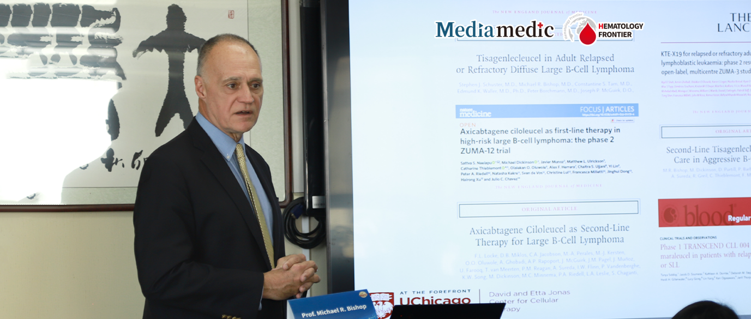
On November 2, 2025, Professor Michael R. Bishop, M.D. visited the Peking University Institute of Hematology for clinical rounds, a keynote lecture, and focused exchanges on the future of cellular therapy. His lecture, “Advancements in CAR-T Cell Therapy for the Treatment of Lymphoma: Steps Toward Better Outcomes,” outlined major progress in earlier use of CAR-T therapy, improved patient selection, and better clinical results.
Professor Bishop emphasized that the most critical factor guiding early CAR-T use is the disease’s response to initial therapy. Patients with primary refractory disease or very early relapse are now strong candidates for earlier intervention, with studies showing improved survival compared with autologous stem cell transplantation. He noted that patient performance status and organ function remain central to determining treatment suitability. LDH levels also serve as an important biomarker, with lower levels generally associated with better outcomes.
He discussed several strategies his team is pursuing to enhance CAR-T effectiveness and address relapse. These include pharmacologic support to improve T-cell health during manufacturing, dual- and multi-target CAR-T constructs to prevent antigen escape, cytokine-engineered CAR-T cells to boost anti-tumor activity, and emerging in vivo CAR technology, which enables patients to generate CAR-T cells internally. He described this last approach as an exciting early-phase innovation with potential to expand access worldwide.
Professor Bishop praised Peking University People’s Hospital as a global leader in stem cell transplantation, citing its high transplant volume and strong integration of clinical care and research. He noted that China and the United States face similar challenges in bringing new discoveries into broader clinical use and in managing the cost of cellular therapies. China’s ability to enroll large patient cohorts in clinical trials, he added, creates major opportunities for impactful international collaboration.
Looking ahead, he expressed strong enthusiasm for deeper China–U.S. cooperation through joint trial design, data sharing, and technological integration, highlighting how digital platforms make these efforts more achievable than ever.
hashtag#CART hashtag#Lymphoma hashtag#CellTherapy hashtag#Hematology hashtag#OncologyResearch hashtag#PekingUniversity hashtag#MedicalInnovation