
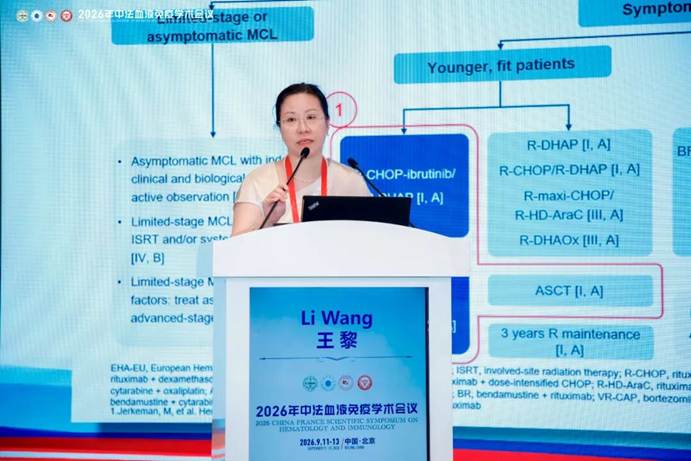
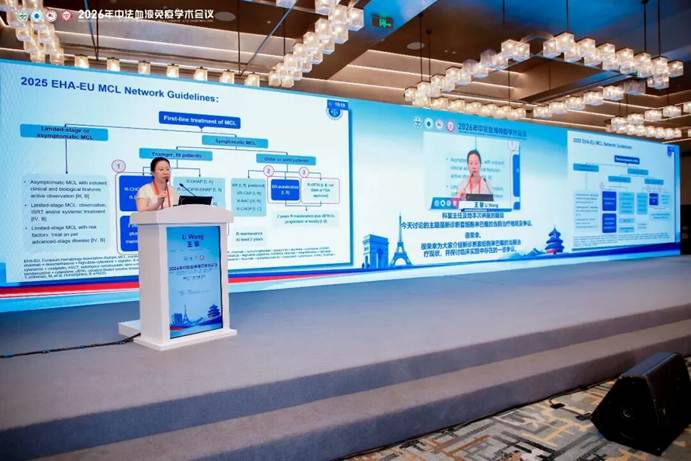
Editor's Note: The 2026 China-France Scientific Symposium on Hematology and Immunology was held in Beijing from September 11 to 13, 2026. Building on the longstanding tradition of hematology exchanges between China and France, this year's meeting expanded its scope to the intersection of hematology and immunology, bringing together renowned experts from both countries to explore scientific advances and exchange perspectives. On this occasion, Oncology Frontier – Hematology Frontier invited Professor Li Wang from Ruijin Hospital, Shanghai Jiao Tong University School of Medicine, to discuss the treatment landscape and controversies in newly diagnosed mantle cell lymphoma (MCL). Professor Wang examined the paradigm shift in first-line MCL treatment in the era of Bruton tyrosine kinase inhibitors (BTKis) and shared valuable clinical insights into the evolving role of autologous stem cell transplantation (ASCT), treatment options for older or transplant-ineligible patients, and precision strategies for high-risk disease.Oncology Frontier – Hematology Frontier: Treatment strategies for newly diagnosed MCL have changed substantially in recent years. Could you describe the current treatment landscape, including the main therapeutic pathways and available options?
Professor Li Wang: The emergence of numerous new therapeutic agents, particularly BTK inhibitors, has substantially transformed the treatment landscape for MCL. Evidence from large prospective clinical studies indicates that, in younger patients, BTKi-based chemoimmunotherapy can increase complete response (CR) rates. Furthermore, patients receiving BTKi maintenance achieve better progression-free survival (PFS), regardless of whether they undergo autologous stem cell transplantation. In older patients, BTKi-based regimens, including acalabrutinib plus bendamustine and rituximab (ABR) and ibrutinib plus bendamustine and rituximab (IBR), have effectively improved response rates and disease-free survival. These findings have established BTKi-based regimens as first-line treatment options for both younger and older patients.
At the guideline level, the 2025 EHA–EU MCL Network guidelines and the 2026 CSCO guidelines both provide risk-stratified recommendations for newly diagnosed MCL. For younger, transplant-eligible (fit) patients, recommended approaches include BTKi-containing induction regimens, such as R-CHOP plus ibrutinib followed by R-DHAP, or a chemotherapy-free regimen of zanubrutinib, obinutuzumab, and venetoclax for patients with TP53 mutations. These approaches may be followed by ASCT consolidation and rituximab maintenance or rituximab plus BTKi maintenance. For older or transplant-ineligible (unfit) patients, recommended options include bendamustine and rituximab (BR) combined with acalabrutinib, or a chemotherapy-free regimen of zanubrutinib plus rituximab.
A pooled analysis of six randomized phase III clinical trials conducted between 1996 and 2020, involving a total of 2,541 patients, showed significant improvements in failure-free survival (FFS) and overall survival (OS) among transplant-eligible patients with newly diagnosed MCL in the BTKi era (2016–2020). The five-year OS rate increased from 49% in 1996–2000 to 84% in 2016–2020. However, China’s multicenter CHOICE study showed that 48% of patients with newly diagnosed MCL experienced relapse or refractory disease following first-line treatment. Among patients with primary refractory disease or progression within six months of treatment initiation (POD6), median OS was only 1.3 years. Prognosis deteriorated progressively with each subsequent line of treatment.
The role of autologous transplantation has also been substantially challenged. Available data suggest that, among patients without high-risk features, survival outcomes do not differ significantly according to whether ASCT is performed. In contrast, ASCT may still provide additional survival benefits for certain high-risk patients. Furthermore, newer therapeutic approaches, including the use of bispecific antibodies, have enabled some high-risk patients, such as those with TP53 mutations or blastoid MCL, to achieve high CR and minimal residual disease (MRD)-negative rates in the first-line setting.
Treatment selection is also increasingly incorporating MRD-guided maintenance strategies. Among patients who achieve MRD negativity, the use of maintenance therapy and the decision to perform ASCT appear to have limited effects on disease-free survival. Conversely, MRD-positive patients continue to have poorer long-term survival than MRD-negative patients, even after ASCT. MRD-guided maintenance is therefore reshaping the treatment landscape and opening up new possibilities for individualized care.
Oncology Frontier – Hematology Frontier: How should first-line treatment strategies differ between younger, transplant-eligible patients and older, transplant-ineligible patients? How should newer therapies, such as BTK inhibitors and CAR T-cell therapy, be used in newly diagnosed MCL, and what are their prospects?
Professor Li Wang: For younger patients, the current general recommendation is to combine BTK inhibitors with chemotherapy-based regimens to further increase MRD-negativity rates. For older patients, BTKi plus BR, as well as BTKi combined with bispecific antibodies or CD20-targeted agents, can further improve CR rates. These approaches may also provide better disease-free survival and OS than conventional R-CHOP-based treatment. Consequently, an increasing number of older patients, particularly those with high-risk disease, may be treated with chemotherapy-free regimens. These emerging approaches are improving response rates, long-term survival, and quality of life in older patients, especially those at high risk.
Evidence from specific clinical trials illustrates these advances. The ECHO study compared acalabrutinib plus BR (ABR) with placebo plus BR (PBR). After a median follow-up of 60.8 months, median PFS was 72.5 months in the ABR group and 47.8 months in the PBR group, representing a 32% reduction in the risk of disease progression or death (HR = 0.68, P = 0.0022). The benefit was more pronounced in high-risk subgroups, including patients with Ki-67 expression of at least 30%, blastoid or pleomorphic histology, or TP53 mutations (HR = 0.66, P = 0.0119). In the blastoid or pleomorphic subgroup, ABR reduced the risk of progression or death by 41%, with an approximately 24-month difference in median PFS between the two groups.
The MANGROVE study evaluated zanubrutinib plus rituximab (ZR) versus BR in 500 patients aged 60 years or older with newly diagnosed MCL. ZR reduced the risk of disease progression or death by 43% (HR = 0.57, P < 0.0001), meeting the primary endpoint of PFS.
CAR T-cell therapy is an effective treatment option for patients with relapsed or refractory MCL. It is particularly important for patients whose disease does not respond to BTKi combined with BCL-2 inhibitors or to bispecific antibody therapy. These emerging non-chemotherapy approaches and novel agents are gradually reshaping the overall treatment pathway for MCL and expanding the available therapeutic options.
Oncology Frontier – Hematology Frontier: What are the major controversies and unresolved issues in the first-line treatment of newly diagnosed MCL? Which key questions should future research prioritize?
Professor Li Wang: With the approval of an increasing number of novel agents, MCL treatment is undergoing a profound transformation. Several important clinical questions and controversies remain.
The first is whether younger patients should routinely undergo ASCT. The international, multicenter, prospective TRIANGLE study has demonstrated that the introduction of highly effective BTKi therapy improves long-term outcomes in younger patients, and that transplantation is no longer necessarily a key determinant of PFS improvement.
Updated TRIANGLE results after 55 months of follow-up showed that the four-year FFS rates were 82% and 81% in the A+I and I groups, respectively, both higher than the 70% observed in the A group. The corresponding four-year OS rates were 88%, 90%, and 81%, respectively. Both ibrutinib-containing regimens significantly outperformed the standard regimen. These findings suggest that ASCT may no longer be the preferred default option for younger patients without high-risk features. ASCT also increases chemotherapy-related toxicity, while its incremental benefit may be limited. The introduction of BTK inhibitors is therefore progressively reducing the routine role of transplantation.
However, prospective subgroup analyses have shown that high-risk patients may still benefit from ASCT. The future approach should therefore move away from routine transplantation for all younger patients and toward selecting those most likely to benefit, such as patients with high-risk disease, for ASCT followed by BTKi maintenance.
The EA4151 study provides further evidence. Among patients achieving CR and undetectable MRD at a sensitivity of (10^{-6}) (uMRD6), consolidation with autologous hematopoietic cell transplantation (auto-HCT) did not demonstrate a clear benefit in OS or PFS. The three-year OS rates were 82.1% versus 82.7% (HR = 1.11, P = 0.66), while the three-year PFS rates were 76.6% versus 77.4% (HR = 1.05, P = 0.79). A 2026 Lancet commentary also noted that first-line regimens containing BTK inhibitors have displaced the traditional paradigm of intensive chemotherapy followed by stem cell rescue that had persisted for more than two decades.
The second major issue concerns older patients who cannot tolerate chemotherapy. These patients are often frail and unable to withstand intensive treatment. Since BTKi-based first-line regimens have substantially improved response rates, long-term survival, and quality of life, chemotherapy-free approaches may become the preferred treatment option for older patients who are unable to tolerate chemotherapy.
The third issue is the management of high-risk patients, particularly those with TP53 mutations or blastoid MCL. Previous studies have established that intensive chemotherapy and ASCT do not adequately improve outcomes in this population. However, newer approaches, including BTKi combined with BCL-2 inhibitors and bispecific antibodies, have demonstrated high response and CR rates.
The BOVen regimen, comprising zanubrutinib, obinutuzumab, and venetoclax, was evaluated in patients with previously untreated, TP53-mutated MCL. After a median follow-up of 39 months, median PFS was 45 months, the three-year PFS rate was 64%, the three-year OS rate was 76%, and the three-year disease-specific survival (DSS) rate was 95%.
The TrAVeRse study evaluated acalabrutinib, venetoclax, and rituximab (AVR) in previously untreated MCL. Among patients who completed AVR induction, 93% achieved an MRD-negative CR. Patients with TP53 mutations derived benefits comparable to those observed in the overall population: the MRD-negative CR rate was 100% versus 93%, and the overall response rate (ORR) was 100% versus 94%. These chemotherapy-free approaches may therefore become standard first-line options for high-risk patients in the future.
Overall, first-line MCL treatment is moving toward greater precision, less chemotherapy, and reduced reliance on transplantation. For younger, transplant-eligible patients, BTK inhibitors are reshaping the first-line treatment paradigm and challenging the routine use of ASCT. Transplantation should no longer be regarded as the default option for every patient; instead, its use should be carefully individualized according to high-risk biological features, depth of MRD response, and patient-specific factors.
For older or transplant-ineligible patients, the treatment focus is shifting from conventional immunochemotherapy toward a chemotherapy backbone combined with a BTK inhibitor. Patients with high-risk features, particularly TP53 mutations, represent the most significant unmet clinical need. Chemotherapy-free triplet regimens combining a BTK inhibitor, a BCL-2 inhibitor, and an anti-CD20 monoclonal antibody have demonstrated high CR and uMRD rates. However, the current evidence is derived primarily from single-arm and early-phase studies, and requires validation through longer follow-up and randomized controlled trials.
Looking ahead, first-line MCL treatment will increasingly center on risk stratification and MRD-guided individualized therapy. Future research should explore treatment de-escalation, fixed-duration regimens, and the feasibility of omitting ASCT or chemotherapy in patients who achieve deep MRD negativity.
Expert Profile

Professor Li Wang
Ruijin Hospital, Shanghai Jiao Tong University School of Medicine
- Chief Physician and Doctoral Supervisor
- Administrative Deputy Director, Department of Hematology, Ruijin Hospital, Shanghai Jiao Tong University School of Medicine
- National-Level High-Level Talent
- Postdoctoral Fellow, French National Institute of Health and Medical Research (INSERM)
- Vice Chair, Lymphoma Integrative Rehabilitation Committee, China Anti-Cancer Association
- Standing Committee Member, Lymphoma Committee, Chinese Society of Clinical Oncology (CSCO)
- Youth Committee Member, 11th Hematology Branch, Chinese Medical Association
- Committee Member, Laboratory Diagnostics Group, Chinese Medical Association
- Committee Member, Geriatric Hematology and Lymphoma Group of China
- Deputy Leader, Waldenström Macroglobulinemia Collaborative Group, China Anti-Cancer Association
- Vice Chair, Lymphoma Committee, Shanghai Anti-Cancer Association
- Distinguished Talent under the Shanghai Municipal Education Commission’s Plateau and Peak Talent Program; Shanghai Outstanding Young Medical Talent
- Shanghai March 8th Red-Banner Holder; Shanghai Outstanding Female Innovator