Editor's Note: During the 2026 European Society for Medical Oncology (ESMO) Congress, first-line treatment options for patients with favorable-risk advanced renal cell carcinoma (RCC) attracted considerable attention. For this patient population, how to control disease while reducing the burden of long-term treatment remains an important question warranting further investigation. Oncology Frontier – UroStream invited Professor Jun Guo of Peking University Cancer Hospital to discuss the patient selection, dual-target blockade strategy, and potential clinical value of ivonescimab.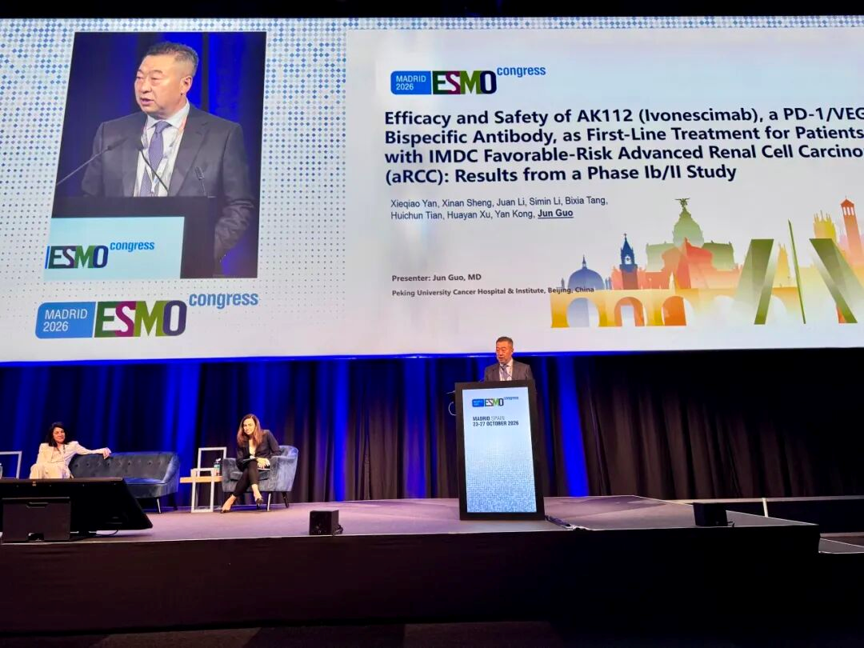
Patient Selection: Unmet Treatment Needs Persist in Patients with Favorable-Risk Disease
Oncology Frontier – UroStream: Why did you select patients with favorable-risk disease according to the International Metastatic Renal Cell Carcinoma Database Consortium (IMDC) criteria for this ivonescimab study? What are the main challenges facing current first-line treatment options?
Professor Jun Guo: I am honored that this study was selected for an oral presentation at this year’s ESMO Congress. Although the sample size was relatively small and the study evaluated monotherapy, it addresses a genuine clinical problem. I have always believed that an important starting point for clinical research design is identifying unmet needs in clinical practice and attempting to develop solutions to address them.
In renal cancer, patients with favorable-risk disease according to the IMDC criteria face precisely this kind of treatment dilemma. During the targeted therapy era, these patients generally achieved relatively good outcomes with targeted monotherapy. With the advent of targeted therapy combined with immunotherapy, regimens such as axitinib plus pembrolizumab and lenvatinib plus pembrolizumab have become available. However, the benefits observed in patients with favorable-risk disease are not entirely the same as those in patients with intermediate- or poor-risk disease.
Analyses of relevant patient populations in studies such as KEYNOTE-426 and CLEAR have shown that combinations of targeted therapy and immunotherapy can improve progression-free survival (PFS). However, in the favorable-risk subgroups, the overall survival (OS) advantage over sunitinib remains unclear. Consequently, these patients still face the challenge of choosing between targeted monotherapy and a combination of targeted therapy and immunotherapy. We should not overlook whether patients can sustain long-term treatment simply because a combination regimen has stronger antitumor activity.
Regardless of whether sunitinib or a targeted therapy–immunotherapy combination is used, adverse events remain an important consideration in clinical management. Many patients find the toxicity difficult to tolerate, and dose reductions or treatment discontinuations are relatively common. This is also one of the important reasons why the OS benefit in patients with favorable-risk disease has not been sufficiently clear. For patients with relatively favorable prognoses, we particularly hope to maintain tumor control while identifying treatment approaches that are easier to tolerate over the long term. This was the main consideration behind our decision to study this population.
Dual-Target Exploration: Integrating Mechanistic Rationale and Tolerability in a Single-Agent Approach
Oncology Frontier – UroStream: Ivonescimab simultaneously blocks programmed cell death protein 1 (PD-1) and vascular endothelial growth factor (VEGF). What clinical problems do you most hope this treatment approach will address? How do you view its potential value?
Professor Jun Guo: We selected ivonescimab because it integrates PD-1- and VEGF-targeting activities into a single bispecific antibody, addressing both immune modulation and antiangiogenesis through a monotherapy approach. From a mechanistic perspective, this strategy aligns with the therapeutic needs of renal cancer. From a clinical implementation perspective, we also hope that this relatively straightforward treatment approach can balance efficacy and tolerability.
In current clinical studies, ivonescimab has demonstrated favorable tolerability characteristics. For patients with favorable-risk disease, if disease control can be achieved with a single-agent regimen while reducing the burden associated with adverse events, this approach may help address some of the practical challenges of existing treatments. Our focus is not only on whether a drug has antitumor activity, but also on whether patients can tolerate and continue treatment more effectively.
Although the sample size in this study was limited, the exploration has attracted attention because it may offer a new treatment model for patients with favorable-risk disease. In the future, we hope that ivonescimab will demonstrate value not only in terms of tolerability, but also potentially deliver greater OS benefits than sunitinib, and perhaps even outperform targeted therapy–immunotherapy combinations.
For me, this study once again illustrates that the value of clinical research is not determined solely by sample size or the complexity of the treatment regimen. More importantly, research should be driven by clinical practicality and focus on the genuine treatment dilemmas faced by patients and physicians, ensuring that study designs respond to real clinical needs.
Conclusion
Professor Jun Guo emphasized that first-line treatment for patients with favorable-risk advanced renal cell carcinoma must take into account disease control, long-term tolerability, and the ability to sustain treatment. By integrating PD-1 and VEGF dual-target activity into a single-agent approach, ivonescimab offers a promising direction for further investigation in this patient population. Its potential value lies in addressing practical limitations of existing treatments, while its long-term survival benefits and relative advantages remain to be established through further evidence.