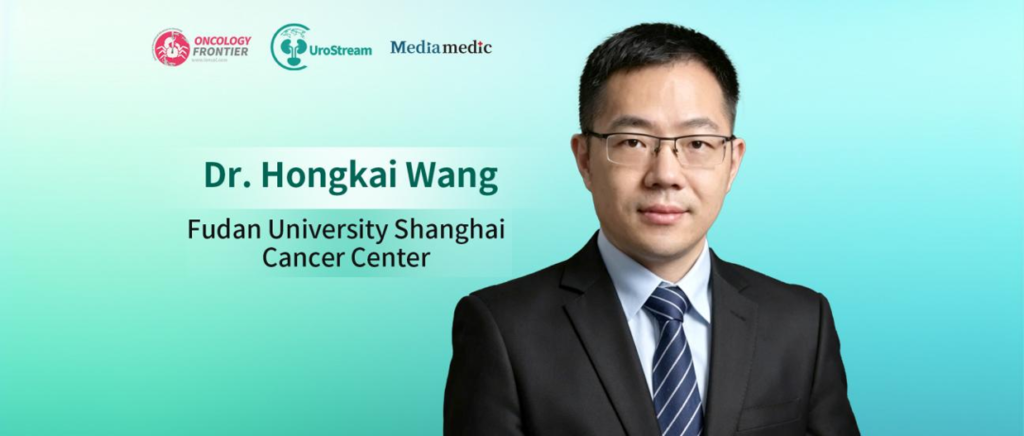
Editor's Note: The 2026 Pujiang Prostate Cancer Academic Conference was successfully held in Shanghai under the central theme of “Standardization, Precision Breakthroughs, Chinese Innovation, and Global Collaboration.” The conference aimed to promote the standardized diagnosis and treatment of prostate cancer in China while advancing key technological innovations. Following the meeting, Oncology Frontier – UroStream invited Professor Hongkai Wang of Fudan University Shanghai Cancer Center to discuss recent innovations in robotic radical prostatectomy, balancing oncological control with functional preservation, and the development of domestically developed surgical robots.01
Oncology Frontier – UroStream: In recent years, robotic radical prostatectomy has continued to evolve toward greater precision and functional preservation. What do you consider the most noteworthy innovations in surgical philosophy today? How have these advances improved postoperative urinary continence and quality of life?
Professor Hongkai Wang: Innovations in prostate cancer treatment concepts and improvements in functional preservation are important drivers of progress in clinical practice. In my view, breakthroughs in functional preservation have primarily focused on two major areas.
First, advances in surgical techniques and a deeper understanding of anatomy. As our understanding of the anatomical structures surrounding the prostate has continued to deepen, we have come to recognize that the extent of resection in traditional radical prostatectomy may sometimes be excessive. Today, with iterative improvements in surgical techniques, particularly the use of robotic surgical systems, we can perform more precise procedures, achieving complete tumor removal while preserving critical structures to the greatest extent possible. For example, precise preservation of the nerves responsible for erectile function and the major blood vessels that support blood supply to the perineum and penis lays the foundation for postoperative functional recovery.
Second, advances in treatment concepts driven by precision imaging technologies. In preserving prostate function, erectile function and urinary continence are among the highest priorities, and achieving these goals depends on accurately identifying tumor location.
During surgery, striking the right balance between functional preservation and oncological radicality is crucial. Excessive tissue preservation may facilitate functional recovery but increase the risk of residual tumor, whereas excessive resection may reduce the risk of residual disease at the expense of functional recovery.
To address this challenge, we have actively incorporated precision imaging technologies to provide a scientific basis for surgical planning. Before surgery, PSMA imaging can be used to precisely localize the tumor and assess its anatomical relationships with critical structures such as the nerves, urethra, and bladder. Based on these findings, we can tailor the surgical plan to each patient and define the boundaries between functional preservation and tumor resection.
In addition, our center is conducting clinical trials of fluorescence imaging, which may provide real-time support for intraoperative decision-making. With robotic fluorescence imaging, surgeons can directly assess surgical margins, lymph node involvement, and invasion of surrounding tissues. Compared with the conventional approach relying on visual inspection, this technology may enable more precise identification of subtle tumor invasion.
If widely adopted in the future, fluorescence imaging could allow surgeons to adjust their strategies in real time based on intraoperative findings, precisely balancing functional preservation with tumor removal.
These technological advances not only facilitate surgical procedures but also improve communication between physicians and patients. For patients who place a high priority on functional preservation, particularly those with strong expectations regarding sexual function, we can use objective imaging findings after surgery to explain the rationale behind surgical decisions. We can clearly inform patients which areas were free of tumor invasion and therefore allowed for optimal functional preservation, and which areas showed invasion, necessitating a wider resection to ensure oncological safety.
02
Oncology Frontier – UroStream: With continued refinements in techniques such as the Hood technique and nerve-sparing surgery, how can clinicians achieve the optimal balance between oncological radicality and functional preservation? Which patients are most likely to benefit from function-preserving surgery?
Professor Hongkai Wang: In prostate cancer treatment, striking the right balance between functional preservation and oncological radicality plays an important role in improving treatment outcomes and patients’ quality of life. Accurately identifying suitable patients is a prerequisite for individualized treatment.
This is because patients’ expectations regarding functional preservation directly influence decisions about surgical risk. For example, men aged over 75 may place less emphasis on recovering sexual function. In such cases, surgeons may not need to accept the potential risk of positive surgical margins associated with nerve preservation and can instead perform a more extensive resection to ensure complete tumor removal.
For younger patients who place greater importance on erectile function and urinary continence, surgeons need to engage in thorough preoperative discussions with them, jointly weigh the benefits and risks, and make every effort to preserve function while ensuring oncological radicality.
Once patients have been appropriately selected and fully informed, an individualized functional preservation strategy can be developed. Precision-based individualized treatment requires a comprehensive assessment, including accurate tumor localization, evaluation of tumor size, assessment of tumor aggressiveness, and careful selection of the surgical approach. Whether the Hood technique or the VIP technique is used, every step requires rigorous consideration.
Intraoperative flexibility and dynamic decision-making are also essential. Even when a comprehensive surgical plan has been established before surgery, adjustments may still be necessary based on actual findings.
For example, if a nerve-sparing procedure is planned but intraoperative findings reveal that the tumor on the right side has invaded the adjacent nerve, the surgeon must promptly adapt the strategy. The left-sided nerve may be fully preserved, while partial preservation on the right side may be considered according to the actual situation. Such individualized adjustments help achieve the optimal balance between oncological radicality and functional preservation.
03
Oncology Frontier – UroStream: Domestic surgical robots have developed rapidly in recent years. Based on your clinical experience, how are domestically developed robots performing in prostate cancer surgery? What key technical aspects still require further improvement?
Professor Hongkai Wang: With strong support from the national strategic framework, China’s domestically developed surgical robotics industry is entering a period of rapid growth. Numerous domestic companies have entered the field, with a wide range of brands emerging and the industry demonstrating vigorous development and healthy competition.
From a clinician’s perspective, we also look forward to seeing more high-quality domestically developed surgical robots enter clinical practice and bring new vitality to medical care.
Overall, domestically developed robots meet established standards in terms of functionality, performance, and operational stability. They can reduce surgical costs, ultimately benefiting a broad range of patients. For this reason, I strongly support the continued development and advancement of domestically developed surgical robots.
Several domestically developed surgical robots have already received market approval, and their operating experience is now very close to that of imported systems. Based on my clinical experience, including my direct participation in clinical trials and surgical demonstrations involving multiple domestic robotic platforms, the differences in operating experience between domestic and imported systems are minimal.
Just recently, we completed a live surgical demonstration featuring both a domestically developed robot and an imported robot. During this joint demonstration, I performed surgery using a domestic robot, while Professor Yao Zhu and Professor Bo Dai performed procedures using imported robotic systems. Professor Yao Zhu also completed a procedure using a domestically developed robot. The surgical times were comparable across the live demonstrations, highlighting the reliability and capabilities of domestically developed robotic systems.
Looking ahead, I hope that more domestically developed surgical robots will be introduced into hospitals and that their excellent performance will help improve surgical outcomes, delivering higher-quality and more efficient medical services to patients.
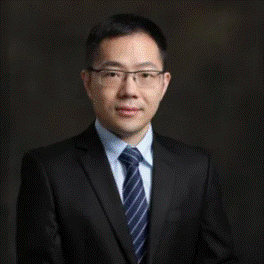
Professor Hongkai Wang