From January 16 to 18, 2026, the Working Meeting of the Chinese Society of Clinical Oncology (CSCO) Leukemia, Lymphoma, and Myeloma Expert Committee and the 2026 CSCO Academic Conference on Hematologic Malignancies were held in Haikou, China. During the meeting, Professor Honghu Zhu of Beijing Chaoyang Hospital, Capital Medical University, provided a comprehensive overview of the current challenges of hematopoietic stem cell transplantation (HSCT) in acute leukemia, the evolution of transplant indications in the era of novel agents, and future optimization strategies. His insights offered important guidance for clinicians seeking to refine treatment approaches.Q1
What key advances has hematopoietic stem cell transplantation achieved in the treatment of acute leukemia in recent years? More importantly, how have transplant strategies undergone adaptive evolution or optimization when integrated with new therapeutic modalities such as targeted agents and immunotherapies?
Professor Honghu Zhu:
The treatment of acute leukemia involves several major therapeutic modalities, including chemotherapy, allogeneic hematopoietic stem cell transplantation (allo-HSCT), targeted therapy, and immunotherapy. Among these, allo-HSCT remains the treatment with the highest curative potential, and in recent years it has played a critical role in improving cure rates for acute leukemia.
However, allo-HSCT is associated with significant adverse effects, particularly organ toxicity and transplant-related complications, such as graft rejection and graft-versus-host disease (GVHD). These factors limit its applicability in a broader patient population, especially among elderly patients. In addition, the high cost of treatment makes transplantation inaccessible for many patients with limited financial resources.
As a result, although the therapeutic value of allo-HSCT is well established, the proportion of patients who can ultimately benefit from this approach remains relatively small. In China, among every 100 patients with acute leukemia, approximately 10 eventually undergo allo-HSCT, and only 6–7 patients derive clear benefit from the procedure.
Therefore, further research is urgently needed to optimize conditioning regimens, reduce transplant-related toxicity, and lower post-transplant relapse rates, with the goal of expanding the eligible population and enabling more patients with acute leukemia to benefit from this potentially curative therapy.
Q2
With the widespread application of targeted and immunotherapies, induction remission rates and survival outcomes in acute leukemia have improved substantially. Have these advances altered the central role of hematopoietic stem cell transplantation? What factors are driving this shift, and how should transplant indications and timing be redefined?
Professor Honghu Zhu:
With the development and clinical application of novel agents, the population eligible for hematopoietic stem cell transplantation has changed markedly.
Taking acute promyelocytic leukemia (APL) as an example, two decades ago transplantation was often considered a primary treatment option after induction remission with all-trans retinoic acid (ATRA) plus chemotherapy. Today, however, APL can be effectively cured using ATRA combined with arsenic-based therapy, without conventional chemotherapy, achieving cure rates exceeding 95%. As a result, transplantation has essentially lost its role in the management of this leukemia subtype.
Similarly, chronic myeloid leukemia (CML) was once treated with transplantation as a first-line strategy. With the advent of tyrosine kinase inhibitors (TKIs), long-term survival rates now exceed 90%, and transplantation has shifted to a second-line option.
The same trend is observed in Philadelphia chromosome–positive acute lymphoblastic leukemia (Ph+ ALL). Historically, transplantation was routinely recommended. Today, with treatment regimens combining third-generation TKIs and CD19 bispecific antibodies, three-year survival rates can reach 90%, surpassing outcomes achieved with transplantation. Consequently, transplantation is increasingly being deferred to second-line therapy in this population as well.
Nevertheless, for high-risk acute leukemia and relapsed or refractory disease, transplantation continues to occupy a firm and irreplaceable position. In recent years, novel agents have improved remission rates in high-risk patients, enabling more individuals to become eligible for transplantation. Moreover, post-transplant maintenance therapy combining targeted agents and immunotherapies has significantly reduced relapse risk, further enhancing transplant outcomes.
Overall, advances in novel therapies have not only refined transplant indications but have also enhanced the overall efficacy of transplantation through combination strategies. In the future, complementary use of different treatment modalities and individualized therapy for appropriate patient populations may further improve overall prognosis in leukemia.
Q3
Looking ahead, to maximize patient benefit, where do you believe transplantation will retain its irreplaceable “core advantages” or “unique clinical niches” in the treatment of acute leukemia? What directions might future transplant development take?
Professor Honghu Zhu:
Among patients with acute leukemia, older adults account for more than 60% of cases. Because elderly patients generally have poor tolerance for conventional myeloablative allo-HSCT, the majority are unable to undergo this treatment.
A key future direction for transplantation is therefore to substantially reduce transplant-related toxicity, allowing more patients aged 60 to 75 years to receive allo-HSCT, while maintaining transplant-related mortality below 20%. Achieving this goal would enable a much larger patient population to benefit from transplantation.
Of course, progress in this area will also depend on continued advances in targeted and immunotherapies. If future novel agents can achieve cure rates approaching those of transplantation, the first-line role of transplantation in certain patient populations may gradually shift to a second-line position.
Expert Biography
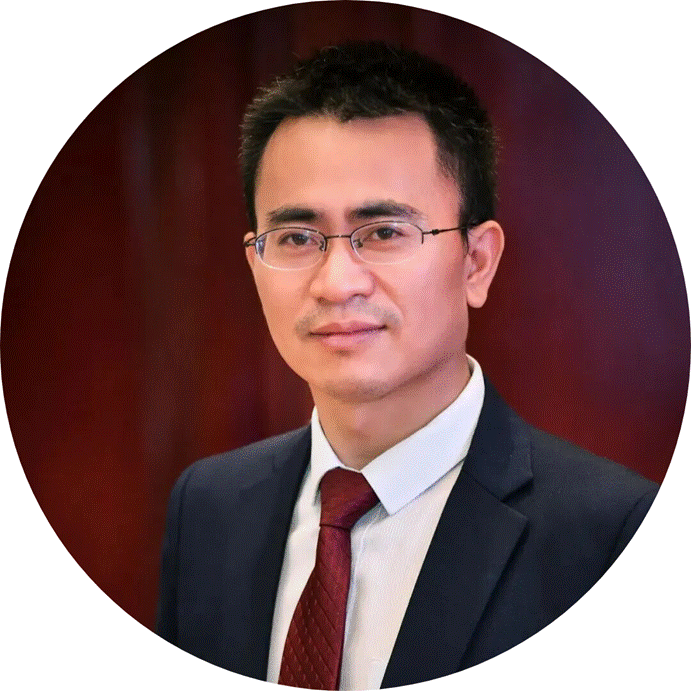
Professor Honghu Zhu
Beijing Chaoyang Hospital,
Capital Medical University
Professor Honghu Zhu is Director of the Department of Hematology at Beijing Chaoyang Hospital, Capital Medical University. He is a Professor, Doctoral Supervisor, and Postdoctoral Co-supervisor, as well as a Senior Research Fellow at the Capital Medical Science Innovation Center.
He currently serves as:
- Vice Chair, CSCO Leukemia Expert Committee
- Member, International APL Foundation Expert Committee
Professor Zhu pioneered the “chemotherapy-free, home-based treatment strategy for APL” and developed the DAV regimen for newly diagnosed acute myeloid leukemia (AML). He was the first internationally to define the novel entity of “RARG-rearranged AML.”
His research findings have been cited in 12 international and Chinese leukemia guidelines and expert consensuses. As first or corresponding author, he has published 69 papers in leading international journals, including The New England Journal of Medicine (2 articles), The Lancet Oncology (1), The Lancet Haematology (2), Journal of Clinical Oncology (1), and Blood (5), with a cumulative impact factor of 1064.
Professor Zhu has led or received funding for one National Key Research and Development Program project, five National Natural Science Foundation of China grants, and multiple major municipal programs, including the Beijing Municipal Science and Technology Commission’s Key Clinical Application Research Project, the Beijing Hospital Authority’s “Sailing Plan”, and the “Summit Talent Program.”