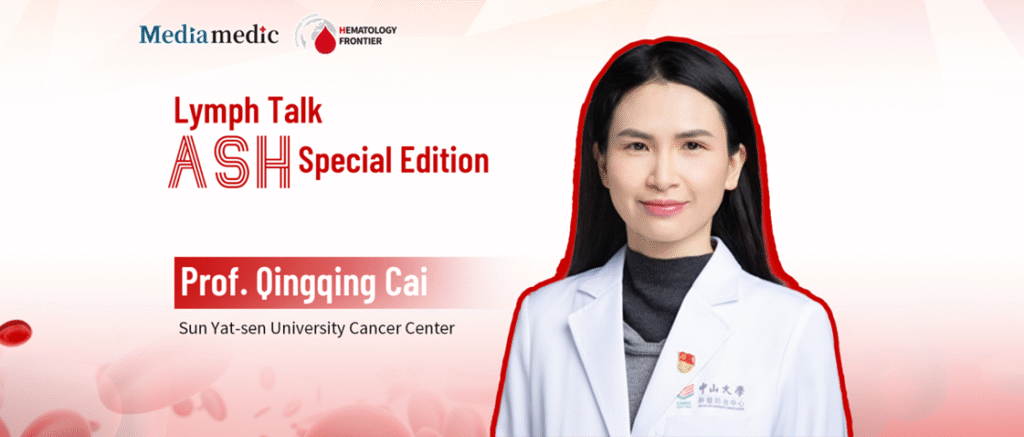
The 2025 Annual Meeting of the American Society of Hematology (ASH 2025) recently concluded successfully in Orlando, USA. As the “year-end flagship event” in hematology, ASH 2025 presented a series of landmark advances in the field of lymphoma, offering new directions for optimizing clinical practice.To better disseminate cutting-edge research and empower real-world decision-making, Oncology Frontier – Hematology Frontier, in collaboration with Qingqing Cai from the Sun Yat-sen University Cancer Center, launched the special column “Lymphoma In-Depth · ASH Special.” Each Friday, this column highlights pivotal lymphoma studies from ASH, decoding frontline data through an authoritative lens and extracting clinically meaningful evidence from complex trial results.
In this issue, Professor Cai focuses on first-line treatment advances in marginal zone lymphoma (MZL), providing an in-depth interpretation of four major ASH 2025 studies, combining evidence-based insights with practical clinical guidance.
Abstract 1003
Mosunetuzumab Plus Lenalidomide as First-Line Therapy for FL and MZL: A Multicenter Phase II Study
Title: Mosunetuzumab with response-driven lenalidomide augmentation achieves high response rates and immune reprogramming in untreated follicular and marginal zone lymphoma Authors: Adam Olszewski, et al.
Background
Mosunetuzumab (Mosun), a CD20×CD3 bispecific antibody, has demonstrated high efficacy in relapsed/refractory follicular lymphoma (FL) and is now being explored in the first-line setting. Lenalidomide (Len), an immunomodulatory agent, enhances T-cell function but is associated with significant toxicity at standard doses. This study evaluated a response-driven immune-enhancement strategy, using fixed-duration Mosun and selectively adding low-dose Len in patients with suboptimal response, aiming to maintain efficacy while minimizing toxicity.
Study Design
Patients with previously untreated, high-tumor-burden FL or MZL requiring therapy received subcutaneous Mosun for eight cycles. Cycle 1 used step-up dosing (Day 1: 5 mg; Days 8 and 15: 45 mg), followed by 45 mg on Day 1 of Cycles 2–8. Patients not achieving complete response (CR) at interim response assessment (IRA) after Cycle 4 received Len (10 mg QD) during Cycles 5–8. Persistent partial response (PR) at Cycle 8 allowed extension to 12 cycles. Primary endpoint: End-of-treatment CR rate (CRR). Secondary endpoints: Safety, ORR, PFS, OS. Exploratory immune analyses included peripheral blood flow cytometry and CD8⁺ T-cell RNA sequencing.
Results
Fifty-two patients were enrolled (median age 65 years; FL 67%, MZL 33%). Forty-three patients were evaluable at EOT.
- Safety: Most common AEs were injection-site reactions (53%), fatigue (45%), and rash (43%). CRS occurred in 27%, all grade 1 and limited to Cycle 1.
- Efficacy: ORR 86%, CRR 84% (FL 81%, MZL 88%). Among FL patients achieving CR, 93% were ctDNA-MRD negative. Twelve-month PFS rate was 87%.
- Immunology: Patients requiring Len had lower baseline NK and activated T-cell levels; differences resolved after combination therapy. Low-dose Len promoted CD8⁺ effector-memory differentiation. Disease progression in cases with occult LBCL transformation was not prevented.
Conclusion
Fixed-duration Mosun with response-driven low-dose Len achieved high CR and MRD-negative rates while sparing most patients Len-related toxicity. Disease progression appeared more related to immune escape than CD20 loss.
Professor Cai’s Commentary: This response-driven, low-dose Len strategy balances efficacy and safety, reflecting a modern approach in indolent lymphoma therapy. While immune reprogramming was observed, histologic transformation and immune escape remain key challenges in the bispecific antibody era.
Abstract 5379
Orelabrutinib Plus Obinutuzumab as First-Line Therapy for MZL: ORION Study
Title: Preliminary analysis of orelabrutinib combined with obinutuzumab in the treatment of marginal zone lymphoma Authors: Rui Lv, et al.
Key Findings
In 33 untreated MZL patients, the chemotherapy-free OG regimen achieved ORR 96.3% and CRR 74.1%, with particularly strong activity in SMZL. Toxicities were predominantly grade 1–2, with no ≥grade 3 events.
Professor Cai’s Commentary: This study supports BTK inhibitor plus anti-CD20 antibody combinations as a promising first-line, chemo-free strategy, especially for high-tumor-burden MZL.
Abstract 3597
Orelabrutinib + Obinutuzumab ± Bendamustine in High-Risk MZL: Orchid Study
Title: Efficacy and safety of first-line orelabrutinib combined with obinutuzumab (with or without bendamustine) in high-risk marginal zone lymphoma Authors: Hu Mao Gui, et al.
Key Findings
Among 20 high-risk patients, 100% CR rate was observed at interim assessment, regardless of chemotherapy addition. Six-month PFS was 90%, with no grade 3–4 toxicities reported.
Professor Cai’s Commentary: Flexible risk-adapted incorporation of chemotherapy aligns with individualized treatment principles and highlights the potency of BTK-based combinations in high-risk MZL.
Abstract 5383
Orelabrutinib + Obinutuzumab + Lenalidomide (GOL) in Untreated MZL
Title: Efficacy and safety of orelabrutinib, obinutuzumab, and lenalidomide in previously untreated marginal zone lymphoma Authors: Wei Wang, et al.
Key Findings
In 23 patients, ORR was 88.9% and CRR 72.2%. All SMZL patients achieved CR, with 83.3% MRD negativity by IgH-DNA sequencing. Toxicities were manageable, with no grade 4–5 events.
Professor Cai’s Commentary: The GOL triplet demonstrates deep molecular responses, particularly in SMZL, offering insights into MRD-guided treatment optimization in chemo-free regimens.
References
- Olszewski A, et al. ASH 2025 Abstract 1003.
- Lv R, et al. ASH 2025 Abstract 5379.
- Hu MG, et al. ASH 2025 Abstract 3597.
- Wang W, et al. ASH 2025 Abstract 5383.
Authors

Qingqing Cai, MD, PhD Professor of Medicine | Chief Physician | Doctoral Supervisor Sun Yat-sen University Cancer Center
- Deputy Director, Department of Medical Oncology
- Principal Investigator (PI), Lymphoma Program
- Distinguished Professor, Changjiang Scholars Program, Ministry of Education
Academic and Professional Appointments
- Chair, Committee of Integrative Medicine in Lymphoma, Chinese Anti-Cancer Association (CACA)
- Chair, Lymphoma Committee, Guangdong Anti-Cancer Association
- Chair, Lymphoma Committee, Guangdong Precision Medicine Application Society
- Vice Chair, Lymphoma Committee, Chinese Society of Clinical Oncology (CSCO)
- Vice Chair, Lymphoma Committee, China Association of Geriatric Health Care
Research and Academic Achievements Professor Cai has served as national leading principal investigator or site PI for multiple registration clinical trials. Over the past five years, she has published more than 20 SCI-indexed papers as corresponding (including co-corresponding) author in top-tier international journals such as The Lancet Haematology, Blood, Signal Transduction and Targeted Therapy, Clinical Cancer Research, and Leukemia.
She has led five National Natural Science Foundation of China (NSFC) grants, including:
- One Key Project
- Three General Projects
- One Key R&D Program supported by the Ministry of Science and Technology
Awards

Bijing Wu, MD Doctoral Researcher (Class of 2025) Department of Medical Oncology Sun Yat-sen University Cancer Center
- Academic (Research-track) PhD Candidate
- Supervisor: Qingqing Cai, MD, PhD