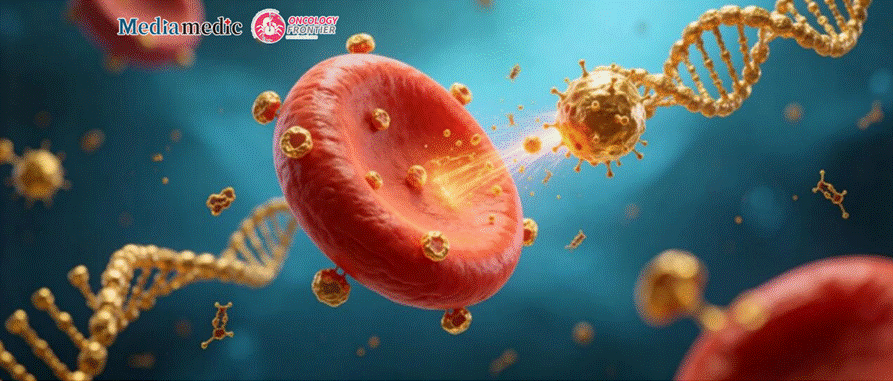
Mature red blood cells (RBCs), the only anucleate blood cells in the human body, have long been regarded simply as carriers of oxygen and carbon dioxide. But do they harbor previously unrecognized biological functions? Could they play an unexpected role in cancer diagnostics?In December 2025, a research team led by Academician Binghe Xu from the National Cancer Center/Cancer Hospital, Chinese Academy of Medical Sciences, together with Professor Conghua Xie and Professor Zongbi Yi from Zhongnan Hospital of Wuhan University, published an original study in Advanced Science entitled “Red Blood Cells Internalize Extracellular DNA via Apoptotic Bodies with Clinical Relevance to Cancer Patients.” This work systematically demonstrates for the first time that mature red blood cells can actively internalize extracellular cell-free DNA and identifies apoptotic bodies as the key vehicles through which tumor DNA enters red blood cells.
This discovery not only expands our understanding of red blood cell biology, but also opens an entirely new source of DNA for liquid biopsy—red blood cell–derived DNA (rbcDNA)—which shows unique clinical potential in tumor burden monitoring and treatment response assessment.
Take-Home Messages
- Mature red blood cells can actively internalize extracellular DNA, overturning the traditional view of RBCs as purely anucleate, inert cells.
- Apoptotic bodies are the primary carriers mediating the entry of tumor DNA into red blood cells.
- RBCs carrying tumor DNA undergo oxidative damage, morphological alterations, and accelerated clearance, potentially leading to localized immunosuppression in the spleen.
- Although rbcDNA is less sensitive than cfDNA for detecting driver mutations, its abundance correlates with tumor burden and treatment response, providing a new dimension for liquid biopsy.
A Paradoxical Observation: The “DNA Mystery” of Anucleate Red Blood Cells
The study began with a paradoxical finding in mature red blood cells from patients with lung cancer: DNA was detected inside cells that should, in principle, be completely devoid of genetic material.
Confocal microscopy revealed that DNA within red blood cells from lung cancer patients (Hoechst staining, blue) was diffusely distributed, in stark contrast to the compact nuclear localization seen in nucleated cells such as PC9 lung cancer cells. Using silver-stained polyacrylamide gel electrophoresis (PAGE) and atomic force microscopy (AFM), the authors found that rbcDNA consisted predominantly of distinct short DNA fragments.
Further quantitative sequencing using Oxford Nanopore long-read sequencing provided a comprehensive landscape of rbcDNA, confirming that its fragment size distribution was markedly different from that of leukocyte genomic DNA. rbcDNA was enriched in short fragments (<1 kb) and intermediate-length fragments (1–8 kb).
Together, these findings provide compelling evidence that mature red blood cells are not a “DNA desert,” but instead harbor a unique, fragmented DNA repertoire.
Tracing the Origin: Where Does the DNA Come From? Apoptotic Bodies Come into Focus
Where do these DNA fragments originate? Are they remnants retained from erythroid precursors, or are they acquired from the extracellular environment?
To address this question, the researchers conducted a series of elegant in vivo and in vitro experiments.
In vivo, red blood cells from mice bearing PC9 lung cancer cell–derived xenograft (CDX) tumors were found to contain human tumor DNA, with rbcDNA levels positively correlated with tumor burden. This directly demonstrated that circulating RBCs can capture and carry tumor-derived DNA in vivo.
In vitro, co-culture of human red blood cells with lung cancer cells (PC9 or A549), or even incubation with tumor cell culture supernatant alone, resulted in a marked increase in DNA fluorescence within RBCs. More convincingly, when RBCs were co-cultured with tumor cells harboring a specific EGFR L858R mutation, Sanger sequencing detected the same mutation within rbcDNA, confirming that red blood cells can internalize extracellular tumor DNA.
How does DNA enter red blood cells? The investigators turned their attention to apoptotic bodies, vesicular structures generated during programmed cell death. They found that treatment of RBCs with tumor-derived apoptotic bodies most efficiently increased intracellular DNA content. When apoptotic bodies were pretreated with DNase to degrade their DNA, this effect was abolished. These results firmly establish apoptotic bodies as the primary transport vehicles for tumor DNA uptake by red blood cells.
Consequences and Impact: How Does DNA Uptake Alter Red Blood Cells?
What happens to red blood cells after they acquire exogenous DNA, and how might this affect the host?
Using scanning and transmission electron microscopy, the researchers observed profound morphological and functional damage in RBCs exposed to tumor-derived apoptotic bodies. These changes included Heinz body formation, irregular cell shapes (echinocytes, flattened or spherocytic cells), and membrane disruption. Intracellular reactive oxygen species (ROS) levels were elevated, indicating oxidative stress. These RBCs also externalized phosphatidylserine, a classic “eat-me” signal, via vesicle shedding.
In a rat model, apoptotic body–treated RBCs were rapidly cleared within 6 hours after reinfusion, predominantly through phagocytosis by splenic macrophages.
Notably, clearance of these RBCs did not trigger a strong systemic inflammatory response. Instead, it led to a locally immunosuppressive microenvironment in the spleen. RNA sequencing of splenic tissue revealed downregulation of pathways related to inflammation and innate immunity. This suggests that tumors may indirectly suppress local immune surveillance by “contaminating” red blood cells and promoting their clearance.
Clinical Value: rbcDNA vs. cfDNA—Which Is the Better Biomarker?
Given that red blood cells can carry tumor DNA, what is their potential value in clinical testing, particularly liquid biopsy?
The investigators performed a head-to-head comparison between rbcDNA and the current gold standard, circulating cell-free DNA (cfDNA). The study analyzed blood samples from 71 patients with lung diseases, the majority of whom (69.0%) had stage III–IV advanced lung cancer, reflecting real-world liquid biopsy applications. Among these, 19 patients underwent high-depth targeted sequencing for detailed comparison of rbcDNA and cfDNA.
For detection of EGFR driver mutations, high-depth targeted sequencing showed that rbcDNA had lower sensitivity (50%) and specificity (73.3%) than cfDNA (75% and 100%, respectively). Digital PCR further confirmed that the absolute copy number of tumor-mutant DNA in rbcDNA was far lower than in cfDNA. These findings indicate that rbcDNA is not an ideal substitute for cfDNA in driver mutation detection.
However, rbcDNA demonstrated other clinically relevant features. Its concentration was significantly positively correlated with tumor burden indicators, including N2–3 lymph node metastasis, M1 distant metastasis, and maximum tumor diameter >30 mm. In longitudinal monitoring, changes in rbcDNA levels were highly concordant with CA125 tumor marker dynamics and disease control rate (DCR). This suggests that rbcDNA abundance may serve as a novel biomarker for monitoring tumor burden and treatment response.
Methylation-based origin analysis revealed that short rbcDNA fragments closely resembled cfDNA, likely representing internalized tumor DNA, whereas intermediate-length fragments were more likely derived from residual nuclear material of erythroid precursor cells. Modeling of targeted sequencing data estimated that only ~4%–27% of rbcDNA sequences originated from cfDNA, explaining the dilution of tumor signal in rbcDNA.
Summary and Outlook: Opening a New Door
This study fundamentally reshapes our understanding of mature red blood cells. Beyond their traditional role as gas transporters, RBCs may also function as scavengers or reservoirs of extracellular DNA. Through apoptotic bodies as key intermediaries, tumor-derived genetic information is transferred into red blood cells—affecting RBC survival and potentially contributing to tumor-associated immune modulation and anemia.
By simultaneously invigorating the fields of red blood cell biology and cancer liquid biopsy, this work opens multiple new research avenues. Future directions include optimizing rbcDNA extraction and enrichment methods, exploring its applicability across different cancer types, and elucidating the role of RBC–apoptotic body interactions in the tumor microenvironment and cancer-related anemia.

Academician Binghe Xu

Professor Conghua Xie

Professor Zongbi Yi