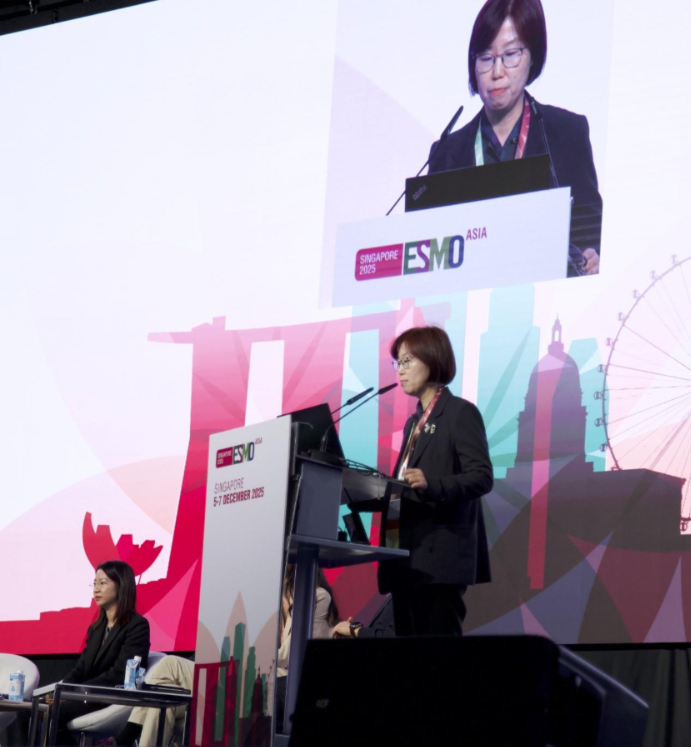
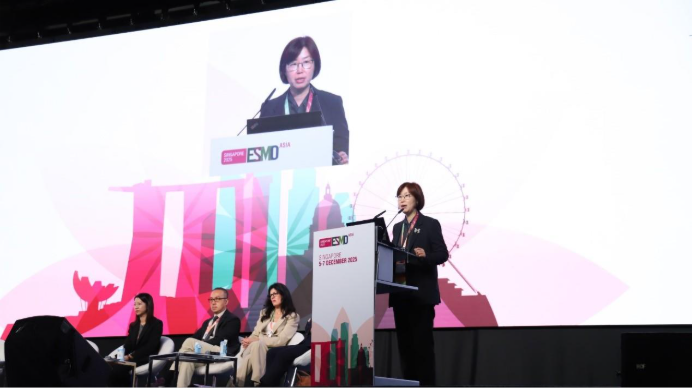
Editor’s Note: In a recent academic presentation, Prof. Do-Youn Oh (Seoul National University College of Medicine) shared updated long-term results from the Asian subgroup of the Phase III KEYNOTE-859 study, confirming the durability of pembrolizumab plus chemotherapy as first-line therapy for advanced HER2-negative gastric or gastroesophageal junction (GEJ) adenocarcinoma.
Study Rationale and Asian Subgroup
KEYNOTE-859 evaluated pembrolizumab plus chemotherapy (CAPOX or FOLFOX) versus placebo plus chemotherapy in previously untreated advanced HER2-negative gastric/GEJ adenocarcinoma, establishing this regimen as a global first-line standard.
Of 1,579 patients enrolled globally, 525 were Asian (China, Hong Kong, Japan, South Korea, Taiwan). Baseline characteristics were well balanced; 90% had gastric primaries, 25% had prior gastrectomy or esophagectomy, and 98.5% received CAPOX. Median follow-up reached 52.4 months, enabling robust long-term assessment.
Overall Survival: Sustained Benefit
After 52.4 months, pembrolizumab plus chemotherapy continued to show durable overall survival benefit. The OS hazard ratio was 0.74, corresponding to a 26% reduction in death risk.
The 3-year OS rate was 24% with pembrolizumab versus 16% with chemotherapy alone, an absolute improvement of 8%, consistent across key subgroups.
Progression-Free Survival
Long-term progression-free survival benefit was maintained, with a PFS hazard ratio of 0.71. The 3-year PFS rate reached 19% in the pembrolizumab arm versus 15% with chemotherapy alone, confirming durable efficacy in Asian patients.
Safety: No New Signals
Extended follow-up revealed no new safety concerns. Grade 3–4 treatment-related adverse events occurred in 58% of the pembrolizumab group versus 44% with placebo. Discontinuation due to adverse events was reported in 26% and 16% of patients, respectively. Fatal treatment-related events were rare (1 with pembrolizumab, 2 with placebo).
Conclusion
Prof. Oh concluded that the 52.4-month follow-up from the KEYNOTE-859 Asian subgroup confirms durable survival benefit and manageable long-term safety of pembrolizumab plus chemotherapy. The improvement in 3-year OS (24% vs 16%) and sustained risk reduction (HR 0.74) reinforce this regimen as the first-line standard of care for advanced HER2-negative gastric or GEJ adenocarcinoma in Asian patients.
Disclosure: This content is AI-generated. Cross-platform reprinting or redistribution is prohibited.
hashtag#KEYNOTE859 hashtag#GastricCancer hashtag#GEJCancer hashtag#ImmunoOncology hashtag#Pembrolizumab hashtag#AsianOncology hashtag#ClinicalTrials