2025 CCHIO CACA–NCCN Summit Review**
Editor’s Note: The 2025 China Conference on Holistic Integrative Oncology (CCHIO)—hosted by the China Anti-Cancer Association (CACA) and the Tengchong Scientist Forum Organizing Committee Office, and co-hosted by the World Association of Integrative Oncology (WAIO) and the China Institute for Integrative Medicine Development Strategy—was held in Kunming, Yunnan, from November 6 to 9, 2025.
To explore global trends in cancer prevention and control and to build a high-quality international academic exchange platform, the conference featured an “International Organization Special Session” co-organized by CACA and ten leading global oncology organizations.
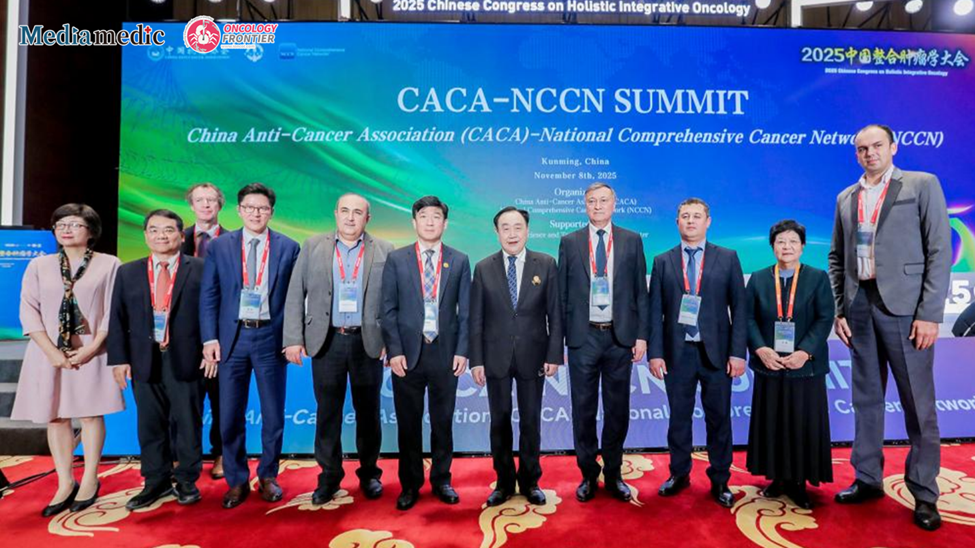
Among these, the CACA–NCCN Summit, jointly convened by CACA and the U.S. National Comprehensive Cancer Network (NCCN), was successfully held on November 8. Experts from China and the United States gathered to discuss key topics including integrative oncology practice, guideline development models, and the global implementation of authoritative cancer guidelines.
The summit aimed to promote the standardization and advancement of cancer diagnosis and treatment through shared insights from two major oncology systems.

This CACA–NCCN Summit was co-chaired by Academician Fan Daiming, President of the China Anti-Cancer Association (CACA), and Professor Crystal Denlinger, Chief Executive Officer (CEO) of the National Comprehensive Cancer Network (NCCN). Professor Hao Jihui of Tianjin Medical University Cancer Institute and Hospital served as Executive Chair.

△ Professor Hao Jihui
The academic session was moderated and commented on by Professor Hao Jihui, together with Professor Li Menghong from the Gastroenterology Research Institute of the Sixth Affiliated Hospital of Sun Yat-sen University, Professor Yuan Peng from the Cancer Hospital, Chinese Academy of Medical Sciences, and Professor Lu Huaiwu from Sun Yat-sen Memorial Hospital of Sun Yat-sen University.

△ Professor Yuan Peng

△ Professor Li Menghong

△ Professor Lu Huaiwu

The first academic lecture of the summit was delivered by Academician Fan Daiming, titled “The Development of Integrated Cancer Management in China.”
Academician Fan systematically outlined China’s newly proposed model of “Holistic Integrative Medicine” for addressing cancer challenges. He emphasized that China differs significantly from Western countries in cancer etiology and population characteristics—such as the high prevalence of HBV-related hepatocellular carcinoma—making a full reliance on international guidelines insufficient for China’s needs.
To address this gap, CACA organized 13,000 experts to jointly develop the China Guidelines for Holistic Integrative Oncology (CACA Guidelines). These guidelines integrate modern Western precision medicine with the holistic principles of traditional Chinese medicine, forming a full-cycle management system covering prevention, screening, treatment, and rehabilitation, grounded in evidence generated from China’s own clinical data.
Through nationwide outreach such as online lectures reaching hundreds of millions, the launch of the English journal HIO, and the establishment of the World Association of Integrative Oncology (WAIO), this model has already produced major impact—China’s five-year cancer survival rate has increased by 10% over the past decade.
Looking ahead, the CACA Guidelines will continue to enhance cancer survival outcomes domestically while contributing a “China Solution” to global cancer control.

△ Academician Fan Daiming
Professor Crystal Denlinger then delivered her lecture titled “NCCN Guidelines on a Global Scale,” introducing the worldwide implementation and impact of the NCCN Clinical Practice Guidelines.
The NCCN, composed of 33 leading cancer centers across the United States, has spent the past 30 years committed to promoting guideline-based oncology practice to ensure effective, equitable, and accessible cancer care globally. To date, NCCN has developed 90 Clinical Practice Guidelines, covering 97% of cancer patients in the United States, including guidelines for supportive care, screening and prevention, and treatment for specific populations.
The guidelines are created by 64 expert panels and were updated over 240 times last year. A strict firewall policy ensures that guideline development remains fair, unbiased, and independent. All NCCN recommendations are categorized by “Levels of Evidence and Consensus,” with most recommendations falling under Category 2A, meaning they are supported by the best available evidence and more than 85% expert consensus.
NCCN Guidelines exert enormous global influence, with over 7.5 million downloads per year, and China is the second-largest user of NCCN guidelines worldwide. To enhance global applicability, NCCN also provides multilingual translations, a four-tier resource stratification framework tailored for low- and middle-income settings, and 88 international adaptations to date. For example, NCCN has collaborated with the CACA Gynecologic Oncology Committee to adapt multiple gynecologic cancer guidelines.
Looking forward, Professor Denlinger expressed NCCN’s strong interest in deepening collaboration with CACA, advancing mutual learning, and jointly promoting progress in global cancer prevention and control.
△ Professor Crystal Denlinger

Professor Wu Jiong from Fudan University Shanghai Cancer Center presented the CACA Breast Cancer Guidelines, which constitute the breast cancer section of the China Integrated Oncology Prevention and Treatment Guidelines. He elaborated on the core philosophy of the guidelines and the development process behind them.
Breast cancer incidence in China continues to rise. Not only is the number of patients large, but the 5-year survival rate remains only 81%, which is 11.6% lower than in the United States. Chinese breast cancer patients also present unique challenges, including a younger age at onset, low screening participation (only 22%), and low rates of breast-conserving and reconstructive surgery.
To address these challenges, the CACA Guidelines adopt the “integrated medicine” philosophy advocated by Academician Fan Daiming, placing comprehensive, patient-centered management throughout the entire disease trajectory at the core. They deeply integrate surgery, chemotherapy, radiotherapy, and holistic care. Compared with international guidelines, the CACA Guidelines provide more detailed descriptions of surgical procedures and adjuvant treatment workflows to better guide clinicians in general surgery and related disciplines in delivering standardized care.
The 2025 edition highlights four guiding principles:
1. New concepts in diagnostic classification
- New tools for precision treatment
3. New paradigms in comprehensive therapy
4. New standards for surgical practice
The guidelines also emphasize establishing an MDT model tailored to China’s healthcare realities. Additionally, they incorporate numerous Chinese innovations and the latest clinical research conducted by Chinese investigators—such as advances in antibody–drug conjugates (ADCs), treatment de-escalation strategies in HER2-positive breast cancer, and electroacupuncture to alleviate chemotherapy-induced nausea and vomiting.
Looking ahead, CACA will continue to promote an integrated medicine model for breast cancer management and actively strengthen international academic exchange and collaboration.

△ Professor Wu Jiong
Joining the summit online, Professor Nadeem Abu-Rustum from Memorial Sloan Kettering Cancer Center (MSKCC) presented on the global dissemination and international adaptation of the NCCN Gynecologic Oncology Guidelines.
Professor Abu-Rustum noted that NCCN guidelines are recognized worldwide for their continuous and rapid dynamic updates, consistently incorporating the latest clinical research findings. The guideline development process also emphasizes real-time collaboration across different NCCN guideline panels, ensuring alignment and coherence among related disease areas.
In promoting the guidelines globally, NCCN employs a structured “resource-stratification framework,” enabling clinicians in various countries to adapt the original recommendations based on local healthcare resources. In addition, some international expert panels contribute their experience back to NCCN, allowing these insights to inform and improve the original NCCN guidelines—a truly bidirectional model of collaboration.
In terms of international adaptation, the NCCN Gynecologic Oncology Guidelines have produced four successful cases so far:
- The Chinese Edition of NCCN Gynecologic Oncology Guidelines, jointly developed with the CACA Gynecologic Oncology Committee
- Collaborative adaptations with Saudi Arabia, Poland, and sub-Saharan Africa
Notably, the partnership with the African Cancer Coalition has facilitated research on region-specific challenges such as advanced vulvar cancer in HIV-positive populations, fully demonstrating the value and global impact of NCCN’s guideline adaptation efforts.
△ Professor Nadeem Abu-Rustum — Presentation

At the close of the summit, Professor Hao Jihui and Professor Crystal Denlinger jointly chaired the concluding session and delivered remarks on behalf of experts from China and the United States.
Professor Denlinger emphasized that NCCN and CACA share deeply aligned missions and working philosophies—both are committed to patient-centered and human-oriented cancer prevention and treatment. She highlighted that the two organizations not only focus on cancer therapies themselves but also place equal importance on supportive care, emotional management, and psychosocial support. Both NCCN and CACA strive to advance oncology practice through evidence-based guidelines and to promote cancer prevention through patient and public education. Professor Denlinger expressed her hope that the two sides will continue to collaborate closely to ensure that patients worldwide receive the right treatment and to collectively reduce the global cancer burden.
On behalf of CACA, Professor Hao Jihui expressed sincere gratitude to all participating experts and offered high praise for the NCCN delegation’s contributions. He noted that the friendship and cooperation between CACA and NCCN will continue to strengthen and expand, and that clinical guidelines will become a vital bridge connecting the United States, China, and the global oncology community in the shared fight against cancer.