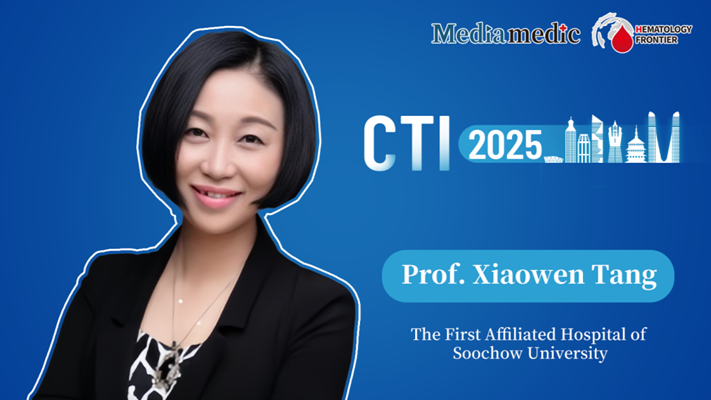
To promote innovation in China’s cell and immunotherapy fields, deepen scientific exchange, and accelerate translation through global collaboration, the 2025 International Cell & Immunotherapy Conference (CTI 2025) was held on November 13–16, 2025, in Hangzhou, Zhejiang. Organized by Zhejiang University, the International Academy for Clinical Hematology (IACH), the Zhejiang Society of Immunology, and the Zhejiang Anti-Cancer Association, and co-hosted by the First Affiliated Hospital of Zhejiang University School of Medicine and Liangzhu Laboratory, the conference gathered international leaders in the field. During the meeting, Hematology Frontier invited Prof. Xiaowen Tang from the First Affiliated Hospital of Soochow University to discuss challenges, innovations, and future directions in conditioning strategies for high-risk acute lymphoblastic leukemia (ALL).
Q1
Prof. Tang, how effective are current standard conditioning regimens for high-risk ALL, and what major limitations remain?
Prof. Tang explained that in ALL—particularly high-risk disease—the central goal of conditioning is to eliminate minimal residual disease (MRD) and create space for donor stem cell engraftment. This process resembles “clearing the cage before introducing new birds,” meaning that leukemia cells must be removed to enable reconstruction of a healthy hematopoietic system.
Standard conditioning must be sufficiently intensive. Total body irradiation (TBI) combined with cyclophosphamide and the widely used modified BuCy “Beijing regimen” (busulfan plus cyclophosphamide) remain the dominant approaches. While TBI can be effective, it carries significant limitations, including acute radiation-related toxicities such as pneumonitis and pericarditis, risks of endothelial injury such as sinusoidal obstruction syndrome, and long-term complications including cataracts and secondary malignancies. Access to TBI is also limited because it requires specialized equipment. Therefore, in patients without extramedullary disease, chemotherapy-based conditioning—particularly modified BuCy—has become standard.
Busulfan plus cyclophosphamide is effective for many patients. Yet for ultra–high-risk groups, such as those who fail to achieve remission before transplant or those with TP53 mutations or adverse genetic rearrangements, the depth of disease clearance may still be inadequate. The field’s major challenge, Prof. Tang noted, is how to enhance anti-leukemic potency while avoiding increased transplant-related mortality. Achieving “more efficacy without more toxicity” is the central goal of future conditioning refinement.
Q2
What strategies has your team used to improve conditioning for high-risk ALL, and how does MRD status guide regimen selection?
Prof. Tang described two complementary optimization directions. First, for patients unable to achieve MRD-negative remission, disease clearance should be deepened before conditioning. This may include the use of blinatumomab or CAR-T therapy, which bypass classical chemoresistance pathways and greatly improve remission depth while reducing relapse risk after transplant.
Second, conditioning must be optimized through mechanistic innovation rather than by simply increasing chemotherapy intensity. Strategies such as combining venetoclax with azacitidine before sequential modified BuCy, or integrating agents with different mechanisms such as navitoclax or other targeted therapies, aim to enhance leukemia eradication while maintaining safety. The goal is precise, synergistic conditioning tailored to patient biology.
Q3
Your team explored venetoclax plus azacitidine (VA) sequentially with modified BuCy. Which patients benefit most from this regimen?
Prof. Tang noted that for patients who remain refractory after multiple lines of chemotherapy—even after blinatumomab or CAR-T therapy—the need to strengthen conditioning becomes particularly urgent. Venetoclax, widely used in lymphoma, multiple myeloma, and AML, is increasingly applied in ALL due to its distinct mechanism. Together with azacitidine, it reshapes apoptotic pathways, disrupts mitochondrial membrane stability, suppresses oxidative phosphorylation and glycolysis, and interferes with the metabolic support of leukemia stem cells. Because relapse often originates from persistent stem cells, this combination may achieve deeper eradication than conventional regimens.
Based on this rationale, the team integrated VA with modified BuCy to enhance total anti-leukemic potency. In clinical practice, the VA + BuCy regimen did not increase conditioning toxicity. Day-100 transplant-related mortality was zero, and neutrophil and platelet engraftment times were comparable to standard BuCy. The main adverse event was mucositis, which was reversible and manageable. Rates of acute and chronic graft-versus-host disease, and of CMV and EBV reactivation, did not exceed those seen with traditional regimens.
Efficacy results were also encouraging. One-year overall survival and leukemia-free survival both approached 90 percent. Importantly, this benefit extended to ultra–high-risk subgroups, including patients with TP53 mutations, KMT2A (MLL) rearrangements, ZNF384 fusions, and Ph-like ALL, all of whom typically have very poor prognosis. Thus, for high-risk B-ALL patients poorly responsive to standard therapies, VA followed by modified BuCy may provide unexpectedly favorable long-term outcomes and represents a highly promising conditioning strategy.


Expert Profile

Xiaowen Tang, MD, PhD
Professor and Deputy Director, Department of Hematology First Affiliated Hospital of Soochow University Chief Physician; Doctoral Supervisor
Prof. Tang specializes in hematopoietic stem cell transplantation and cellular immunotherapy. He serves as a national committee member of the Hematology Branch of the Chinese Medical Doctor Association, deputy leader of the Hematopoietic Stem Cell Transplantation Working Group of the Chinese Medical Association Hematology Branch, and holds multiple leadership roles in transplantation and immunotherapy societies across China.
He has led major national research projects, including a key joint program of the National Natural Science Foundation of China, three general program grants, and numerous provincial and municipal initiatives. His scientific work has been recognized by national and provincial awards, including the National Science and Technology Progress Award (Second Class). He has pioneered sixteen new technologies and therapies, holds two granted national invention patents, and has four pending.
Prof. Tang has published 47 SCI articles as first or corresponding author, including in Journal of Clinical Oncology and Journal of Hematology & Oncology, with a cumulative impact factor of 344.9. His highest-impact paper (IF 42.1) has been cited 353 times and ranks among the top 1% globally by citation frequency.