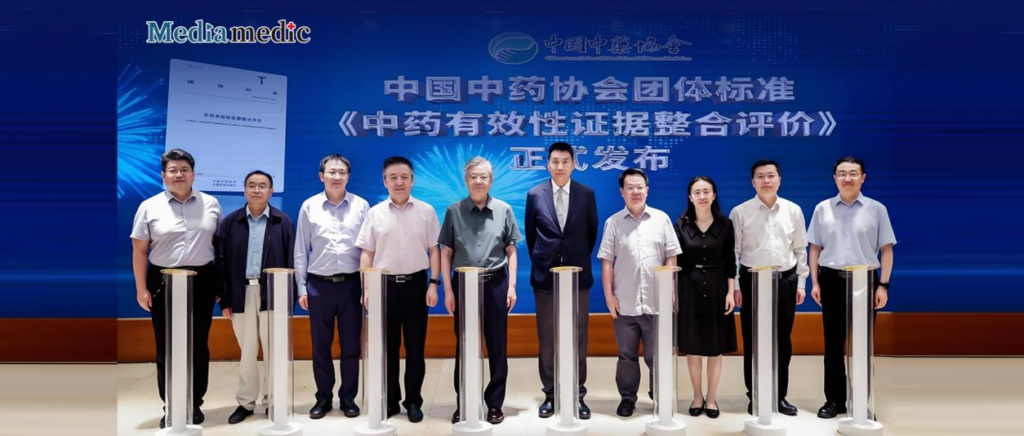
Recently, the China Association of Chinese Medicine (CACM) Group Standard, Integrated Evaluation of Evidence on the Efficacy of Traditional Chinese Medicine was officially released in Beijing. As the world’s first guiding standard for the integrated evaluation of evidence on the efficacy of traditional Chinese medicine (TCM), the standard was jointly developed under the leadership of Researcher Xiao Xiaohe, Professor Wang Jiabo, Academician Tian Jinzhou, Academician Chen Xiangmei, and Professor Dai Aiguo, with the participation of more than 60 leading experts from 13 universities, research institutes, medical institutions, and pharmaceutical companies across China, including the Chinese PLA General Hospital, Capital Medical University, Beijing University of Chinese Medicine, and Hunan University of Chinese Medicine.The Integrated Evaluation of Evidence on the Efficacy of Traditional Chinese Medicine group standard was officially released in Beijing. (From left: Cheng Long, Xiao Xiaohe, Xie Zhangshu, Wu Xian, Wang Qi, Tian Jinzhou, Zhao Junning, Li Dejuan, Cheng Jiuyan, and Wang Jiabo.)
The release of the Integrated Evaluation of Evidence on the Efficacy of Traditional Chinese Medicine was accompanied by an academic symposium. The symposium was hosted by the China Association of Chinese Medicine and co-organized by the School of Traditional Chinese Medicine at Capital Medical University, the Fifth Medical Center of the Chinese PLA General Hospital, the Chinese Society of Traditional Chinese Medicine’s Committee on Chinese Patent Medicines, the Chinese Pharmaceutical Association’s Committee on Clinical Chinese Pharmacy, and Chengdu Kanghong Pharmaceutical Group Co., Ltd. More than 60 academicians, experts, scholars, and industry representatives attended the meeting.
At the symposium, Researcher Xiao Xiaohe and Professor Wang Jiabo provided detailed interpretations of the standard, covering its development background, core framework, technical principles, application value, and plans for implementation and promotion. Academicians and experts in attendance discussed and reviewed the standard in depth. Participants agreed that the standard represents a pioneering achievement in the global evaluation of TCM efficacy and marks a milestone in advancing evidence-based regulation and the high-quality development of TCM. Experts and scholars also engaged in extensive discussions on its clinical translation, industry application, and pathways toward international dissemination, putting forward practical and actionable recommendations.
Expert Perspectives: From the “Evidence Pyramid” to a “Complete Evidence Chain”
Academician Wang Qi emphasized that the standard uses the integrated evidence chain methodology as its core, reforming the evaluation system for TCM efficacy and promoting a paradigm shift in evidence-based medicine from the traditional “evidence pyramid” toward a “complete evidence chain.” This approach enables different types of evidence to reinforce and cross-validate one another. He noted that the contribution of the standard lies not only in reshaping the concepts and principles underlying evidence evaluation for TCM, but also in addressing limitations in modern medicine when evaluating functional diseases and individualized treatment outcomes, while offering an important pathway for tackling the increasingly complex challenge of multimorbidity worldwide. According to Wang Qi, the publication of the standard provides a Chinese approach to evidence-based evaluation in traditional medicine worldwide.
Academician Tian Jinzhou pointed out that the standard’s most significant innovation is its departure from the notion that randomized controlled trials (RCTs) should be the sole form of valid evidence. The integrated evidence chain methodology fully reflects the distinctive strengths of TCM, particularly its emphasis on clinical practice and bidirectional translation. He noted that the standard directly addresses the urgent need to implement China’s “three-in-one” evaluation approach for TCM, clearly grading and quantifying evidence from classical medical texts, the experience of renowned and senior TCM practitioners, and hospital-developed formulations. In doing so, it transforms traditionally qualitative human-use experience into standardized evidence that can be assessed and compared.
Tian Jinzhou emphasized that the standard balances academic rigor with practical applicability for the pharmaceutical industry. It provides a unified and objective framework for developing guidelines for chronic and complex diseases, supporting health insurance assessment, and other applications, while also establishing an important bridge for the international registration of TCM products.
Researcher Zhao Junning stated that the standard balances adherence to established principles with openness and innovation. While compatible with mainstream international frameworks, it also preserves the distinctive characteristics of TCM. He noted that the standard could facilitate mutual recognition of evidence for traditional medicines both domestically and internationally, helping TCM and natural medicines expand into global markets.
Filling a Critical Gap: From the “Three-in-One” Policy to a Practical Tool
Wu Xian, Executive Vice President of the China Association of Chinese Medicine, noted in his opening remarks that standardization provides fundamental support for the modernization, industrialization, and internationalization of TCM. Based on the original integrated evidence chain methodology, the standard establishes a three-dimensional framework encompassing clinical experience as initial evidence, experimental research as supporting evidence, and clinical trials as confirmatory evidence, thereby translating China’s “three-in-one” policy into a quantitative and standardized approach that can be implemented consistently.
Li Dejuan, Deputy Director of the Beijing Municipal Administration of Traditional Chinese Medicine, noted that the newly released group standard directly addresses several bottlenecks facing the industry and provides an operational and practical evaluation tool for TCM drug development, industrial advancement, and internationalization. She emphasized that the value of a standard ultimately depends on its application in practice. Going forward, efforts should focus on training and dissemination, monitoring real-world implementation, and establishing effective feedback mechanisms to facilitate continuous refinement and optimization, ensuring that the standard remains scientifically sound, advanced, and practical.
Integrated Evidence Chain Methodology: A New Approach to Transforming TCM Evaluation
In response to the limitations of relying solely on RCT-based evaluation for assessing the efficacy of TCM, the standard adopts the principle of “integrating diverse forms of evidence while preserving the distinctive characteristics of TCM.” It establishes a new efficacy evaluation system that is tailored to the characteristics of TCM while remaining compatible with international medical standards, enabling a more appropriate and individualized approach to evaluating TCM efficacy.
In response to the opportunities and needs of the evolving TCM sector, the team led by Researcher Xiao Xiaohe developed a new conceptual framework and evaluation paradigm for TCM efficacy and proposed the Integrated Evidence Chain methodology (Eff-iEC) for the first time internationally.
This methodology moves beyond the limitations of an RCT-only approach by establishing a multidimensional evidence loop comprising clinical experience, experimental research, and clinical trials, corresponding to initial evidence, supporting evidence, and confirmatory evidence. Through this framework, the efficacy of TCM can be evaluated in a more scientific, objective, and comprehensive manner.
Expert Forum: Exploring Full-Chain Approaches to Advancing High-Quality Development of the TCM Industry
A roundtable discussion focused on the dissemination and implementation of the standard, translational application, continuous refinement, international communication, and the development of evidence-based medicine, resulting in a number of practical recommendations.
Experts agreed that the standard can integrate fragmented forms of evidence and establish evaluation principles for treating different diseases with the same therapeutic approach, as well as different diseases presenting with similar symptoms. This could help facilitate a transformation in the paradigm of clinical research. Participants called for the establishment of an open platform to promote the application, validation, and continuous refinement of the standard.
Experts also noted that the standard’s underlying philosophy is aligned with the goals of comprehensive value assessment in the healthcare insurance system. Greater coordination with health insurance value-assessment frameworks could provide an evidence base for reimbursement decision-making and support the high-quality development of the TCM industry.
Participants further noted that the standard provides a common evaluation language across medical services, pharmaceutical products, and healthcare insurance, helping establish an evidence chain connecting drug assessment, clinical application, and reimbursement decisions, and facilitating a shift from experience-driven to evidence-driven decision-making.
The standard may also provide technical support for differentiated pricing based on the quality and value of Chinese patent medicines and could potentially align with international drug-selection criteria, helping address challenges surrounding the selection of Chinese patent medicines in general hospitals. Its ability to integrate multiple forms of evidence may also provide a useful reference and measurement framework for the translation of hospital preparations, institutional formulations, and validated clinical prescriptions into new drug development. Pharmaceutical companies can likewise use the standard as a framework for product evaluation.
According to the organizers, research related to the Integrated Evidence Chain methodology for evaluating TCM efficacy has been published in leading domestic and international journals, including Acta Pharmaceutica Sinica B (APSB), and was selected as one of the Top 10 Academic Advances in Traditional Chinese Medicine in 2024.
Based on this body of research, the Integrated Evaluation of Evidence on the Efficacy of Traditional Chinese Medicine establishes a clear overall architecture and comprehensive evaluation framework, combining theoretical innovation, industry leadership, clinical relevance, and practical applicability.
The standard can be applied to the efficacy evaluation of classical formulas, clinically experienced formulations, hospital-developed prescriptions, marketed Chinese patent medicines, new TCM drugs, ethnic medicines, and overseas botanical medicines. It can also provide methodological reference for evaluating the efficacy of non-pharmacological traditional therapies such as moxibustion and tuina. The standard is intended for professionals involved in TCM research and development, clinical practice, pharmaceutical regulation, drug procurement and supply, education, and training.