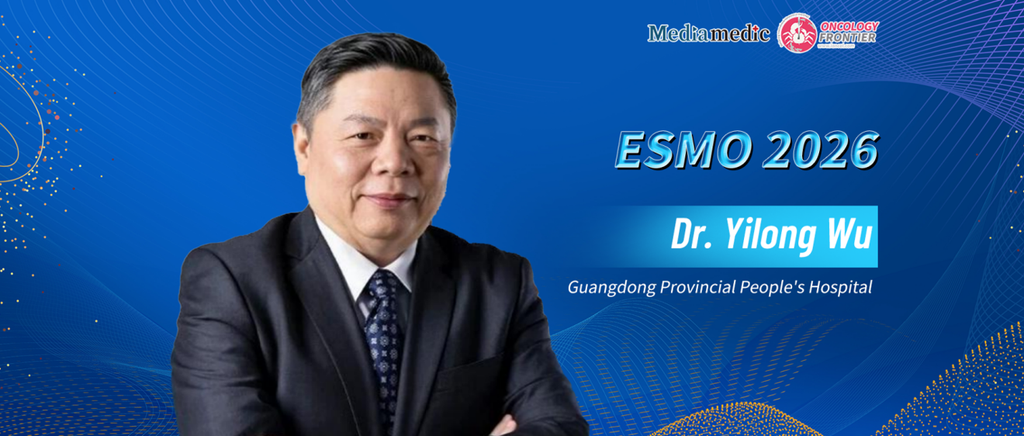
In driver gene-positive non-small cell lung cancer (NSCLC), mesenchymal-epithelial transition factor (MET) abnormalities represent an important bypass resistance mechanism in patients with epidermal growth factor receptor (EGFR) mutations. Primary MET overexpression is also often associated with poor efficacy of EGFR tyrosine kinase inhibitor (TKI) monotherapy. How to overcome resistance through precision treatment and achieve more refined patient stratification in the first-line setting remain pressing challenges for the global lung cancer community.At the 2026 European Society for Medical Oncology (ESMO) Congress, the Phase III SANOVO study, led by Professor Yilong Wu’s team at Guangdong Provincial People’s Hospital, was selected as a late-breaking abstract (LBA). The study evaluated savolitinib plus osimertinib as first-line treatment for patients with EGFR-mutated NSCLC and MET overexpression. During the congress, Oncology Frontier invited Professor Yilong Wu for an exclusive interview. Drawing on the latest SANOVO data, he discussed the precision stratification and clinical value of dual EGFR/MET targeting, shared insights into treatment decisions following EGFR-TKI resistance, and explored broader trends in lung cancer drug development.
Oncology Frontier: Congratulations on your team’s SANOVO study being presented at this year’s ESMO Congress. Based on the study results, could you discuss the clinical value of this “all-oral dual-targeted” strategy in the first-line treatment of patients with EGFR-mutated NSCLC and MET overexpression? What implications do these findings have for reshaping the first-line treatment landscape?
Professor Yilong Wu: At the lung cancer oral presentation session of the 2026 ESMO Congress, I presented these important findings on behalf of the SANOVO study team. The study enrolled treatment-naïve patients with advanced NSCLC harboring EGFR mutations and MET overexpression. Patients were randomly assigned to receive savolitinib plus osimertinib (the dual-targeted arm) or placebo plus osimertinib (the monotherapy arm). The study achieved its intended objectives, demonstrating positive results for both progression-free survival (PFS) and overall survival (OS).
Among patients with MET immunohistochemistry (IHC) 3+ expression, median PFS reached 24.8 months in the dual-targeted arm, significantly longer than the 11.1 months observed in the monotherapy arm (HR 0.45). In the overall intention-to-treat (ITT) population, median PFS was 24.9 months with dual-targeted therapy, also significantly longer than the 13.8 months with monotherapy (HR 0.56). Even more encouragingly, median OS in the ITT population reached 44.5 months, significantly longer than the 34.9 months in the monotherapy arm (HR 0.48), representing a 52% reduction in the risk of death.
The international attention this study has attracted stems from three major advances.
First, the study used a testing method with high clinical accessibility. Previous biomarker investigations targeting MET often failed to achieve their expected outcomes. In contrast, this study successfully identified the population benefiting from treatment using the conventional MET IHC method.
Second, this is the first study in the first-line EGFR-mutated setting to validate the feasibility of selecting patients based on MET overexpression as a biomarker. Previously, it was generally believed that only driver gene alterations such as mutations, fusions, or amplifications had value as targets for therapeutic intervention. This study establishes MET protein overexpression as an important reference biomarker for precision stratification in the first-line setting.
Third, these findings further confirm the importance of precision intervention based on specific molecular biomarkers. A median OS of 44.5 months represents a substantial survival benefit in first-line lung cancer treatment and provides a strong evidence base for the EGFR/MET dual-targeted strategy.
Oncology Frontier: At this year’s ESMO Congress, which innovative therapies or strategies for managing resistance to EGFR-TKIs left the strongest impression on you? How might the emergence of these drugs with novel mechanisms reshape subsequent treatment decision-making and sequencing?
Professor Yilong Wu: Managing resistance to tyrosine kinase inhibitors (TKIs) in patients with EGFR mutations is currently a central focus of clinical research. Existing second-line treatment strategies include combination therapies guided by resistance mechanisms, conventional chemotherapy, immunotherapy, bispecific antibodies, and antibody-drug conjugates (ADCs). However, most previous second-line studies did not apply rigorous biomarker-based patient selection, which limited their overall efficacy.
Two important advances presented at this year’s congress illustrate the trend toward precision intervention.
The first is targeted intervention based on resistance mechanisms. The SAFFRON study is the first global clinical trial to validate MET amplification/overexpression as a specific resistance mechanism. The data showed that osimertinib plus savolitinib significantly prolonged median PFS compared with chemotherapy (7.6 months vs. 5.4 months; HR 0.55). Median OS was also significantly improved (17.8 months vs. 12.9 months; HR 0.68). These findings establish dual-targeted intervention as a treatment strategy when a specific resistance mechanism has been identified.
The second is the continued evolution of ADCs. In the second-line setting, ADCs have generally achieved PFS of approximately 6–7 months, while adverse events remain a major clinical challenge. At this congress, the OptiTROP-Lung04 study reported the final OS analysis comparing the TROP2-targeted ADC sacituzumab tirumotecan with chemotherapy. Median OS reached 25.9 months, significantly longer than the 17.4 months in the chemotherapy arm (HR 0.69). These data confirm its OS benefit and establish its position in second-line treatment. Nevertheless, the toxicity of ADCs still requires close attention.
In addition, the HERON-Lung01 study, led by my team, evaluated the efficacy of SHR-A2009, an HER3-targeted ADC independently developed in China, compared with chemotherapy. Through optimization of the drug-to-antibody ratio (DAR = 4) and payload design, this drug aims to balance efficacy and safety. The results showed that median PFS assessed by blinded independent central review (BICR) was 8.3 months, significantly longer than the 5.4 months in the chemotherapy arm (HR 0.47). The objective response rate (ORR) reached 60.0%, while the incidence of interstitial lung disease (ILD) was only 2%, demonstrating a profile characterized by high efficacy and low toxicity.
Overall, second-line and later-line treatment strategies are evolving in two main directions: first, targeted intervention guided by precise biomarker-based patient selection; and second, the development of novel ADCs with higher therapeutic indices and lower toxicity.
Oncology Frontier: With an increasingly broad range of later-line options, including dual-targeted therapies and ADCs, what is the clinical value of dynamic circulating tumor DNA (ctDNA) monitoring in guiding precision treatment switching and sequencing after resistance develops? What are the key barriers that still need to be overcome before it can genuinely change clinical decision-making?
Professor Yilong Wu: As later-line treatment options continue to expand, the central clinical challenge has shifted toward the overall planning and optimization of treatment strategies. Clinical decisions must now be highly individualized rather than based on a single standardized approach.
At different stages of treatment, we need to balance each patient’s expected benefit against potential risks. For example, younger patients with a high tumor burden and good performance status may be more suitable for potent but relatively more toxic treatments, such as bispecific antibodies or ADCs, in an effort to secure better survival outcomes. For elderly patients or those with poor performance status, treatment options with lower toxicity should be prioritized.
Therefore, dynamic monitoring based on biomarkers such as ctDNA is particularly important for guiding treatment sequencing. By capturing molecular changes over time, we can select treatments more precisely for individual patients and ensure that they receive the most appropriate therapy at the optimal time.
Oncology Frontier: In light of the positive results with tarlatamab in the first-line maintenance setting for extensive-stage small cell lung cancer (ES-SCLC), how do you think novel-mechanism therapies such as T-cell engagers (TCEs) will reshape the overall treatment pathway for small cell lung cancer?
Professor Yilong Wu: On the first day of the congress, the DeLLphi-305 study presented data on first-line maintenance treatment with tarlatamab, a DLL3/CD3 bispecific antibody, at the Presidential Symposium. These findings mark a major shift in the treatment landscape for ES-SCLC.
Previously, the standard treatment for ES-SCLC consisted of chemotherapy combined with immunotherapy, followed by immunotherapy maintenance, with median OS remaining around 12 months for a prolonged period. In this study, introducing tarlatamab maintenance after first-line induction therapy increased median OS to 21.1 months, compared with 12.7 months in the control arm (HR 0.42). Median PFS also increased from 1.9 months to 7.4 months (HR 0.34).
Observing an almost twofold improvement in OS in a large Phase III study is rare in the history of solid tumor treatment and represents a substantial therapeutic breakthrough. However, it also raises new clinical questions. Previously reported data for B7-H3-targeted ADCs (HR 0.46) were based on a patient cohort treated with chemotherapy and immunotherapy. With the introduction of TCEs in the first-line maintenance setting, it remains to be established whether patients who progress after prior TCE treatment can also benefit from ADCs. This requires further validation. The strategy for comprehensive management of SCLC is undergoing a systematic transformation.
Oncology Frontier: Looking ahead, as treatment options continue to expand with novel targeted therapies, immunotherapy combinations, ADCs, and TCEs, what fundamental changes do you think are taking place in the treatment paradigm for lung cancer and thoracic malignancies more broadly? What are your expectations for clinical practice and drug development over the next few years?
Professor Yilong Wu: As a member of the Lung Cancer Scientific Committee of this year’s ESMO Congress, I participated throughout the abstract review and program development process. Looking at the overall trends at the congress, two points deserve particular attention.
First, the globalization of research from China needs to accelerate. Chinese researchers contributed a large number of high-quality studies to this year’s congress, but most were still based exclusively on data from China. Innovative drugs developed in China should not be limited to benefiting domestic patient populations; they should also aim to benefit patients worldwide. In the future, international multicenter clinical trials will be essential to promoting the global translation of research achievements from China.
Second, the development of novel drugs requires continuous optimization. New-mechanism therapies, including ADCs and bispecific antibodies, are emerging rapidly, although some studies have not achieved their expected outcomes. The key priorities going forward will be to improve the efficacy and safety of these novel therapies through more precise target selection and optimization of drug structure.
Overall, lung cancer diagnosis and treatment are moving toward an increasingly precise approach. Whether we are discussing targeted therapy, immunotherapy, or ADCs, the ultimate objective of drug development and clinical decision-making remains the same: to accurately identify the patients most likely to benefit and optimize the balance between treatment risks and benefits.