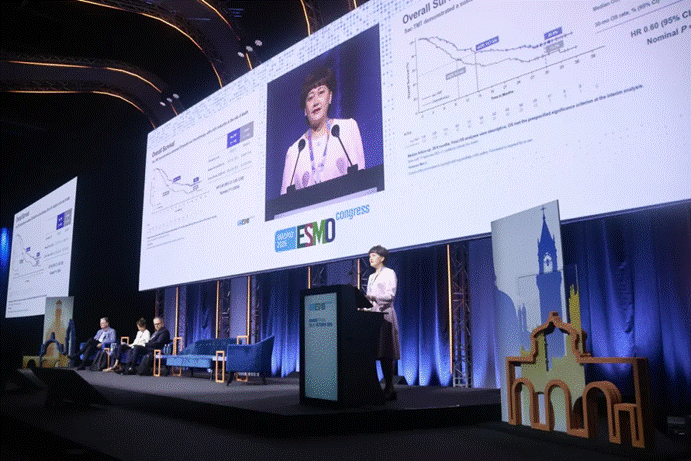
Editor's Note: The 2026 European Society for Medical Oncology (ESMO) Congress was held in Madrid, Spain, from October 23 to 27. Professor Man Li of the Second Hospital of Dalian Medical University presented the final overall survival (OS) analysis of the Phase III OptiTROP-Breast01 study of sacituzumab tirumotecan (Sac-TMT) in a Rapid Oral presentation (Abstract No. 4639RO). The results were also published in the internationally renowned oncology journal Annals of Oncology. Against this background, Oncology Frontier invited Professor Man Li to discuss the latest findings, the characteristics of the survival benefit with extended follow-up, and the implications for the treatment landscape of previously treated locally recurrent or metastatic triple-negative breast cancer (mTNBC).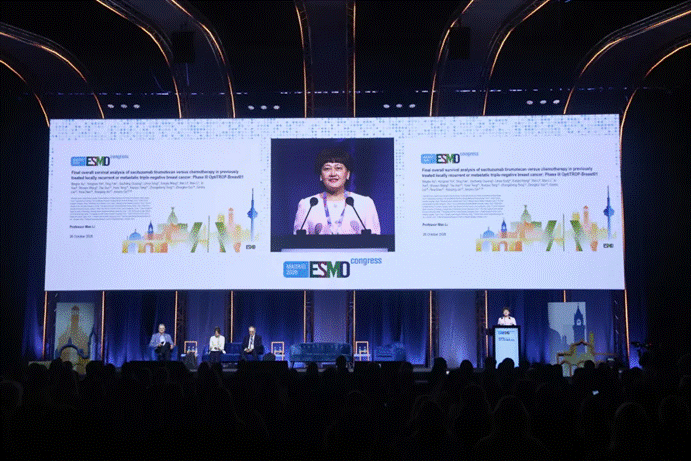
Oncology Frontier: You presented the final OS analysis of the OptiTROP-Breast01 study at this year’s ESMO Congress. Could you introduce the latest results and explain the key updates in this final analysis compared with previous reports?
Professor Man Li: At this year’s ESMO Congress, I presented the final OS analysis of OptiTROP-Breast01, a domestic, multicenter, randomized, controlled Phase III clinical trial. The study enrolled 263 patients with locally recurrent or metastatic TNBC who had received at least two prior lines of therapy and whose disease had progressed following taxane treatment. Patients were randomized 1:1 to receive sacituzumab tirumotecan or treatment of physician’s choice (TPC), which consisted of chemotherapy regimens selected by the treating physician.
The primary endpoint was progression-free survival (PFS) assessed by blinded independent central review (BICR). Secondary endpoints included OS, objective response rate (ORR), and investigator-assessed PFS, among others. A total of 130 patients were enrolled in the sacituzumab tirumotecan arm and 133 in the chemotherapy arm. The data cutoff for the final OS analysis was September 17, 2025, and the median follow-up reached 29.4 months. At this relatively mature follow-up point, several important updates emerged.
First, at the interim analysis, median OS (mOS) had not yet been reached in the sacituzumab tirumotecan arm (NE; 95% CI, 11.2 months–NE), while mOS in the chemotherapy arm was 9.4 months (95% CI, 8.5–11.7). Nevertheless, a statistically significant OS benefit had already been demonstrated (HR, 0.53; 95% CI, 0.36–0.78; P=0.0005). With longer follow-up, the final OS analysis showed an mOS of 14.7 months with sacituzumab tirumotecan versus 9.9 months with chemotherapy (HR, 0.60; 95% CI, 0.45–0.80; P=0.0004), confirming that the benefit observed at the interim analysis was maintained with extended follow-up.
Second, the longer follow-up allowed us to observe more mature long-term survival data. The 24-month OS rates were 33.8% versus 21.4%, respectively, and the 30-month OS rates were 26.8% versus 13.2%. Third, 27.8% of patients in the chemotherapy arm subsequently received ADC treatment. The study also conducted an adjusted analysis accounting for subsequent ADC therapy. After adjustment, mOS was 14.7 versus 9.4 months, with an HR of 0.55 (95% CI, 0.39–0.73). This demonstrates that the survival benefit of sacituzumab tirumotecan remained clear even after accounting for the potential impact of subsequent treatment. In addition, no new safety signals were observed.
Oncology Frontier: After nearly 30 months of follow-up, the final OS analysis of OptiTROP-Breast01 showed an mOS of 14.7 months with Sac-TMT versus 9.9 months with chemotherapy (HR, 0.60). The 24- and 30-month OS rates were 33.8% versus 21.4% and 26.8% versus 13.2%, respectively. How do you interpret the extent to which these final results sustain and reinforce the survival benefit observed at the interim analysis? What does the “long-tail” effect seen in the survival curves with extended follow-up mean for clinical practice?
Professor Man Li: I believe the way the final analysis sustains and reinforces the interim results is reflected mainly in two aspects.
The first is statistical robustness. At the interim analysis, the HR of 0.53 was based on a relatively early data cutoff, and median OS in the sacituzumab tirumotecan arm had not yet been reached. Now, with nearly 30 months of follow-up, a greater number of events have accumulated, and mOS is 14.7 versus 9.9 months in the two arms, representing an absolute difference of nearly five months. This is a meaningful result in previously treated mTNBC, a population with a very poor prognosis. The HR of 0.60 in the final OS analysis further demonstrates that the benefit was not simply a chance fluctuation in early data, but one that has stood the test of time.
The second aspect is the “long-tail” effect, which may have even greater implications for clinical practice. The 24-month OS rates were 33.8% versus 21.4%, and the 30-month OS rates were 26.8% versus 13.2%. The two OS curves remained separated beyond two years, and more than one-quarter of patients in the sacituzumab tirumotecan arm survived for over 30 months. This means that the benefit was not merely the result of a temporary reduction in tumor size; rather, a proportion of patients achieved substantial long-term survival. Patients with previously treated metastatic TNBC generally have a poor prognosis. Extending survival beyond two years for a proportion of these patients is, in itself, a meaningful improvement.
From a clinical perspective, this “long-tail” effect conveys an important message: sacituzumab tirumotecan does more than simply extend median survival by a few months. It can achieve relatively durable disease control in a proportion of patients. Of course, we still need to further investigate which molecular or clinical characteristics are associated with a greater likelihood of experiencing this long-tail benefit. That will be an important focus of future research. However, we can already tell patients that this drug offers the possibility of more durable survival than traditional chemotherapy.
Oncology Frontier: The study showed generally consistent OS benefits across prespecified subgroups, including patients with prior exposure to PD-1/PD-L1 inhibitors and those with HER2-low disease. Considering the subgroup data and final OS results, how do you think this study will affect the treatment landscape for patients with previously treated locally recurrent or metastatic TNBC? What are your perspectives on the role of TROP2 ADCs in TNBC and the directions for future research?
Professor Man Li: The consistency of benefit across subgroups is a particularly important finding of this study. The direction of the OS benefit was generally consistent both in patients who had previously received PD-1/PD-L1 inhibitors and in those with HER2-low disease. This means that, in clinical practice, clinicians do not need to hesitate about using sacituzumab tirumotecan simply because a patient has previously received immunotherapy or has HER2-low disease. These are precisely the patient populations in which effective subsequent treatment options are needed in the current mTNBC treatment landscape.
Impact on the treatment landscape: Based on the OptiTROP-Breast01 data, sacituzumab tirumotecan has been approved in China for patients with unresectable locally advanced or metastatic TNBC who have previously received at least two systemic therapies, including at least one treatment in the advanced or metastatic setting. The final OS data further strengthen the level of evidence supporting its use in this setting. When making treatment decisions for previously treated mTNBC, sacituzumab tirumotecan should be considered an option with clear evidence of survival benefit, rather than being evaluated solely on the basis of PFS and response rates. The findings in these two subgroups also give us greater confidence when selecting treatments for patients in clinical practice.
Regarding the role and future development of TROP2 ADCs, current directions include combination with immunotherapy, investigation in earlier lines of treatment, and use in special populations such as patients with brain metastases. OptiTROP-Breast01 provides a solid foundation for the use of TROP2 ADC monotherapy in later-line treatment. Future studies need to determine whether the benefit can be brought into earlier treatment settings and whether combination strategies can further expand the population that benefits. Long-term safety management is also important. Adverse events such as stomatitis and hematologic toxicity require appropriate supportive care in clinical practice to help patients continue treatment and derive sustained benefit.
In summary, the final OS data from OptiTROP-Breast01 provide a more complete body of evidence supporting sacituzumab tirumotecan in previously treated mTNBC. They also establish a stronger foundation for future investigations into its use in earlier treatment settings and in combination strategies.