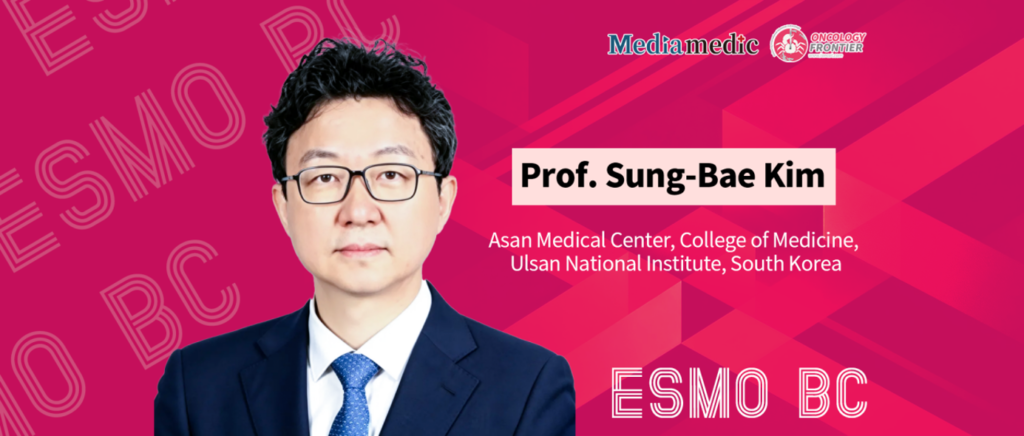
Editor’s Note: During the “Adjuvant Therapy for Hormone Receptor-Positive Early Breast Cancer” session at the 2026 ESMO Breast Cancer Congress (ESMO BC), Professor Sung-Bae Kim from Asan Medical Center, University of Ulsan College of Medicine, delivered an insightful presentation entitled “Adjuvant CDK4/6 Inhibitors: Could They Replace Chemotherapy for Intermediate-Risk ER+ Early Breast Cancer?” Following the session, Professor Sung-Bae Kim spoke with Oncology Frontier and further elaborated on the key concepts presented in his talk.Professor Sung-Bae Kim
“My name is Sung-Bae Kim, and I am a medical oncologist at Asan Medical Center in Seoul, Korea. It is a pleasure to connect with everyone virtually. As a breast medical oncologist, I had the privilege of serving as Co-Chair of the ESMO BC Scientific Committee from 2021 to 2023, so this meeting holds special meaning for me. I have also been very pleased to see the conference continue to grow over the years. ESMO BC is not only an outstanding platform for learning about the latest advances, but also an important opportunity for colleagues to build professional connections.
This year, I participated as a speaker in a session focused on the treatment of patients with early breast cancer, specifically HR-positive/HER2-negative early breast cancer with intermediate-risk features.
As new evidence continues to emerge, adjuvant CDK4/6 inhibitors have demonstrated meaningful clinical benefit. Data from studies such as monarchE and NATALEE have shown improvements in invasive disease-free survival (iDFS), while overall survival (OS) results have also appeared highly encouraging.
However, in the NATALEE trial, approximately 12% of patients did not receive neoadjuvant chemotherapy. This raised an important question that became the focus of my presentation: could CDK4/6 inhibitors combined with endocrine therapy potentially replace chemotherapy in selected patients?
At present, we do not yet have mature phase III clinical trial data capable of definitively answering this question, although several relevant studies are ongoing. Nevertheless, evidence from trials such as TAILORx and RxPONDER suggests that the benefit of chemotherapy in intermediate-risk populations may actually be limited.
While some benefit was observed in premenopausal subgroups, it remains unclear whether this effect was driven by chemotherapy itself or by chemotherapy-induced amenorrhea and ovarian function suppression.
Against this background, gene expression profiling has already enabled us to identify patients who are highly sensitive to endocrine therapy and who may safely forgo chemotherapy.
Although definitive phase III evidence is still lacking, the existing data are becoming increasingly compelling, and this is a question well worth exploring further. Therefore, the key message I hoped to convey in my presentation was this: it is still too early to conclude that CDK4/6 inhibitors can fully replace chemotherapy. However, for carefully selected patients with intermediate-risk HR-positive/HER2-negative early breast cancer, chemotherapy-free adjuvant strategies incorporating CDK4/6 inhibitors may represent a reasonable option. Importantly, such decisions must be based on shared decision-making between physicians and patients.
Looking ahead, approaches such as escalation and de-escalation strategies guided by circulating tumor DNA (ctDNA), together with the integration of novel oral selective estrogen receptor degraders (SERDs), are likely to bring truly transformative advances to the optimization of treatment for HR-positive early breast cancer. These are areas we must continue to actively investigate in the years ahead.”
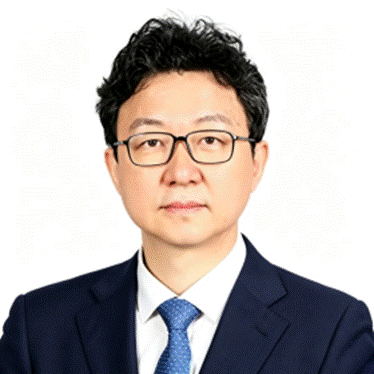
Sung-Bae Kim