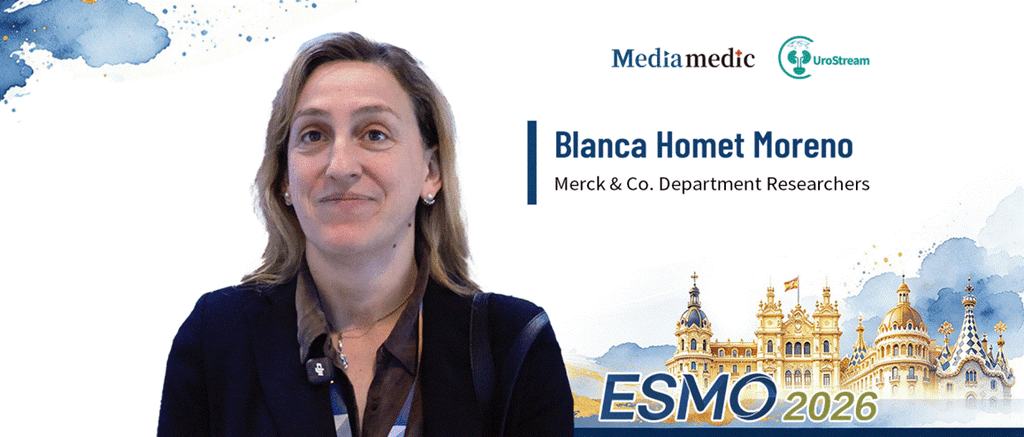
Editor's Note: The 2026 European Society for Medical Oncology (ESMO) Congress presented findings from several studies in genitourinary cancers. Among the key topics were differences in the results of studies investigating perioperative chemotherapy combined with immunotherapy, patient selection for bladder-preserving treatment, and emerging approaches combining antibody–drug conjugates (ADCs) with immunotherapy. These developments raise important questions for bladder cancer treatment. How should new evidence influence established clinical perspectives? As treatment options continue to expand, how can clinicians better define individualized treatment pathways for patients? Oncology Frontier – UroStream invited Blanca Homet Moreno, a researcher in the oncology division of Merck & Co., for an interview to share her observations and perspectives on these topics.
Perioperative Treatment: New Considerations Arising from Divergent Study Results
Oncology Frontier – UroStream: Which findings presented at this year’s ESMO Congress challenged established approaches to genitourinary cancer treatment or offered new perspectives on existing strategies? How do you interpret these findings?
Blanca Homet Moreno: Among the most clinically relevant findings presented at this year’s congress were two Phase III randomized controlled trials conducted in cisplatin-eligible patients. Both studies focused on the perioperative setting and compared the efficacy of chemotherapy combined with immunotherapy against chemotherapy alone. Ultimately, both trials reported negative results.
Notably, these findings differ significantly from the positive results of the earlier NIAGARA study. Against the background of the existing body of evidence, how to interpret the heterogeneity in results across these studies, and what implications this heterogeneity has for perioperative treatment strategies, have become important scientific questions requiring further investigation.
The research not only focuses on the key findings of these two trials but also places particular emphasis on analyzing their potential implications for clinical practice. Overall, I consider these developments among the key scientific advances presented at this year’s congress, with the potential to significantly influence treatment decisions for patients in the near future.
Bladder Preservation: From Identifying Suitable Patients to Selecting the Right Treatment Pathway
Oncology Frontier – UroStream: As treatment options for genitourinary cancers continue to expand, what are the most important challenges that clinical decision-making needs to address? How can clinicians better select among different treatment strategies?
Blanca Homet Moreno: Given that ADCs combined with immunotherapy have demonstrated clinical value in the treatment of muscle-invasive bladder cancer (MIBC), the central scientific question that now needs to be addressed is how to accurately identify patients who can safely undergo bladder-preserving treatment and determine which patients still require radical surgery.
Clinical decision-making regarding bladder preservation involves two sequential steps. The first is to assess whether a patient meets the clinical criteria for safely retaining the bladder. The second, once eligibility for bladder preservation has been established, is to identify the optimal individualized bladder-preserving treatment strategy.
Throughout this decision-making process, biomarker testing and comprehensive clinical assessment will both play essential roles.
ADC-Based Combination Therapy: Longer Follow-Up Needed to Clarify the Clinical Positioning of New Regimens
Oncology Frontier – UroStream: Among the new efficacy data and follow-up results presented at this year’s ESMO Congress, what evidence do you consider most important when determining whether a treatment can deliver meaningful long-term benefits to patients?
Blanca Homet Moreno: This year’s congress presented clinical data from an exploratory study of sacituzumab tirumotecan (Sac-TMT) combined with pembrolizumab as first-line treatment. This study is of considerable academic interest, with its key innovation lying in the use of a differentiated ADC target and payload design.
Based on the results reported to date, the clinical efficacy demonstrated by this combination appears broadly comparable to previously reported data from ADCs carrying monomethyl auristatin E (MMAE) as the payload when combined with immunotherapy. The efficacy signals observed with combination regimens using different targets and payloads are worth continued attention from the research community.
A clearer assessment of the clinical value and future prospects of this regimen will only be possible as follow-up continues and the data mature. This approach may offer a new first-line treatment option, and its potential to move into earlier lines of treatment is also worth exploring. However, whether it can ultimately establish itself as a new standard of care will need to be confirmed by subsequent follow-up results.
Conclusion
This interview focused on three key questions in bladder cancer treatment: how to interpret differences in perioperative study results, how to identify patients suitable for bladder-preserving treatment through the combined use of biomarkers and clinical assessment, and how to evaluate the future potential of new ADC–immunotherapy combinations.
Emerging evidence continues to deepen our understanding of bladder cancer treatment, while placing greater emphasis on patient selection and the choice of individualized treatment pathways. For combination regimens that remain under investigation, the current efficacy signals merit attention, but their long-term benefits and clinical positioning require further clarification through more mature follow-up data.
Blanca Homet Moreno
Researcher, Oncology Division, Merck & Co.