

To promote innovation in China’s cell therapy and immunotherapy fields, advance discussion of key scientific challenges, share the latest clinical research, and strengthen global collaboration and translational progress, the 2025 International Cell & Immunotherapy Congress (CTI 2025)—jointly organized by Zhejiang University, the International Academy for Clinical Hematology (IACH), the Zhejiang Immunology Society, and the Zhejiang Anti-Cancer Association—was held on November 13–16, 2025 in Hangzhou. 
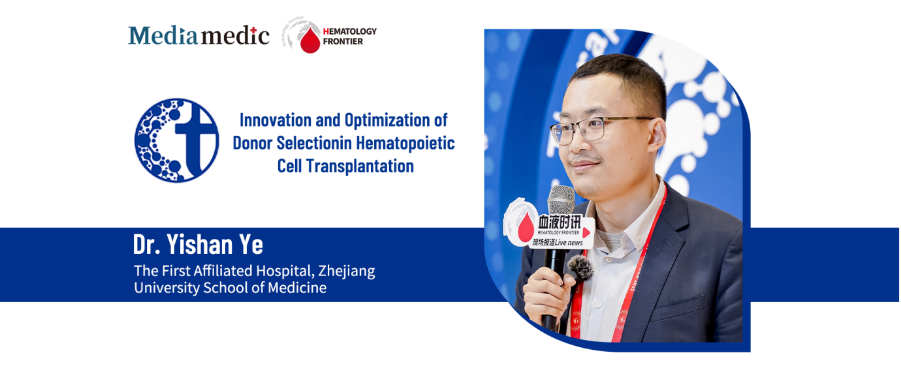
During the meeting, Oncology Frontier – Hematology Frontier invited Dr. Ye Yishan from the First Affiliated Hospital of Zhejiang University School of Medicine for an in-depth discussion on cutting-edge issues including:
• advances in haploidentical transplantation (haplo-HSCT) for AML,
• development of individualized donor-selection systems,
• and future directions in donor-selection science.

Q1
Your EBMT2025oral presentation (OS505) showed that haploidentical HSCT using PTCy offered superior GRFS compared with matched unrelated donor (MUD) transplantation in AML patients in second complete remission (CR2). Based on these international multicenter data, what role should haploidentical transplantation play in donor-selection algorithms today? For high-risk or elderly patients, can it be considered a “preferred option”?
Dr. Yishan Ye: China is now a global leader in the field of haploidentical hematopoietic stem cell transplantation. As a result, comparative studies between haplo-HSCT and other graft sources have attracted major attention.
Recent results demonstrate that in AML patients receiving transplantation in CR2, haploidentical HSCT provides superior graft-versus-host disease–free, relapse-free survival (GRFS) compared with MUD transplantation. These findings align with a series of collaborative studies by Prof. Huang He’s team together with the EBMT, all indicating that for high-risk AML, haploidentical transplantation may offer a more favorable therapeutic profile, and may even challenge matched sibling donor transplantation as a first-line option in the future.
Q2
When building a personalized donor-selection system, what factors beyond HLA matching should be incorporated? For patients with multiple potential haploidentical donors, what key indicators should guide donor prioritization?
Dr. Yishan Ye: Researchers and clinicians have long been investigating variables that may influence transplant outcomes. These include:
- donor/recipient CMV serostatus,
- donor/recipient EBV serostatus,
- donor age,
- donor comorbidities,
- and minor histocompatibility antigens (mHAs), which may be important additional determinants.
Current comparative studies show that across AML subtypes, haploidentical, unrelated, and matched-related donor transplantation each offer distinct advantages, depending on patient characteristics. As more high-quality prospective datasets accumulate, clinicians will be able to make donor decisions with higher precision, shortening the time needed to identify the optimal donor.
Q3
You have advocated the transition from “everyone has a donor” to “everyone has a good donor.” Looking ahead, what innovations do you foresee in donor-selection technology? Based on your collaboration with EBMT, what donor-selection challenges will future China–EBMT partnership prioritize?
Dr. Yishan Ye: To truly achieve the goal of “timely access to optimal donors for all,” our efforts currently focus on two major directions:
1. Expanding the donor pool
This includes evaluating the feasibility of extended family donors, such as collateral relatives, to ensure every patient can rapidly identify a donor.
2. Increasing donor-selection precision
Optimizing biological and clinical criteria will help maximize post-transplant survival and minimize relapse risk.
Together, these two directions outline the future of donor-selection science. We aim to deepen collaboration with the EBMT while simultaneously strengthening multi-center cooperation nationwide, helping China develop donor-selection strategies that set global standards and drive meaningful progress in the field.


Expert Profile

Dr. Yishan Ye First Affiliated Hospital, Zhejiang University School of Medicine
- Special-appointed Associate Researcher
- Master’s Advisor, Zhejiang University
- Research Coordinator, EBMT China Office
- Secretary, Hematologic Immunology Committee, Zhejiang Immunology Society
- Youth Member, Zhejiang Medical Association Hematology Branch
- PhD in Medicine/Science, Sorbonne University (Mentor: Prof. Mohamad Mohty)
- Published 10+ SCI papers as first/corresponding author, 30+ co-authored (Cell Discovery, J Hematol Oncol, Am J Hematol, etc.)
- Reviewer for Bone Marrow Transplantation and other journals
- PI of National Natural Science Foundation Youth Grant
- Participant in multiple national key research projects
- ASH Oral Presentations ×3
- EBMT Oral Presentations (multiple years)
- EBMT 2023 & 2024 Best Oral Abstract Award
- ASH Abstract Achievement Award

