

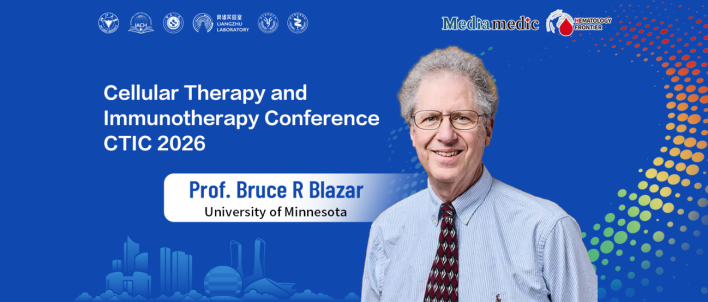
Qiantang Forum, Shaping the Future Through Innovation. From November 6 to 8, 2026, the 2026 Cellular Therapy and Immunotherapy Conference (CTIC 2026) was grandly held in Hangzhou. Taking a global perspective, the congress brought together leading experts and scholars from China and abroad to explore cutting-edge developments in cellular therapy, gene therapy, AI-enabled hematology, and translational research, addressing clinical challenges and charting a path toward high-quality development in the field. During the congress, Oncology Frontier – Hematology Frontier invited Professor Bruce R. Blazar of the University of Minnesota, USA, to share his latest research findings and academic insights into the core mechanisms of CD8 inducible CAR Tregs, the challenges of clinical translation, and future breakthroughs in basic immunology. The key points are presented below.
Redefining Cellular Phenotypes: How CD8 Inducible CAR Tregs Precisely Separate GVHD and GVL Effects
Oncology Frontier-Hematology Frontier: You reported at this congress that “CD8 inducible CAR Tregs can ameliorate GVHD while augmenting GVL.” Could you introduce the core mechanism of this novel cell design? How does it achieve precise decoupling of GVHD and GVL effects?
Professor Bruce R Blazar: Thank you for your question. We have developed a strategy wherein we use immunosuppressive molecules rapamycin and TGF-beta to induce suppressor activity in CD8-positive T cells. At the time of culture initiation, CD8-positive T cells are negatively selected for expression of IL-2 receptor alpha chain thereby reducing cytolytic activity that accompanies preformed CD8-positive T cells. Essentially, we’ve converted cytolytic cells that have little suppressor capacity into a cytolytic cell that has potent suppressor activity. The goal of this was to be able to suppress graft-versus-host disease and to have a direct effect on removing leukemia cells by harnessing the natural cytotoxic capacity of CD8-positive T cells. This contrasts to the typical strategy that people have used, which is to inhibit graft-versus-host disease and try to preserve any anti-leukemic effect. We want to augment anti-leukemic effect.
Overcoming the Persistence Bottleneck: Optimizing Intracellular Domains and Metabolic Reprogramming
Oncology Frontier-Hematology Frontier: Regulatory T cell (Treg) therapy has shown potential in preventing GVHD, but ensuring its persistence and specificity in vivo has always been a challenge. What do you consider the main safety and efficacy challenges for inducible CAR-Treg in clinical translation?
Professor Bruce R Blazar: As far as in vivo persistence, I think we have been looking at different intracellular domains of the CAR19 cells and found that one domain is better than another. Part of the answer rests in how the cells are prepared, how dependent they are on the media and the amount of IL-2 in the media, whether they have acquired oxidative phosphorylation capacity or they are skewed toward glycolysis since typically T cells that are primarily glycolytic cells survive less well upon adoptive transfer in vivo. By optimizing our conditions, we do get superior in vivo persistence that tracks with one intracellular signalling domain over another one that is sufficient to eliminate the leukemia cells at least for a prolonged period of time. This anti-leukemia effect in CD8-positive induced Treg exceeded that of CAR19 CD8-positive cytotoxic T cells.
Toward Immune Tolerance: From Microbiome Modulation to Tissue Protection
Oncology Frontier-Hematology Frontier: Your team has carried out extensive work in combining basic research with clinical translation. In the field of GVHD, from which direction do you think the next basic immunology breakthrough that could change clinical practice is most likely to emerge?
Professor Bruce R Blazar: It’s an interesting and hard question. I think a lot of attention has been placed on trying to optimize the donor-recipient choices including HLA disparities and donor age, the conditioning regimen and graft-versus-host disease prophylaxis. I think the issue with those strategies is there’s a limit to how much you can improve and the graft-versus-host disease prophylaxis which in general is controlled by globally immunosuppressive agents and is itself immunosuppressive. I think in the future there’s a great need to look at tolerance, the ability of such cells to allow the recipient to survive and the ability of the tissues to survive the challenge of alloreactive, tissue destructive T cells. Where the field has been going is to look at microbiome and manipulating microbiome properties. CD4-positive regulatory T cells now have FDA approval in the United States from Orca Bio (approved product is trademarked Tregzi). We believe that if we could produce Treg in vitro to be potent, long-lasting regulatory cells before infusion or generate such cells in vivo that will be tolerant of the host that will be one part of the formula. Another part is fortifying the tissues to withstand injury from any residual T cells that cause graft-versus-host disease. Finally we need to learn how best to accomplish all of this by imbuing Treg to actively eliminate leukemia cells from the patient.
Expert Profile
Professor Bruce R. Blazar
Professor in the Department of Pediatrics, Division of Blood & Marrow Transplant & Cellular Therapy, University of Minnesota Medical School, USA. He is an internationally recognized expert in basic and translational GVHD research, transplant immunology, and T-cell immune regulation.
His long-standing research focuses on the design and clinical translation of CAR Tregs and identifying other strategies for separating graft-versus-host disease (GVHD) from graft-versus-leukemia (GVL) effects. His team has made a series of important advances in inducible CAR Tregs and the reshaping of tissue immune tolerance.