

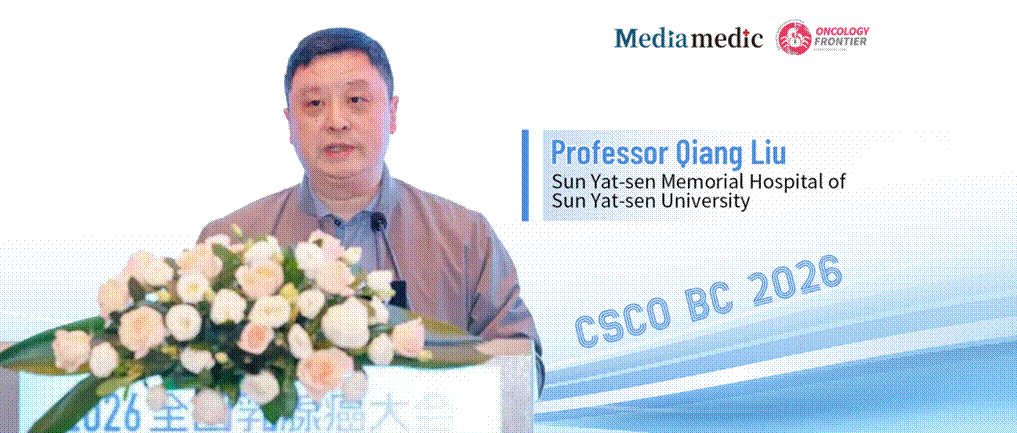
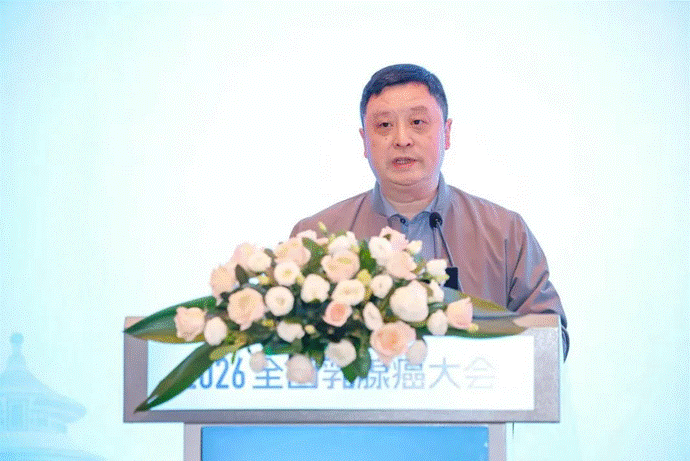
Editor’s Note: The 2026 National Breast Cancer Conference was held in Beijing from April 10–12. During the meeting, Professor Qiang Liu from Sun Yat-sen Memorial Hospital, Sun Yat-sen University delivered a dedicated presentation on the Chinese Expert Consensus on the Diagnosis and Treatment of Young Breast Cancer (2025 Edition).Oncology Frontier invited Professor Liu for an in-depth discussion focused on four major clinical topics: stratification of ultra-young patients, standardized monitoring of ovarian function suppression (OFS), ovarian protection during chemotherapy, and fertility safety management. In the interview, Professor Liu systematically outlined the key updates and practical implications of the new consensus document, providing important guidance for standardized clinical management.
01
Oncology Frontier: Could you elaborate on the major updates in the Chinese Expert Consensus on the Diagnosis and Treatment of Young Breast Cancer (2025 Edition)? What practical guidance does the updated consensus provide for clinical management?
Professor Qiang Liu:
Young breast cancer has long represented a highly important patient population in China. Clinically, these patients face a series of complex challenges, including higher recurrence risk, strong demands for ovarian function preservation, and significant fertility-related concerns. The updated consensus was developed precisely in response to these real-world clinical needs and incorporates the latest available evidence.
This revision focuses primarily on several key clinical issues.
First, the consensus further refines the stratification criteria for ultra-young breast cancer patients, enabling more precise identification of high-risk populations and facilitating intensified interventions when appropriate.
Second, it standardizes the overall management strategy for ovarian function suppression (OFS), clearly defining treatment duration, medication use, and the full-process standards for efficacy monitoring. Through standardized management, clinicians can better ensure adequate ovarian suppression and avoid treatment failure resulting from insufficient suppression.
Third, the updated consensus further clarifies the appropriate patient population for ovarian protection during chemotherapy, providing standardized intervention strategies for patients who wish to preserve ovarian function.
Fourth, it refines fertility-related management pathways by specifying the optimal timing for interruption of endocrine therapy, approaches to risk assessment, and safety monitoring protocols.
Collectively, these updates establish a more comprehensive and clinically actionable framework for risk stratification, treatment, ovarian protection, and fertility management in young breast cancer patients. The ultimate goal is not only to improve oncologic outcomes, but also to better preserve patients’ long-term quality of life.
02
Oncology Frontier: How does the updated consensus define ultra-young breast cancer, and what are the unique clinical characteristics of this subgroup? What treatment strategies should be emphasized for these patients?
Professor Qiang Liu:
The updated consensus defines patients younger than 35 years of age as the ultra-young breast cancer subgroup.
This definition is supported by data from the MammaPrint 70-gene assay, which demonstrated that patients younger than 35 years have a significantly higher recurrence risk compared with patients aged 36–40 years. The two groups also exhibit substantial differences in tumor biological characteristics.
Although both domestic and international guidelines recommend ovarian function suppression combined with endocrine therapy as the standard treatment strategy for hormone receptor-positive ultra-young patients, inadequate or inconsistent monitoring in real-world practice may still lead to insufficient ovarian suppression and suboptimal therapeutic outcomes.
In my own clinical practice, I encountered a representative case in which a patient receiving an aromatase inhibitor combined with OFS failed to undergo standardized efficacy monitoring. As a result, ovarian suppression proved inadequate, ultimately leading to disease recurrence and metastasis. This case further underscores the critical importance of continuous standardized monitoring throughout treatment to ensure optimal therapeutic efficacy.
In addition, chemotherapy can reduce ovarian reserve and may even result in ovarian failure. Therefore, for young patients who wish to preserve ovarian function or maintain fertility potential, ovarian protection strategies during chemotherapy are routinely recommended to minimize the risk of ovarian damage.
For patients with future fertility plans, treatment decisions must be made cautiously following comprehensive recurrence-risk assessment. The timing of endocrine therapy interruption should be carefully determined, accompanied by close surveillance and follow-up. The overarching principle is to safeguard oncologic safety while simultaneously addressing patients’ reproductive goals.
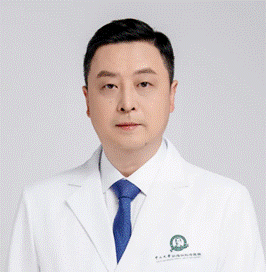
Professor Qiang Liu
Sun Yat-sen Memorial Hospital, Sun Yat-sen University

