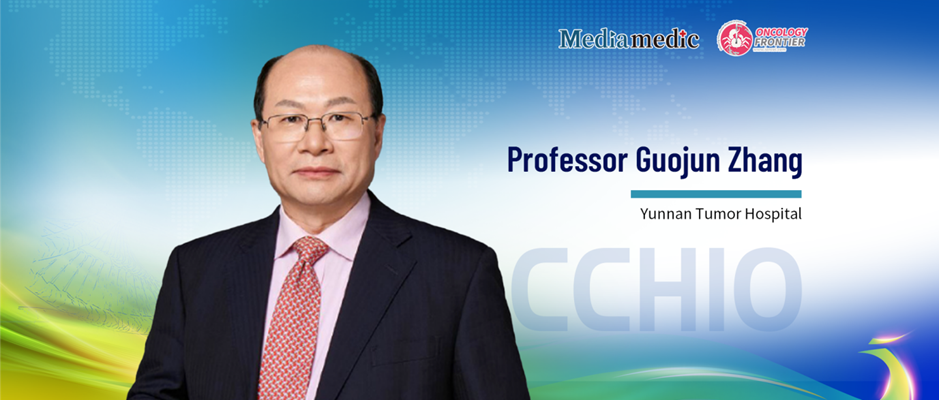
Editor’s Note: The 2025 China Conference on Holistic and Integrative Oncology (CCHIO) was held in Kunming from November 6–9, 2025. The meeting was hosted by the China Anti-Cancer Association (CACA) and the Tengchong Scientist Forum Organizing Committee Office, co-organized by the World Association of Integrative Oncology (WAIO) and the China Institute for Development Strategy of Integrative Medicine, and jointly undertaken by Yunnan Cancer Hospital, Kunming Medical University, and the Yunnan Anti-Cancer Association. Oncology Frontier invited Professor Guojun Zhang, Executive Chair of the conference and President of Yunnan Cancer Hospital, to discuss the highlights and defining features of this year’s meeting, how innovative hospital management models can empower high-quality development, and the profound impact of this congress on cancer prevention and control in Yunnan.01
Oncology Frontier: First of all, congratulations on the successful convening of CCHIO 2025 in Kunming. As the Executive Chair, could you introduce the core themes and major highlights of this year’s conference?
Professor Guojun Zhang:
The 2025 China Conference on Holistic and Integrative Oncology (CCHIO) continues to uphold its theme of “Winning in Integration for Cancer Prevention and Control.” To begin with, this year’s meeting consists of one main venue, 14 thematic forums, 26 international sessions, and 129 parallel sessions—demonstrating not only the magnitude of the congress but also its high academic caliber. Among the 14 thematic sessions, we included an Academician Forum, an Innovation Forum, and a Hospital Management Forum. While these retain continuity with previous editions, the distinctive features of this year’s meeting are even more striking.
In the main venue, we invited numerous leading oncology experts to deliver keynote presentations. These talks were fully international in style, delivered entirely in English, with simultaneous interpretation provided for the many Chinese attendees participating both online and offline. The 26 international sessions further highlight the global dimension of this meeting, featuring collaborations between CACA and international organizations or journals. These sessions examine global and Chinese advances in cancer prevention and control, as well as China’s contributions to high-impact publications in basic, applied, and clinical oncology research.
Given Yunnan’s geographic position bordering several South and Southeast Asian countries, we also established a special session entitled “2025 CCHIO Science and Technology Innovation Forum for South and Southeast Asia,” marking the first time such a session has been included.
02
Oncology Frontier: We noticed that you delivered a special report titled “Exploring New Hospital Management Models to Support High-Quality Development.” Could you share the innovative concepts or practical pathways behind this new model and how they will drive high-quality development?
Professor Guojun Zhang:
Hospital development has entered a new stage, often summarized as “three transformations and three improvements.” We see a transition from extensive development to high-quality development, from coarse management to refined management, and a shift in investment priorities from equipment and materials toward talent development. These shifts inevitably call for management models that are more precise and targeted.
First, with the rise of artificial intelligence, AI technologies will empower high-quality hospital development. Building smart hospitals will become a meaningful and transformative direction in hospital management. Second, refined management is increasingly important, especially the “three-medical linkage” of medicine, medical care, and medical insurance. Healthcare reform has brought significant challenges—for example, patient pathways must adapt, with many treatments shifting from inpatient settings to day-treatment models. Third, we emphasize scientific and technological innovation, education-driven growth, and talent development. Innovation will also shape future hospital management structures.
Overall, hospital management is undergoing at least three major transformations:
- A shift toward intelligent and digital hospital systems.
- Evolving diagnostic and treatment models driven by the move from invasive to minimally invasive or non-invasive technologies, demanding more robust day-treatment systems.
- A firm commitment to scientific and technological innovation, ensuring that basic research findings can ultimately be translated into clinical benefit.
The path is long, but innovation is indispensable.
03
Oncology Frontier: This congress brings together world-class experts and scholars. From a broader perspective, what long-term impact will such a high-level academic event have on Kunming and on cancer prevention and control across Yunnan Province?
Professor Guojun Zhang:
Yunnan is located along China’s border, and with increasing domestic and international exchange, collaboration with partners both within China and abroad is expanding. Although Kunming has hosted multiple oncology-related meetings in the past, this conference is the largest and highest-level oncology congress ever held in Kunming and Yunnan Province.
The China Anti-Cancer Association plays an increasingly central role in national cancer control efforts and is the academic organization with the largest membership and broadest coverage nationwide. Therefore, hosting such a congress in Yunnan will have profound and lasting effects on cancer prevention and control in the province.
Specifically, the impact will be felt in several areas: It will strengthen collaboration among provincial, national, and international peers; It will promote cooperation among hospitals, research institutes, and universities; And it will help attract more talent to Yunnan, driving forward the province’s cancer prevention and treatment efforts.
Ultimately, such initiatives will significantly contribute to extending survival and improving quality of life for patients. Letting patients benefit is the primary purpose of hosting academic conferences and fostering academic exchange.
About Professor Guojun Zhang
Guojun Zhang, M.D. Professor, Chief Physician, Doctoral Supervisor President, Yunnan Cancer Hospital (Beijing University Cancer Hospital Yunnan Hospital / The Third Affiliated Hospital of Kunming Medical University