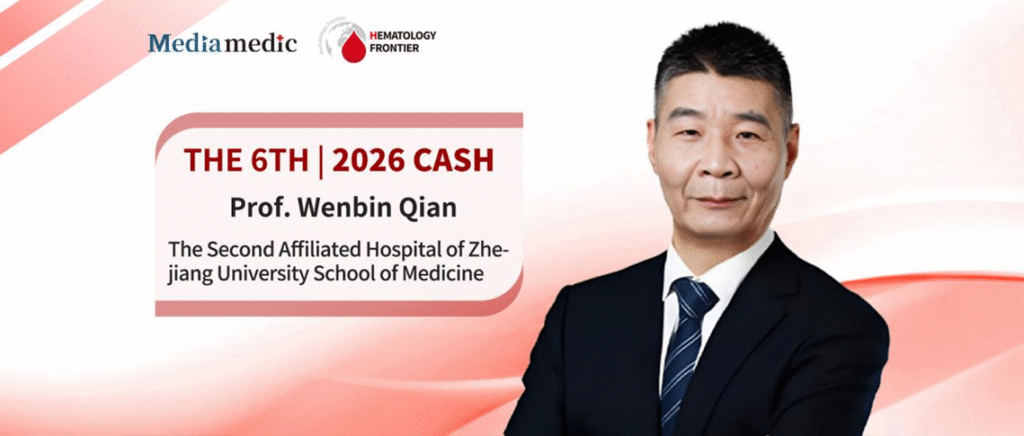
With continuous technological iteration in CAR-T cell therapy, fourth-generation CAR-T is increasingly demonstrating substantial clinical potential. From January 9 to 11, 2026, the 6th China Hematology Discipline Development Conference (CASH) was grandly held in Tianjin. The meeting brought together leading hematology experts from China and abroad, focusing on cutting-edge advances and national health strategy priorities, fostering in-depth academic exchange and exploration of new directions in the field.During the conference, Oncology Frontier – Hematology Frontier invited Professor Wenbin Qian of the Second Affiliated Hospital, Zhejiang University School of Medicine, for an in-depth discussion on the long-term efficacy, mechanisms of resistance, and future optimization strategies of fourth-generation CAR-T cell therapy, providing important insights for both clinical practice and translational research.
Oncology Frontier – Hematology Frontier:
Your team has accumulated long-term follow-up data on fourth-generation CAR-T cell therapy. Based on five-year follow-up results, what key features have emerged regarding durability of response, survival benefit, and functional persistence? What implications do these findings have for CAR-T efficacy evaluation frameworks?
Professor Wenbin Qian:
Fourth-generation CAR-T therapy builds upon conventional CAR constructs by genetically engineering CAR-T cells to express and secrete specific cytokines or chemokines, thereby enhancing T-cell function, reducing exhaustion, and improving trafficking, migration, and infiltration into tumor sites.
Preclinical studies have demonstrated that CD19-targeted fourth-generation CAR-T cells exhibit significantly enhanced antitumor activity, improved migration, and reduced exhaustion. Based on these findings, we conducted a phase I dose-escalation and expansion clinical study. To date, the follow-up period has exceeded 70 months (more than five years), with a five-year overall survival (OS) rate of 43.6%. By comparison, the ZUMA-1 trial reported a five-year OS rate of 42.6%.
Notably, nearly 40% of patients enrolled in our study were previously resistant to second-generation CAR-T therapy. In addition, the inclusion criteria were broader, encompassing patients with ECOG performance status scores of 0–3 (international studies typically restrict enrollment to 0–1, while scores ≥2 are associated with poorer prognosis), as well as patients with bulky disease and elevated lactate dehydrogenase (LDH)—known high-risk factors for resistance to second-generation CAR-T therapy.
These findings suggest that fourth-generation CAR-T therapy can overcome certain resistance mechanisms associated with second-generation CAR-T, even under unfavorable conditions such as poor performance status, elevated LDH, and high tumor burden, thereby achieving long-term survival outcomes comparable to—or slightly better than—benchmark studies. This underscores the potential advantage of fourth-generation CAR-T therapy in relapsed/refractory large B-cell lymphoma.
Internationally, studies from Professor Carl June’s group have shown that engineering CAR-T cells to express interleukin-15 (IL-15) significantly enhances in vivo expansion and antitumor activity in solid tumors, further validating the potential of fourth-generation CAR-T therapy in functional enhancement and durability. Taken together, fourth-generation CAR-T therapy is poised to become a major developmental direction in the future of CAR-T treatment.
Oncology Frontier – Hematology Frontier:
Despite the transformative success of CAR-T therapy, resistance or relapse still occurs in some patients. Based on your research and clinical observations, what are the primary biological mechanisms underlying CAR-T resistance? What new insights have emerged regarding antigen modulation, CAR-T cell exhaustion, and the tumor microenvironment?
Professor Wenbin Qian:
Mechanisms of resistance to CAR-T cell therapy can be broadly classified into two categories: antigen-negative resistance and antigen-positive resistance.
Antigen-negative resistance primarily results from loss of target antigen expression or genetic alterations in tumor cells, rendering them unrecognizable to CAR-T cells. In contrast, antigen-positive resistance is more closely associated with immunosuppressive tumor microenvironments and intrinsic T-cell dysfunction or exhaustion.
Overall, CAR-T resistance can be conceptualized across three key dimensions:
- Abnormal T-cell quality and function, including intrinsic exhaustion mechanisms;
- Immunosuppressive factors within the tumor microenvironment;
- Tumor cell–level mechanisms, such as antigen escape or resistance to apoptosis.
In our long-term follow-up studies, we systematically analyzed the relationship between CAR-T cell quality and clinical outcomes. We found that in some resistant patients, CAR-T cells exhibited abnormalities in ubiquitination pathways, which adversely affected their function and persistence. Based on this discovery, we are currently investigating targeted CAR-T modification strategies, aiming to improve therapeutic efficacy by inhibiting specific ubiquitination-related proteins.
From a mechanistic research perspective, a key future direction is to closely integrate clinical data with molecular studies, deeply elucidate the critical pathways driving resistance, and use these insights to guide innovative, mechanism-based engineering of CAR-T cells, thereby further enhancing efficacy and improving patient outcomes.
Oncology Frontier – Hematology Frontier:
Based on current understanding of long-term efficacy and resistance mechanisms, which future directions in CAR-T structural design, combination strategies, or treatment timing are most likely to further improve outcomes and reduce resistance? How do you envision the development of CAR-T technology over the next five to ten years?
Professor Wenbin Qian:
Although fourth-generation CAR-T therapy has demonstrated significant advantages in the treatment of B-cell lymphomas, resistance remains an issue driven by multiple factors rather than a single mechanism.
Recent domestic and international data indicate that multi-target—particularly dual-target—CAR-T strategies can help overcome resistance caused by tumor antigen escape. For example, the team led by Professor Aibin Liang at Tongji Hospital, Tongji University, developed a CD19/CD20 dual-target CAR-T, achieving a complete response rate approaching 80% in related studies. These findings suggest that optimization of fourth-generation CAR-T therapy should address not only the tumor microenvironment and T-cell function, but also resistance driven by antigen escape.
Accordingly, integrating dual-target designs into fourth-generation CAR-T constructs represents one of the most promising future optimization strategies.
In addition, the application of CAR-T cell therapy is gradually expanding beyond hematologic malignancies to non-hematologic diseases, including autoimmune disorders. Given the large patient populations affected by these conditions, CAR-T therapy holds broad clinical promise and has the potential to reshape treatment paradigms across multiple disease areas.
From a clinical perspective, we hope that future CAR-T therapies can achieve scalable manufacturing and standardized production, thereby substantially reducing costs and improving accessibility. Enabling more patients to benefit from CAR-T therapy remains one of the most critical challenges and priorities in the field.
Expert Biography
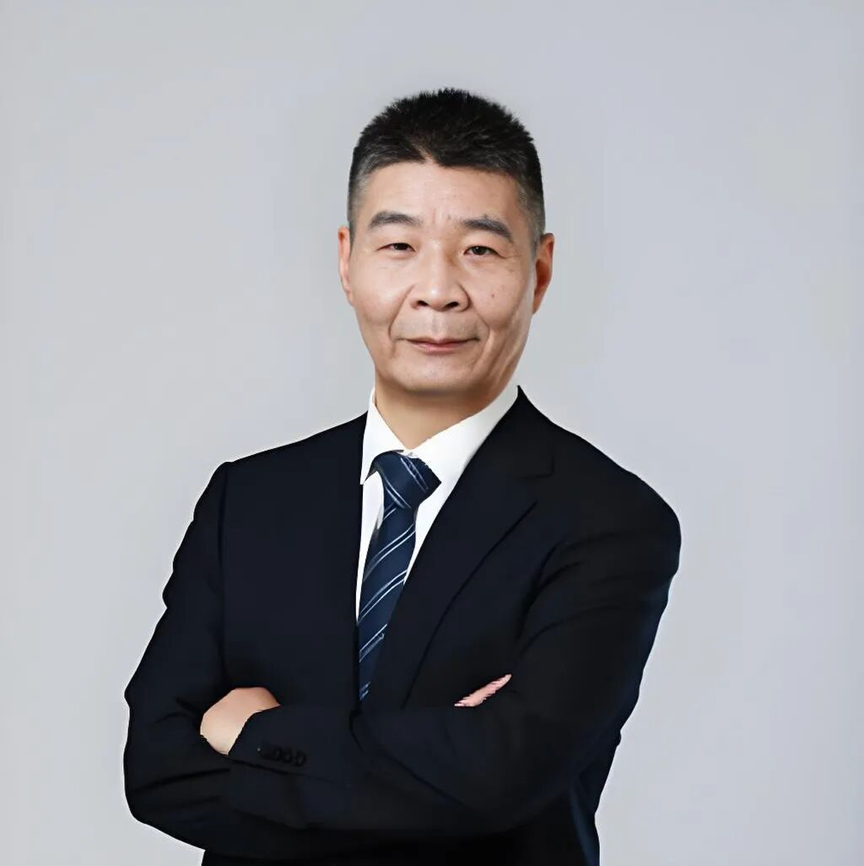
Professor Wenbin Qian
Second Affiliated Hospital, Zhejiang University School of Medicine
Professor Wenbin Qian is a Chief Physician and Doctoral Supervisor, and serves as Director of the Department of Hematology and Director of the Biological Therapy Center at the Second Affiliated Hospital of Zhejiang University School of Medicine.
He is the Chief Scientist of a National Major Project under the “Science and Technology Innovation 2030” Initiative.
Professor Qian holds numerous prominent academic and professional positions, including:
- Member, Hematology Branch, Chinese Medical Association
- Standing Committee Member, CSCO Lymphoma Expert Committee
- Member, Hematology Physicians Branch, Chinese Medical Doctor Association
- Standing Committee Member, Hematologic Oncology Committee, Chinese Anti-Cancer Association
- Standing Committee Member, Lymphoma Committee, Chinese Anti-Cancer Association
- Vice Chair, Lymphoma Committee, China Association of Gerontology and Geriatrics
- Chair, Hematology Branch, Zhejiang Medical Association
Professor Qian has authored or co-authored more than 90 peer-reviewed publications as first or corresponding author in leading international journals, including Nature Cancer, Cell Discovery, eClinicalMedicine, Clinical Cancer Research, Leukemia, Haematologica, Blood Cancer Journal, Cancer Communications, Journal of Hematology & Oncology, Signal Transduction and Targeted Therapy, Cellular & Molecular Immunology, Journal for ImmunoTherapy of Cancer, and The Lancet Haematology.
He is a co–editor-in-chief of Clinical Guidelines for the Management of CAR-T Cell Therapy–Related Toxicities in Non-Hodgkin Lymphoma and Expert Consensus on Multidisciplinary Management of CAR-T Therapy for Lymphoma (Tsinghua University Press, 2021); associate editor of CAR-T Cell Immunotherapy (People’s Medical Publishing House, 2021); and associate editor of Case-Based Interpretations of Tumor Biologic Cell Therapy (Shanghai Scientific & Technical Publishers, 2024).
Professor Qian has led multiple major research programs, including one national “Science and Technology Innovation 2030” major project, one Key Project of the National Natural Science Foundation of China, one Original Exploration Project, five General Program grants, and key projects under the Zhejiang Provincial Key Research and Development Program.
As principal investigator or key contributor, he has received two National Science and Technology Progress Awards (Second Class) and nearly ten provincial science and technology awards, including first- and second-class honors.