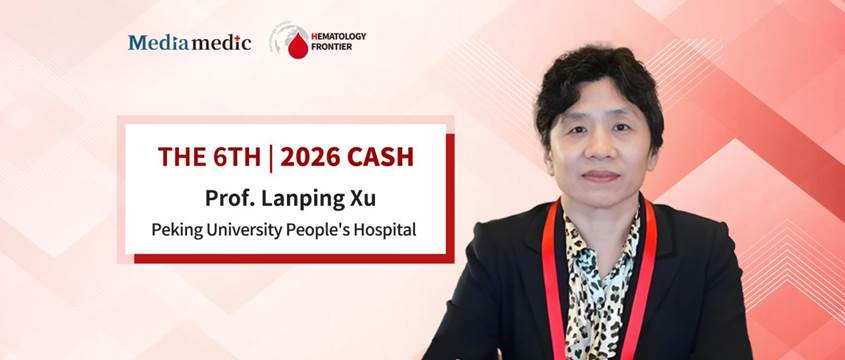
Editor’s Note: From January 9–11, 2026, the 6th China Hematology Discipline Development Conference (CASH) was held in Tianjin, bringing together leading experts to discuss cutting-edge advances in hematology and national health priorities. During the conference, Oncology Frontier – Hematology Frontier invited Professor Lanping Xu from Peking University People’s Hospital to share her team’s latest progress in hematopoietic stem cell transplantation (HSCT) for severe aplastic anemia (SAA), with a focus on long-term outcomes of haploidentical transplantation, as well as optimization of transplant timing, patient stratification, and donor selection.Long-Term Outcomes of Haploidentical Transplantation in Severe Aplastic Anemia
Oncology Frontier – Hematology Frontier:
Your team has made notable progress in haploidentical transplantation for severe aplastic anemia. Could you share the latest long-term follow-up data, especially regarding survival, failure-free survival, and quality of life?
Professor Lanping Xu:
We conducted a national multicenter prospective study involving 11 institutions, evaluating haploidentical hematopoietic stem cell transplantation (HSCT) as second-line therapy for patients with severe aplastic anemia. With a median follow-up of 4.56 years, the 9-year overall survival (OS) rate reached 85.4%, and the failure-free survival (FFS) rate was 84%, demonstrating strong long-term efficacy of haploidentical transplantation in this setting.
We also analyzed long-term outcomes of haploidentical transplantation as first-line therapy in a multicenter retrospective cohort across 11 major centers, comparing haploidentical HSCT (median follow-up 75.5 months) with matched sibling donor transplantation (median follow-up 70.3 months).
Results showed no statistically significant differences between the two groups in:
- 9-year OS (87.1% vs 89.3%)
- 9-year FFS (86.5% vs 88.1%)
Furthermore, quality of life improved significantly in both groups compared with pre-transplant levels, with no meaningful differences between transplant types at various follow-up time points.
These findings support haploidentical transplantation as a highly effective and durable therapeutic option for SAA.
Optimizing Transplant Timing and Individualized Treatment Strategies
Oncology Frontier – Hematology Frontier:
As haploidentical transplantation becomes more mature, transplant timing is increasingly critical. How should individualized transplant strategies be determined across different ages and disease stages?
Professor Lanping Xu:
Effective management begins with distinguishing newly diagnosed SAA from severe disease evolving from chronic aplastic anemia. For patients with severe or transfusion-dependent aplastic anemia, transplantation remains the primary curative treatment.
Key Strategy by Patient Group:
- Younger patients with SAA:
If a matched sibling donor, matched unrelated donor, or haploidentical donor is available, transplantation should be strongly considered.
For very severe SAA (profound neutropenia or high risk of bleeding/infection), a related donor is often preferred due to faster donor availability. - Patients aged 40–50 years:
If general health is good and donor conditions are favorable, transplantation remains a viable and beneficial option. - Patients over 50 years:
- For newly diagnosed SAA, immunosuppressive therapy (IST) is usually preferred first.
- For chronic progressive SAA, transplantation should be considered if the patient’s condition allows.
- Relapsed, refractory, or graft-failure patients:
Second transplantation should be evaluated.
Core Decision Factors:
- Age and overall physical condition
- Disease severity and progression
- Presence of high-risk clinical or biological factors
- Expected response to immunosuppressive therapy
- Availability and type of donor
If transplantation is likely to provide superior benefit, it should be prioritized.
Donor Selection:
- Matched sibling donor remains the first choice
- Matched unrelated donor and haploidentical donor are strong alternatives
- Our recent data indicate that in patients aged 40–50 years, haploidentical HSCT achieves outcomes comparable to matched sibling transplantation when appropriately optimized
Guideline Development and National Practice Leadership
We recently led the development of the “Clinical Practice Guidelines for Comprehensive Management of Allogeneic HSCT in Severe Aplastic Anemia in China”, which has been published in the Chinese Medical Journal (CMJ).
This guideline integrates evidence-based medicine and the Delphi consensus method, synthesizing expert insights nationwide to support standardized, high-quality clinical decision-making.
Future Directions: Key Challenges and Research Priorities
Oncology Frontier – Hematology Frontier:
What are the major remaining challenges in transplant treatment for aplastic anemia, and which research directions hold the greatest promise?
Professor Lanping Xu:
Although transplantation has significantly improved outcomes for severe aplastic anemia, important challenges remain. Key research priorities include:
- Optimizing transplant timing and patient stratification
- Personalizing conditioning regimens based on risk profiles
- Improving prevention and treatment of graft-versus-host disease (GVHD)
- Enhancing strategies for graft failure or poor engraftment
- Refining approaches to second transplantation
- Improving long-term survivorship and quality of life
Future progress will depend on better risk classification, reduced transplant-related toxicity, and stronger long-term supportive care frameworks.
Expert Profile
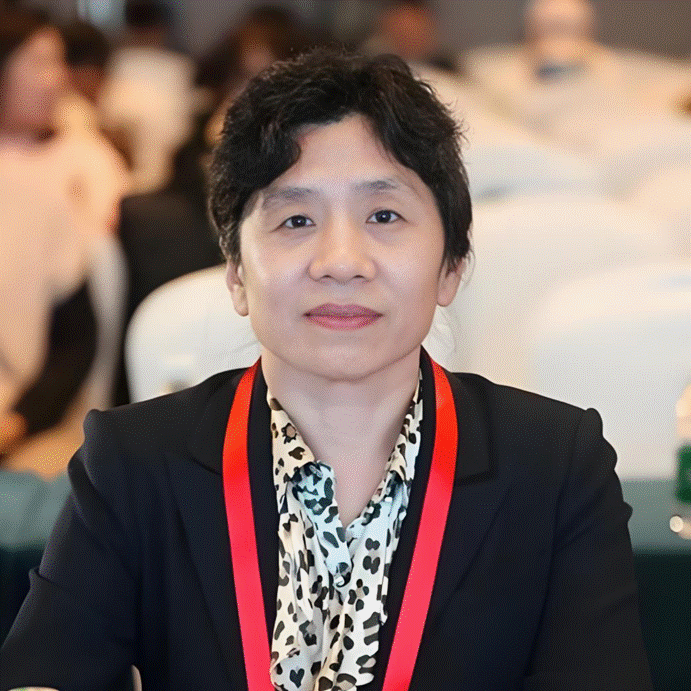
Professor Lanping Xu
Peking University People’s Hospital
National Clinical Research Center for Hematologic Diseases
- Vice Director, Department of Hematology
- Chief Physician, PhD Supervisor
- Standing Council Member, Cross-Strait Medical & Health Exchange Association
- Former Chair, Hematology Committee (2nd–3rd Terms)
- Chair, Expert Committee, Beijing Branch of China Marrow Donor Program
- Standing Member, Cell Research & Therapy Committee, Chinese Research Hospital Association
- Editorial Board Member, Chinese Journal of Hematology, Leukemia & Lymphoma, and others
- Two-time recipient of China National Science and Technology Progress Award (Second Prize)
- Research focus: HSCT in bone marrow failure syndromes
- 50+ SCI papers as corresponding/first author; 500+ total publications
- Contributor to 10+ national textbooks and academic monographs