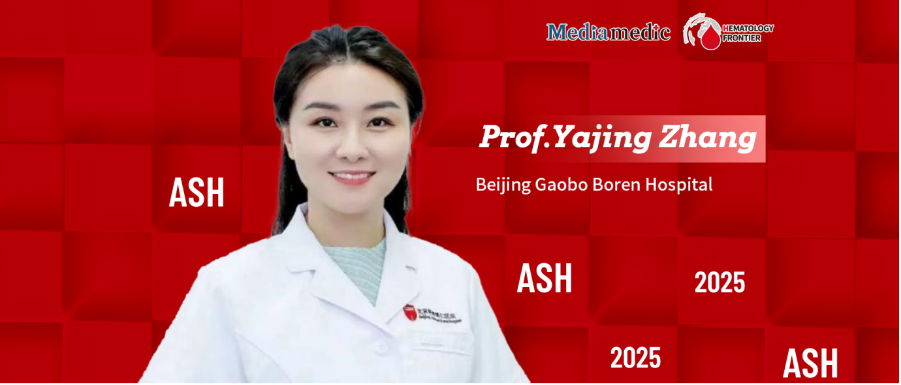
The 67th Annual Meeting of the American Society of Hematology (ASH) was held in Orlando from December 6 to 9, 2025, bringing together the latest global advances in hematologic research and clinical practice. At this year’s meeting, four studies led by Prof. Yajing Zhang from Beijing Gobroad Boren Hospital were accepted, including one oral presentation. On site, Hematology Frontier invited Prof. Zhang to provide in-depth interpretation of these landmark studies, highlighting her team’s original and internationally leading work in multitarget CAR-T strategies, toxicity mechanism–based management, and immune kinetic regulation. She also shared a comprehensive strategic perspective on CAR-T therapy, offering new insights to advance the field toward greater safety, higher efficacy, and broader patient benefit.
Breaking the Bottleneck in High-Risk Extramedullary Disease
Sequential BCMA and GPRC5D CAR-T With Individualized Bridging Therapy
Q1:
Your ASH 2025 study introduced a novel strategy combining sequential BCMA and GPRC5D CAR-T infusions with DCEP chemotherapy plus low-dose radiotherapy (LDRT) as bridging therapy. What are the key challenges in treating relapsed/refractory multiple myeloma (RRMM) patients with bulky or extensive extramedullary disease (EMD)?
Prof. Yajing Zhang: RRMM with bulky or extensive EMD represents one of the most formidable challenges in myeloma today. The major obstacles include:
- Sanctuary effects and physical barriers: Extramedullary masses often have poor vascularization and dense fibrotic encapsulation, forming “sanctuary sites” that limit penetration of drugs and immune cells, rendering chemotherapy, targeted agents, and even conventional CAR-T cells less effective.
- A profoundly immunosuppressive microenvironment: EMD lesions are enriched with suppressive immune cells (e.g., Tregs, MDSCs) and inhibitory cytokines, leading to rapid CAR-T exhaustion and loss of function.
- High tumor burden and antigen escape: Massive tumor burden rapidly consumes CAR-T cytotoxic capacity, while selective pressure from single-target therapies (e.g., BCMA) promotes antigen downregulation or loss, driving early relapse.
Treating EMD is essentially a siege against a fortified stronghold—one that combines structural defenses, immunologic suppression, and adaptive tumor escape.
Q2:
Could you explain the design rationale of the DCEP + LDRT bridging strategy followed by BCMA→GPRC5D sequential CAR-T therapy?
Prof. Yajing Zhang: The core philosophy is systematic, stepwise design, rather than reliance on a single aggressive intervention.
Step 1: Bridging therapy—battlefield clearance and remodeling. Bridging therapy is an active strategic preparation. DCEP reduces systemic tumor burden, while low-dose radiotherapy, a key innovation, serves dual roles: precise cytoreduction and immune sensitization. Radiotherapy disrupts physical barriers, induces immunogenic tumor cell death, releases tumor antigens, and reshapes the local microenvironment—potentially generating an abscopal effect. This phase opens the “fortress” before CAR-T assault.
Step 2: Sequential CAR-T—active attack and sustained eradication. To address antigen escape, we adopted a relay strategy. BCMA CAR-T acts first as the vanguard, achieving rapid and deep cytoreduction. GPRC5D CAR-T then targets residual BCMA-low or BCMA-negative clones. This sequential approach minimizes antigen escape and promotes durable remission.
In essence, individualized bridging optimizes the battlefield, while rational dual-target sequencing enables spatiotemporal tumor eradication.
Q3:
What key breakthroughs were achieved with this strategy in RRMM patients with bulky or extensive EMD?
Prof. Yajing Zhang: The results were highly encouraging:
- Depth of response: We observed very high overall response rates, with most patients achieving complete radiographic resolution of extramedullary lesions—rarely reported previously.
- Durable remission and survival benefit: Patients achieved prolonged, high-quality remissions, with significantly improved PFS and OS, largely due to effective suppression of antigen escape.
- Manageable safety: Despite intensified treatment, toxicities—including neurotoxicity—were controllable under refined management, with no unexpected severe adverse events.
Most importantly, this study establishes a feasible and effective treatment paradigm for a traditionally “forbidden zone” population, expanding CAR-T applicability to the most refractory EMD subsets and offering a realistic path toward long-term disease control.
Addressing Refractory Post–CAR-T Complications
Mechanisms and Targeted Intervention for Delayed Platelet Recovery
Q1:
Your team reported delayed thrombocytopenia in over 60% of CAR-T patients and proposed an inflammation-driven mechanism with TPO-RA–based intervention. What are the clinical implications?
Prof. Yajing Zhang: Delayed platelet recovery is among the most common hematologic toxicities after CAR-T. Traditionally attributed to lymphodepleting chemotherapy, management has been largely supportive.
Through longitudinal multi-omics analysis, we identified persistent inflammation—particularly IFN-γ–mediated suppression of megakaryocyte maturation—as the core mechanism, rather than simple marrow suppression. This is a major paradigm shift.
Clinically, this enables two key transitions:
- From passive support to causal intervention: TPO receptor agonists (e.g., avatrombopag, eltrombopag) can reverse inflammation-mediated suppression, accelerate platelet recovery, reduce transfusions, and lower bleeding risk.
- Identification of an optimal treatment window: Initiating TPO-RA during sustained post-expansion inflammation yields maximal benefit.
Q2:
How can an “early identification + risk-adapted intervention” system be implemented?
Prof. Yajing Zhang: We are translating these findings into clinical workflows. The framework emphasizes precision and anticipation:
- Early risk identification: Using baseline factors (tumor burden, platelet count) and early post-infusion markers (IL-6, IFN-γ, CAR-T expansion kinetics) to predict high-risk patients before severe cytopenia develops.
- Stratified intervention:
- Low risk: close monitoring only
- Intermediate risk: early TPO-RA upon platelet decline
- High risk: prophylactic TPO-RA after CAR-T peak expansion
This shifts management from reactive rescue to proactive prevention, enhancing safety and resource efficiency.
A New Paradigm in CRS Management
Siltuximab vs. Tocilizumab
Q1:
Your study suggests that siltuximab, by directly neutralizing IL-6, may better control CRS while preserving CAR-T function. Does this signal a shift in CRS management?
Prof. Yajing Zhang: Tocilizumab blocks the IL-6 receptor but may cause compensatory IL-6 accumulation. Siltuximab directly neutralizes IL-6, offering cleaner and more complete inflammatory control.
Crucially, this approach reduces negative inflammatory feedback on CAR-T cells, preserving their expansion and persistence. Thus, siltuximab is not only a more effective “firefighter” but also a “guardian” of CAR-T function—particularly valuable in high tumor burden or tocilizumab-refractory cases.
We are entering an era of mechanism-driven, precision CRS management.
Early Recognition of the “Second Storm”
Infection-Triggered Late IEC-HS
Q1:
Why is infection-triggered late-onset IEC-HS particularly difficult to recognize?
Prof. Yajing Zhang: This condition often emerges weeks to months after CAR-T, triggered by common viral infections (e.g., EBV, CMV). Patients present with fever and cytopenias, easily misdiagnosed as infection or septic shock.
Mechanistically, viral infection can reactivate residual CAR-T cells, inducing biphasic expansion and a secondary HLH-like cytokine storm—hence its covert yet lethal nature.
Q2:
What are the implications of successfully treating this condition with low-dose etoposide?
Prof. Yajing Zhang: Low-dose etoposide selectively eliminates hyperactivated immune cells, precisely terminating the cytokine storm while preserving antitumor CAR-T activity.
This underscores that CAR-T safety management must be long-term and systematic, with vigilant post-discharge monitoring. Any infection warrants careful evaluation of viral load and CAR-T copy number to enable early, targeted intervention.
A Holistic Strategic Vision for CAR-T Therapy
The Core Principles of Full-Cycle Management
Q1:
What is your overarching strategic vision for CAR-T therapy?
Prof. Yajing Zhang: The future of CAR-T does not hinge on a single “super CAR,” but on building a scientific, integrated, and dynamic full-cycle management system, summarized as three transformations:
- Upfront strategic integration: Personalized bridging, early multitarget planning, and microenvironment optimization to deepen and sustain remission.
- Mechanism-driven management: Understanding toxicity biology—delayed cytopenias, CRS pharmacodynamics, biphasic expansion—to guide precise interventions (TPO-RA, siltuximab, low-dose etoposide).
- Dynamic, longitudinal control: Continuous immune kinetic monitoring to predict efficacy, anticipate toxicity, detect relapse, and fine-tune CAR-T activity over time.
This elevates CAR-T from a single infusion to a comprehensive, lifecycle-based therapeutic system, encompassing pre-treatment preparation, core therapy, toxicity precision control, long-term monitoring, and relapse prevention.
While the path is challenging, with a holistic strategy and global collaboration, CAR-T therapy will reach new heights of safety, efficacy, and accessibility.

Expert Profile

Prof. Yajing Zhang
Beijing Gobroad Boren Hospital
Director, Oncology & Immunotherapy Innovation Center Chief Physician, MD, Postdoctoral Fellow Beijing Science and Technology Rising Star
Research focus: clinical and translational cellular and immunotherapies in oncology and autoimmune diseases
Principal investigator of 6 national and provincial grants First author publications in Blood, Leukemia, JEM, STTT (cumulative IF >140)$ Recipient of the 2023 JEM Outstanding Paper Award
Academic appointments include CSCO Myeloma Committee member and multiple national cell therapy organizations.