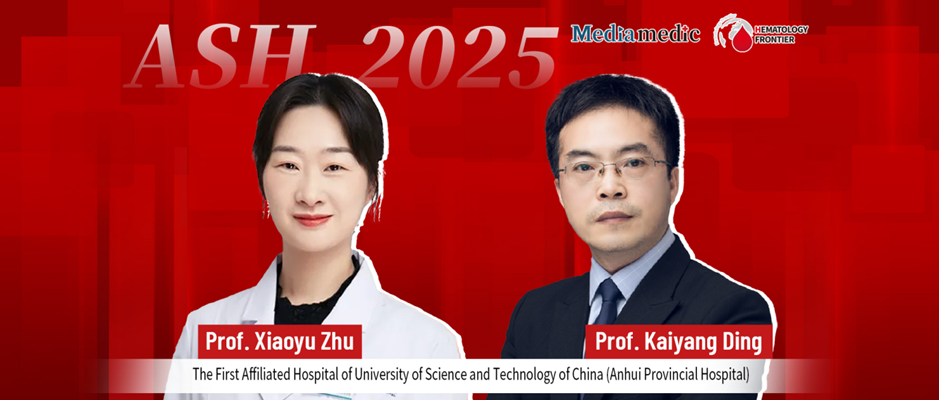
From December 6–9, 2025, the 67th Annual Meeting of the American Society of Hematology (ASH) was held in Orlando, bringing together leading experts worldwide to present the latest breakthroughs in hematology. At this year’s meeting, multiple studies from Prof. Xiaoyu Zhu’s team and Prof. Kaiyang Ding’s team at The First Affiliated Hospital of the University of Science and Technology of China (Anhui Provincial Hospital) were accepted. Notably, one study led by Prof. Zhu received the prestigious ASH Abstract Achievement Award.
This feature highlights these landmark studies, spanning acute myeloid leukemia (AML), B-cell acute lymphoblastic leukemia (B-ALL), marginal zone lymphoma (MZL), and chronic lymphocytic leukemia (CLL), and covering cutting-edge approaches such as double-negative T-cell therapy, universal CAR-T therapy, precision medicine, and innovative combination strategies.
Study 1 | ASH Abstract Achievement Award
Abstract No.: abs25-4257 Publication No.: 5910 Title: Long-term outcomes of double-negative T cell therapy in AML patients with relapse post allo-HSCT First Author: Dongyao Wang Corresponding Author: Xiaoyu Zhu
Overview
Relapse after allogeneic hematopoietic stem cell transplantation (allo-HSCT) remains the leading cause of treatment failure in AML. CD3⁺CD4⁻CD8⁻ double-negative T cells (DNTs) represent a non-conventional mature T-cell population with potent anti-leukemic activity and “off-the-shelf” therapeutic potential.
A phase I clinical trial evaluated third-party donor–derived DNT therapy in patients with post-transplant relapsed AML, with up to 5 years of follow-up.
Key Results
- 10 relapsed AML patients received three weekly infusions of allogeneic DNTs
- No GVHD or severe neurotoxicity observed
- All patients experienced only grade 1–2 CRS
- 4 patients remained disease-free at 5 years, yielding a 5-year PFS of 40%
Single-cell RNA sequencing revealed enhanced CD8⁺ T-cell and NK-cell activation in long-term responders. Bone marrow cytokine profiling showed significantly elevated IL-7 and IL-15, suggesting induction of stem cell–like memory T cells (TSCM). Notably, donor-derived DNTs were detectable five years post-infusion in two patients, displaying a CD45RA⁺CD45RO⁻ phenotype, higher CD69, and lower NKG2A expression.
Conclusion
Third-party DNT therapy represents a feasible, safe, and durable treatment option for patients with post-transplant relapsed AML and limited therapeutic alternatives, offering a new paradigm for immune-based relapse control.
Study 2 | Universal CAR-T Therapy in R/R B-ALL
Abstract No.: abs25-4257 Publication No.: 5920 Title: CTA311, a universal anti-CD19 CAR T-cell therapy with improved persistence in R/R B-ALL First Author: Guangyu Sun Corresponding Author: Xiaoyu Zhu
Overview
Autologous CAR-T therapy in R/R B-ALL is limited by manufacturing delays, disease progression during production, and short CAR-T persistence. CTA311 is an off-the-shelf universal anti-CD19 CAR-T product, engineered via TCR and HLA-II knockout and NK-inhibitory molecule overexpression to prevent GVHD and immune rejection while enhancing persistence.
Key Results
- 10 R/R B-ALL patients treated across two centers
- No dose-limiting toxicity, neurotoxicity, or GVHD
- CRS occurred in 70%, all grade 1
- CR/CRi rate: 75%, with 100% MRD negativity among responders
- Median DoR not reached; longest remission 12.3 months
- Robust CAR-T expansion and persistence (up to >3 months)
Conclusion
CTA311 demonstrated excellent safety, deep responses, and enhanced persistence, even at doses lower than approved autologous CAR-T therapies. Its off-the-shelf design offers a promising, timely option for high-risk R/R B-ALL.
Study 3 | First-Line Therapy for High-Risk Marginal Zone Lymphoma
Abstract No.: abs25-10721 Publication No.: 3597 Title: Orelabrutinib plus obinutuzumab ± bendamustine in high-risk MZL (ORCHID study) First Author: Maogui Hu Corresponding Author: Kaiyang Ding
Key Results
- 23 high-risk MZL patients, median age 63
- CR rate: 100%, ORR: 100% (interim analysis)
- Estimated 6-month PFS: 88.9%
- No grade ≥3 adverse events reported
Conclusion
Risk-adapted treatment with orelabrutinib plus obinutuzumab, with or without chemotherapy, achieved exceptional efficacy and favorable safety, highlighting a precision-medicine strategy for high-risk indolent lymphoma.
Study 4 | First-Line CLL: Orelabrutinib + Short-Course BR
Abstract No.: abs25-12937 Publication No.: 2127 First Author: Linlin Cao Corresponding Author: Kaiyang Ding
Key Results
- ORR: 80%, CR: 60%
- uMRD rate: 80% at 9 months
- Deep responses achieved even in TP53-aberrant patients
- Manageable hematologic toxicity
Conclusion
Orelabrutinib combined with short-course BR enables deep, fixed-duration responses, offering the potential for treatment-free remission in CLL.
Study 5 | MRD-Eradication Strategy in BTKi-Treated CLL
Abstract No.: abs25-12918 Title: Orelabrutinib ± rituximab in BTKi-exposed CLL/SLL First Author: Linlin Cao Corresponding Author: Kaiyang Ding
Key Results
- ORR: 60.7%, CR: 32.1%
- Progressive and sustained MRD reduction, with emerging MRD negativity
- 1-year OS: 100%
- Excellent tolerability
Conclusion
This strategy demonstrates a safe and effective approach to deepen responses in BTKi-treated CLL/SLL patients, supporting MRD-driven treatment optimization.
Expert Profiles
Prof. Xiaoyu Zhu
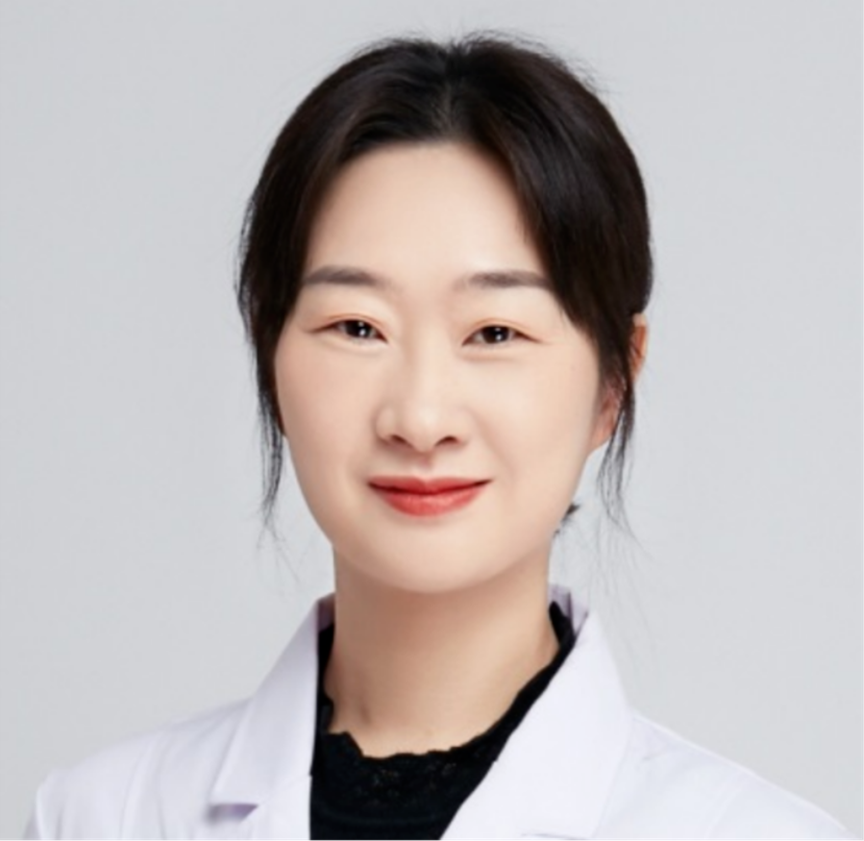
Director, Department of Hematology The First Affiliated Hospital of USTC (Anhui Provincial Hospital) Principal investigator of national key programs; >30 SCI publications in Cell, Blood, Blood Advances, Cell Reports Medicine, among others.
Prof. Kaiyang Ding

Director, Hematologic Oncology & Lymphoma/Myeloma Program The First Affiliated Hospital of USTC Senior leader in lymphoma and myeloma research; extensive experience in BTK inhibitor–based precision therapies.