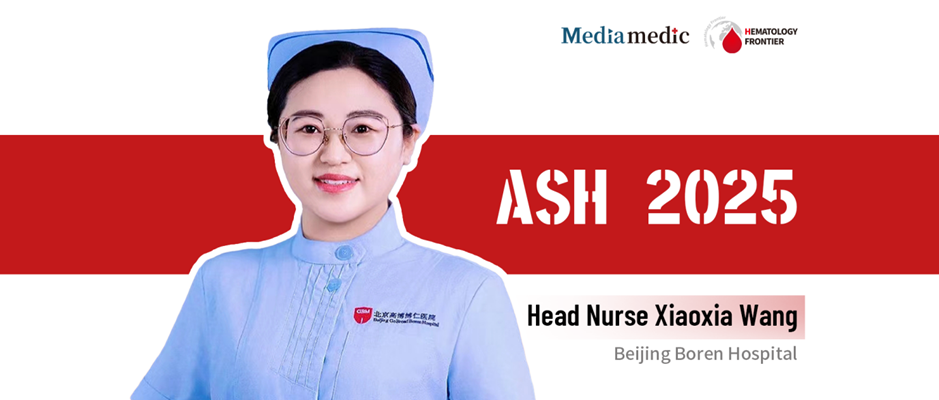
The 67th Annual Meeting of the American Society of Hematology (ASH) was held in Orlando from December 6 to 9, 2025. As the world’s largest and most influential hematology conference, ASH brings together tens of thousands of clinicians and researchers each year to share cutting-edge advances in the field.
At this year’s meeting, a study led by Chief Nurse Xiaoxia Wang from Beijing Gobroad Boren Hospital, titled “A Five-Year Continuous Improvement Pathway for Perianal Infection Prevention in Hematopoietic Stem Cell Transplantation Patients,” was successfully accepted. Through a data-driven approach and optimized nursing interventions, the study achieved a zero-infection milestone, delivering a powerful Chinese nursing voice on the international stage.
On site, Hematology Frontier invited Chief Nurse Wang to provide an in-depth interpretation of the study and to share plans for broader implementation.
Hematology Frontier: Perianal infection is known to be particularly challenging in HSCT patients. Why is it so difficult to manage, and why is prevention during the immunosuppressed phase especially critical?
Chief Nurse Xiaoxia Wang:
Perianal infection poses an exceptional challenge in hematopoietic stem cell transplantation (HSCT) patients for two main reasons. First, during the immunosuppressed phase, patients’ immune function is nearly “zeroed,” while the perianal mucosa is highly susceptible to micro-injuries. Once infection occurs, it can spread rapidly and may progress to sepsis, a life-threatening complication.
Second, the immunosuppressed phase represents the highest-risk window for infection. If prevention is inadequate at this stage, subsequent management becomes exponentially more difficult and may directly compromise transplant success. Therefore, effective perianal infection prevention during immunosuppression is a cornerstone of transplant safety and survival.
Hematology Frontier: You adopted a data-driven closed-loop management model. How did you ensure the accuracy and timeliness of data monitoring, and how were the data used to continuously optimize nursing practice?
Chief Nurse Xiaoxia Wang:
To ensure data accuracy and timeliness, we established a two-tier quality control system. First, a leadership structure was formed with the head nurse as team leader and the education lead as deputy. Dedicated wound-care specialists received standardized training in data collection, and all data underwent double verification to ensure accuracy at the source.
Second, we provided systematic training for all nurses on standardized assessment and documentation. The head nurse then conducted secondary verification of nurses’ assessments and wound-care records, eliminating underreporting or misclassification.
Data utilization was straightforward yet powerful. We regularly analyzed trends—identifying which patients, which stages, and which interventions were associated with higher risk or better outcomes. Based on these analyses, we continuously refined nursing workflows and intervention timing, forming a “monitor–analyze–optimize” closed loop that ensured care strategies remained tightly aligned with patient needs.
Hematology Frontier: Your study highlights an innovative comprehensive nursing intervention, including water-based–oil-based sequential application and rapid repair and cell regeneration technologies. Could you explain how this strategy was implemented and whether it changed nursing workflows?
Chief Nurse Xiaoxia Wang:
The core of this innovative strategy lies in the clinical application of Quanyuheyi Ointment combined with standardized operating procedures. We first conducted baseline assessments of perianal mucosal integrity and implemented stratified care plans.
The ointment contains key traditional herbal components—saffron (promoting circulation and detoxification), calculus bovis (anti-inflammatory and detoxifying), and dragon’s blood resin (wound healing and tissue regeneration). Using a water-based followed by oil-based sequential application, we enhanced absorption and formed a protective antimicrobial barrier over the perianal mucosa. The formulation effectively inhibits Staphylococcus aureus and Escherichia coli while remaining gentle on fragile mucosa.
Notably, the ointment also provides excellent analgesic and repair effects, significantly relieving pain and accelerating mucosal healing. We continuously monitored wound healing and pain relief, adjusting application frequency as needed.
Clinically, this approach markedly improved healing speed, reduced infection risk, and ultimately enabled zero infection. Importantly, it transformed nursing practice from a reactive “treat-after-problem” model to a proactive “early protection and dynamic monitoring” model, with standardized procedures that significantly improved efficiency and consistency.
Hematology Frontier: With perianal infection rates reduced to 0%, what challenges remain, and what advice would you offer to institutions seeking to adopt this model?
Chief Nurse Xiaoxia Wang:
Future challenges include adapting the model to different departments and treatment phases, as care conditions vary, and expanding long-term follow-up data to further validate durability.
Our optimization and dissemination strategy focuses on expanding the application of best-practice perianal care across more patient populations and clinical settings, including chemotherapy phases and post-transplant recovery. Larger sample sizes will further validate effectiveness and accelerate mucosal healing for more patients.
For implementation, we recommend:
- Standardizing core indicators and nursing workflows into practical manuals
- Conducting multicenter, hands-on training programs
- Establishing communication platforms to share real-world challenges and solutions
The herbal antimicrobial cleanser (Pimima) combined with Quanyuheyi Ointment also shows broad applicability in pressure ulcers, diabetic foot, burns, oral mucositis, perianal mucositis, and post-transplant sclerotic ulcers, under professional guidance. To date, no adverse reactions have been observed in hematology patients.
Study Abstract
Publication No. 5989
Title: A Five-Year Continuous Improvement Pathway for Perianal Infection Prevention in Hematopoietic Stem Cell Transplantation Patients: Achieving Zero Infection Through Data-Driven and Optimized Nursing Strategies
Background: Perianal infection is a common and severe complication in HSCT patients, particularly during post-transplant immunosuppression, where rapid progression to sepsis significantly increases transplant-related mortality. Profound immunodeficiency and mucosal barrier injury place HSCT patients at especially high risk.
Objective: To establish a data-driven, continuous quality improvement system for perianal infection prevention in HSCT laminar-flow wards, using a closed-loop model of monitoring, analysis, intervention optimization, and outcome verification.
Methods: A total of 809 HSCT patients treated between January 2020 and December 2024 were included. Thirteen core indicators—including mucosal injury rate, infection rate, nursing interventions, pain scores, and duration—were prospectively monitored. In 2023, an innovative comprehensive nursing intervention integrating rapid repair, analgesia, antimicrobial protection, and cell regeneration was implemented using sequential water–oil application techniques.
Results: From 2020 to 2024, perianal mucosal infection rates declined from 0.8%, 1.8%, 0.6%, and 0.2% to 0%, respectively. By 2024, zero perianal infections were achieved, with only mild mucositis observed and no progression to abscess, bloodstream infection, or transplant delay.
Conclusion: A data-driven closed-loop management model combined with continuously optimized nursing interventions can effectively reduce perianal infection in HSCT patients. Over five years, this approach transformed nursing practice from experience-based to precision-driven care, achieving a sustained zero-infection outcome and providing a scientific, practical framework for transplant infection prevention.
Expert Profile
Xiaoxia Wang, RN, MSN
Beijing Gobroad Boren Hospital
Chief Nurse, HSCT Laminar-Flow Unit II Associate Chief Nurse Master’s Degree in Management
Certified EWMA Wound Care Specialist Head, Institutional Skin & Wound Care Group Member, China Wound Repair Alliance Expert, Beijing Municipal Health Commission (Science Education)
With 22 years of experience in HSCT nursing, education, management, and research, Nurse Wang specializes in complex transplant care and mucocutaneous injury management. She has presented at APBMT, EBMT, EHA, and ASH, published multiple papers and patents, and received numerous awards for excellence in nursing leadership and education.