

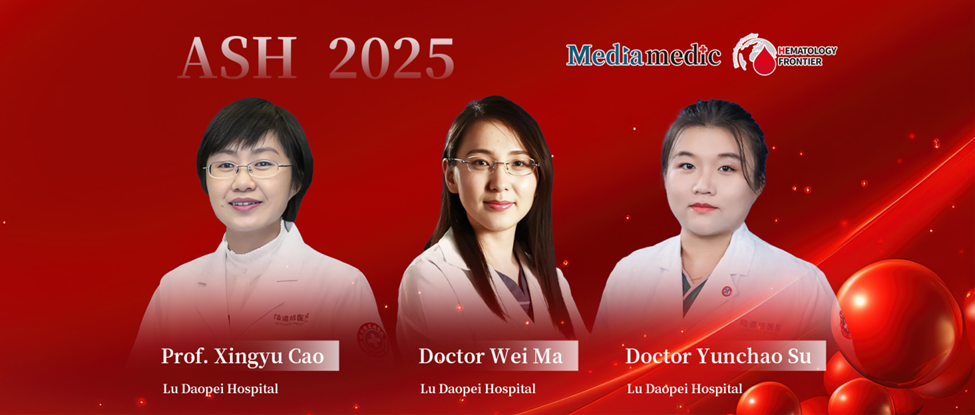
From December 6–9, 2025, the 67th American Society of Hematology (ASH) Annual Meeting was held in Orlando, USA. As one of the world’s largest and most influential academic events in hematology, the conference draws tens of thousands of experts each year to present major advances and breakthrough research.
At this year’s meeting, two studies from Professor Xingyu Cao’s team at Lu Daopei Hospital were selected for poster presentation. These studies focus on cytomegalovirus (CMV) infection, Epstein–Barr virus (EBV) viremia, and post-transplant lymphoproliferative disorder (PTLD) following allogeneic hematopoietic stem cell transplantation (allo-HSCT).
We invited the first authors, Wei Ma and Yunchao Su, to share their work.
Single-Center Retrospective Analysis of Maribavir in the Treatment of Refractory and Drug-Intolerant Cytomegalovirus Viremia and Cytomegalovirus Disease After Allogeneic Hematopoietic Stem Cell Transplantation
First Author: Wei Ma Corresponding Author: Xingyu Cao
Background
CMV infection is a frequent and potentially life-threatening complication after allo-HSCT. It is associated with increased non-relapse mortality (NRM), higher incidence of graft-versus-host disease (GVHD), and more secondary bacterial and fungal infections. Conventional anti-CMV agents cause bone marrow suppression and nephrotoxicity and have limited efficacy in refractory CMV infection or CMV disease.
Maribavir is a novel antiviral agent with multimodal anti-CMV activity, and with no cross-resistance to ganciclovir or foscarnet. Its therapeutic potential and improved safety profile make it noteworthy for post-transplant CMV infections.
Objective
To evaluate the safety and efficacy of maribavir in treating refractory or drug-intolerant CMV viremia and CMV disease after allo-HSCT.
Methods
This retrospective study analyzed patients treated with maribavir at Hebei Yanda Lu Daopei Hospital between April 2024 and March 2025. Maribavir was used under one of the following conditions:
- refractory CMV infection;
- intolerance to conventional antivirals (e.g., marrow suppression or renal impairment);
- early CMV reactivation soon after engraftment.
Dosing: ≥12 years: 400 mg orally twice daily; <12 years based on clinical trial NCT05319353.
Results
A total of 57 patients were included (35 male, 22 female), median age 30 years (1–61). The majority had AML or ALL; most (49) received haploidentical transplantation.
CMV serostatus before transplantation: D+/R+ in 88%.
Fifty patients had received letermovir prophylaxis. Median time to CMV viremia: 118 days post-transplant. Eight patients (14%) had CMV disease (5 pneumonia, 3 enteritis).
Before maribavir, 53 patients had already received traditional anti-CMV therapies; 5 developed renal injury, 6 developed pancytopenia. Four patients received maribavir as first-line therapy.
Median time from CMV detection to maribavir initiation: 6 days. Median treatment duration: 10.5 days. CMV DNA dropped below 1,000 copies/mL within 7 days of starting therapy.
Five patients had viral rebound after discontinuation; all achieved sustained negativity after re-treatment.
Adverse events were mild: grade 1 dysgeusia (4 cases), grade 2 marrow suppression (2 cases). Five deaths occurred (TA-TMA, septic shock, CMV pneumonia, and two grade IV aGVHD).
One-year overall survival: 86.5% (95% CI 74.7–98.4).
Conclusion
Oral maribavir achieved rapid viral clearance, high response rates, and favorable tolerability in both refractory and drug-intolerant CMV infection or disease after allo-HSCT.
Safety and Efficacy of Blinatumomab for EBV Viremia and PTLD Following Allogeneic Hematopoietic Stem Cell Transplantation
First Author: Yunchao Su Corresponding Author: Xingyu Cao
Background
Allo-HSCT is a key treatment for hematologic malignancies and selected non-malignant disorders. EBV infection or reactivation occurs in 30–60% of patients and up to 70–80% in high-risk groups (e.g., D+/R−, cord blood, heavy immunosuppression). EBV-PTLD occurs in 1–10% of allo-HSCT recipients, exceeding 15% in high-risk cases, with >50% mortality if untreated.
No effective direct anti-EBV drug currently exists. Rituximab targets CD20+ B cells but is ineffective for EBV infection involving plasma cells, T cells, or NK cells.
Since B cells and some plasma cells express CD19, they are potential targets for blinatumomab, a bispecific T-cell engager (BiTE®) linking CD19 on B-lineage cells to CD3 on T cells, activating endogenous T cells to eliminate CD19+ cells. Its immunomodulatory effects may benefit post-transplant patients with impaired EBV-specific T-cell immunity. However, evidence for its use in EBV viremia or PTLD after allo-HSCT is limited.
Methods
We retrospectively analyzed allo-HSCT recipients treated with blinatumomab for EBV viremia and/or PTLD at Beijing Lu Daopei Hospital and Hebei Yanda Lu Daopei Hospital from July 1, 2024 to August 1, 2025.
EBV viremia was defined as EBV DNA ≥1,000 copies/mL in plasma. Magnetic bead–based sorting quantified EBV DNA in B, T, NK, and plasma cells. PTLD diagnosis followed WHO criteria.
Results
Twelve patients (7 male, 5 female), median age 37 years (6–62), were included. Most had AML; 11 underwent haploidentical transplantation.
Median time to EBV viremia: 39 days post-transplant. Median time to starting blinatumomab: 46.5 days. Median interval between EBV viremia onset and blinatumomab treatment: 8.5 days.
Median EBV DNA at treatment: 7.2 × 10³ copies/mL. EBV was detectable in multiple cell types across patients, including B cells, T cells, NK cells, and plasma cells.
Six patients had peripheral monoclonal cell populations (B cells, plasma cells, or both); all resolved after treatment. Five patients had lymphadenopathy; one was biopsy-confirmed polymorphic PTLD. All achieved complete resolution after therapy.
Most patients had received immunosuppressants and various pre-emptive treatments (rituximab, DLI, IL-2, IFN-α, anti-CD38), generally without adequate response.
Blinatumomab was dosed by weight: • >45 kg: 9 μg/day (one escalated to 28 μg/day) • <45 kg: 5 μg/m²/day (one escalated to 15 μg/m²/day)
Median treatment duration: 8.5 days.
All 12 patients achieved complete EBV clearance. Median time to negativity: 11 days. None experienced EBV recurrence after discontinuation.
CRS occurred in 4 patients, all grade 1. No ICANS and no drug-related severe toxicity. No GVHD during treatment; 4 mild GVHD events occurred later.
As of August 1, 2025, all patients were alive.
Conclusion
Blinatumomab demonstrated excellent safety and a high response rate for EBV viremia and/or PTLD after allo-HSCT, supporting further investigation with larger cohorts.
Expert Biography

Xingyu Cao, Professor
Lu Daopei Hospital MD, Chief Physician, Transplant Specialist Director of the Bone Marrow Transplantation Department (Vice-President level) at Beijing Lu Daopei Hospital and Hebei Yanda Lu Daopei Hospital Member, Hematology Branch of the Beijing Medical Association Member, Hematopoietic Stem Cell Transplantation Committee of the Beijing Anti-Cancer Society Standing Member, First Hematopoietic Stem Cell Application Committee of the Hebei Society of Experimental Hematology Youth Member, Translational Hematology Committee of the China Anti-Cancer Association
First Author Biographies

Wei Ma
Lu Daopei Hospital MS, Associate Chief Physician Has worked in clinical hematology since 2010 Joined the Transplantation Department at Lu Daopei Hospital in 2012 and continues to work there Has participated in more than 700 hematopoietic stem cell transplantation procedures Has presented posters at multiple national and international hematology conferences
Areas of expertise: Comprehensive experience in diagnosing and treating common hematologic disorders. Skilled in applying hematopoietic stem cell transplantation to a broad range of diseases, including: • Acute leukemia • Chronic myeloid leukemia • Aplastic anemia • Myelodysplastic syndromes • Hemophagocytic lymphohistiocytosis • Dyskeratosis congenita • Paroxysmal nocturnal hemoglobinuria • Lymphoma • Multiple myeloma • Plasma cell leukemia
She has extensive experience managing post-transplant complications such as acute and chronic GVHD, infections, viral diseases, hemorrhagic cystitis, and relapse.

Yunchao Su
Lu Daopei Hospital
Transplantation Department, Beijing Lu Daopei Hospital
Attending Physician
After graduating in 2012, he joined the Hematology Department at Hebei Yanda Lu Daopei Hospital. He is experienced in diagnosing and treating general hematologic diseases, leukemia, lymphoma, and autologous transplantation. He is also proficient in managing cytokine release syndrome (CRS) associated with CAR-T therapies targeting CD19, CD22, CD7, and BCMA.
Since June 2022, he has been working in the Transplantation Department at Beijing Lu Daopei Hospital, participating in allogeneic hematopoietic stem cell transplantation for various hematologic malignancies and managing common post-transplant complications such as acute graft rejection.

