At the 2026 American Society of Clinical Oncology (ASCO) Annual Meeting, held from May 29 to June 2 in Chicago, USA, results from the IRIS-A study (Abstract #508) were presented during the Rapid Oral Abstract Session on Local, Regional, and Adjuvant Breast Cancer.Conducted by the team of Zhimin Shao and Zhonghua Wang at Fudan University Shanghai Cancer Center, the study demonstrated that oral capecitabine plus trastuzumab as adjuvant therapy for Stage IA HER2-positive breast cancer achieved an outstanding 5-year invasive disease-free survival (iDFS) rate of 97.8% while substantially reducing treatment-related toxicity. The findings suggest that this chemotherapy de-escalation strategy may become a new adjuvant treatment option for patients with favorable-risk Stage IA disease.
Oncology Frontier invited Ruoxi Wang, who presented the study at ASCO, to discuss the rationale behind the IRIS-A trial, its key findings, and the potential impact of the ongoing Phase III confirmatory study and the broader IRIS research program on future clinical practice.
Oncology Frontier: The IRIS-A study adopted an oral capecitabine plus trastuzumab regimen to achieve de-escalation by eliminating intravenous chemotherapy. Why was capecitabine selected over other oral agents, and what efficacy did the study demonstrate?
Ruoxi Wang:
The IRIS-A study focused on patients with Stage IA HER2-positive breast cancer and evaluated a de-escalated adjuvant regimen consisting of oral capecitabine combined with trastuzumab.
Capecitabine was selected because it is one of the most widely used oral chemotherapeutic agents, is highly accessible, and offers favorable cost-effectiveness. Its efficacy and safety have already been well established in multiple clinical settings, including intensified adjuvant treatment for triple-negative breast cancer in the CREATE-X trial and in the management of metastatic disease.
Our treatment schedule consisted of six cycles of capecitabine plus trastuzumab, with the design largely inspired by the landmark APT trial, which administered weekly paclitaxel plus trastuzumab over a 12-week period. Our goal was to reduce treatment toxicity while maintaining excellent efficacy.
Although the current study included a relatively modest number of patients, we plan to conduct additional randomized controlled trials to further validate this regimen as a low-toxicity, chemotherapy-sparing alternative for selected patients with early-stage HER2-positive breast cancer.
Oncology Frontier: More than 80% of patients in IRIS-A had tumors measuring ≤0.5 cm, while 87.2% had hormone receptor-negative disease. After a median follow-up of 62 months, the 5-year iDFS reached 97.8%. Given these excellent outcomes in such an early-stage population, do you think targeted therapy combined with oral chemotherapy alone may eventually be sufficient? How should clinicians identify patients most suitable for this de-escalation strategy while avoiding overtreatment?
Ruoxi Wang:
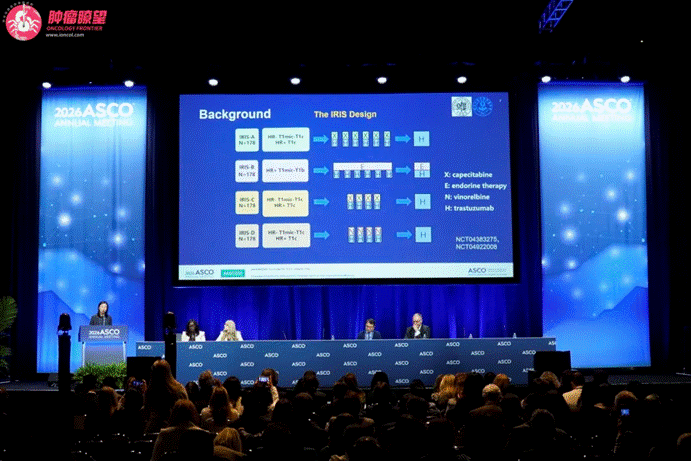
The IRIS program consists of four cohorts—IRIS-A, B, C, and D—with IRIS-A being the first to complete its primary endpoint.
In IRIS-B, we have already begun exploring the complete omission of chemotherapy by evaluating one year of trastuzumab combined with five years of endocrine therapy alone. Meanwhile, IRIS-C and IRIS-D investigate further reductions in oral chemotherapy intensity by shortening capecitabine treatment from six cycles to four.
The overall objective of the IRIS program is to determine which de-escalated regimen—and what treatment duration—can maintain excellent efficacy while minimizing treatment burden and improving routine clinical practice. However, additional evidence is still needed.
To further address these questions, our center has initiated an ongoing Phase III randomized controlled trial. Patients receiving the experimental regimen are treated with six cycles of capecitabine plus trastuzumab, while the control arm follows the established APT regimen, consisting of 12 weeks of weekly paclitaxel plus one year of trastuzumab.
We look forward to sharing those results in the future, which we hope will provide stronger evidence supporting de-escalated treatment strategies—and perhaps even return to the ASCO stage.
Oncology Frontier: Grade ≥3 adverse events occurred in only 2.7% of patients, with hand-foot syndrome being the main toxicity and no impact on treatment completion. Could you describe the design of the ongoing Phase III study? If its findings confirm the IRIS-A results, how might this China-developed strategy influence international guidelines and clinical practice?
Ruoxi Wang:
Treatment toxicity was actually one of the key discussion points following my presentation at ASCO. Both Chinese and international patients are increasingly seeking adjuvant therapies that are not only effective but also less toxic.
Compared with conventional intravenous chemotherapy, our regimen resulted in few serious adverse effects beyond hand-foot syndrome. Importantly, patients generally did not experience significant alopecia, nor did they require central venous access devices, which represents a meaningful quality-of-life advantage for lower-risk patients and long-term cancer survivors.
The ongoing Phase III study enrolls patients with HER2-amplified breast cancers measuring ≤2 cm and randomly assigns them to either six cycles of capecitabine plus trastuzumab or the current standard regimen of 12 weeks of weekly paclitaxel followed by completion of one year of trastuzumab, as established by the APT trial.
When the study is completed, it will provide more definitive efficacy data as well as a more comprehensive assessment of treatment-related toxicities.
Study Overview
Background
Based on the single-arm Phase II APT trial, weekly paclitaxel plus trastuzumab has become the standard adjuvant treatment for most patients with Stage I HER2-positive breast cancer. However, treatment-related toxicity remains a concern, prompting ongoing interest in less intensive regimens that can preserve efficacy while improving tolerability.
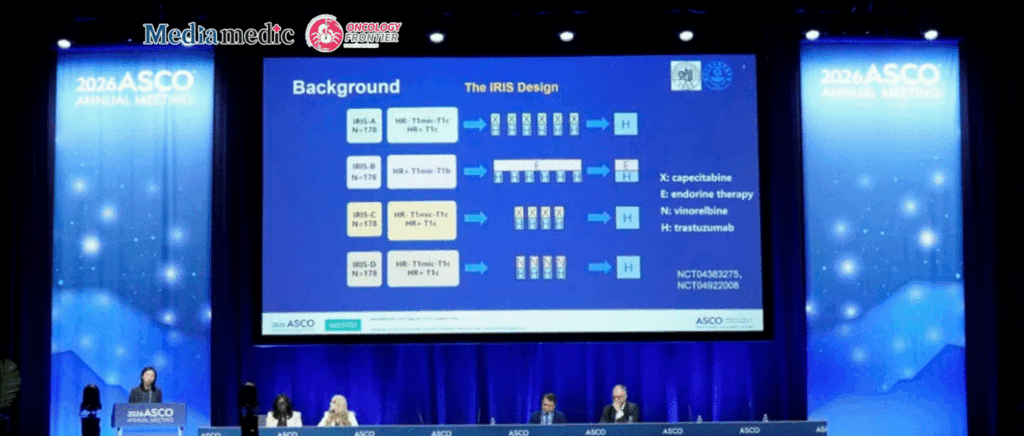
The IRIS program (NCT04383275) was designed as a series of single-arm de-escalation studies evaluating adjuvant treatment strategies that avoid intravenous chemotherapy in patients with early-stage HER2-positive breast cancer.
The program includes:
- IRIS-A: Capecitabine plus trastuzumab
- IRIS-B: Endocrine therapy plus trastuzumab
- IRIS-C: Short-course capecitabine plus trastuzumab
- IRIS-D: Vinorelbine plus trastuzumab
IRIS-A is the first cohort to report results.
Methods
Patients with pathologically confirmed Stage IA HER2-positive breast cancer received:
- Oral capecitabine (1,000 mg/m² twice daily for 14 days every 3 weeks) combined with
- Trastuzumab (8 mg/kg loading dose followed by 6 mg/kg)
This combination was administered for six cycles, followed by 11 additional cycles of trastuzumab monotherapy given every three weeks.
The primary endpoint was invasive disease-free survival (iDFS).
Results
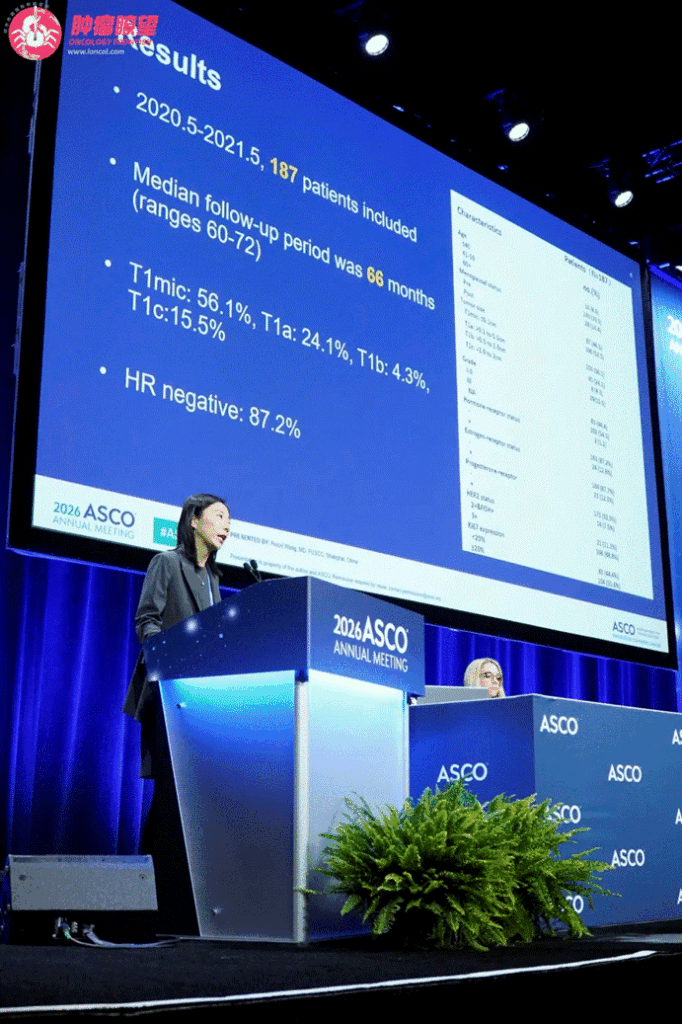
Between May 20, 2020, and May 27, 2021, 187 patients were enrolled at Fudan University Shanghai Cancer Center.
More than 80% (80.2%) had tumors measuring ≤0.5 cm, while 87.2% had hormone receptor-negative disease.
After a median follow-up of 62 months (range, 56–68 months), the 5-year iDFS rate reached 97.8% (95% CI, 94.3%–99.1%).
Only four recurrence events were observed. Two represented new contralateral HER2-negative primary invasive breast cancers rather than recurrence of the original disease. Excluding these events and other non-breast cancer events, only two disease-specific recurrences occurred, including one ipsilateral breast and axillary recurrence. No deaths were reported during the study.
Only five patients (2.7%) experienced at least one Grade 3 adverse event, none of which interfered with treatment completion. The most common adverse event was hand-foot syndrome, occurring in 46.5% of patients overall, with Grade 3 events reported in only 1.1%.
Conclusion
Adjuvant capecitabine plus trastuzumab achieved an excellent 5-year iDFS of 97.8% in patients with Stage IA HER2-positive breast cancer, while maintaining a highly favorable safety profile and preserving treatment continuity.
The regimen represents a promising low-toxicity alternative for selected patients with small HER2-positive tumors, and a confirmatory Phase III trial is currently underway.
Expert Profiles

Zhimin Shao
Fudan University Shanghai Cancer Center

Zhonghua Wang
Fudan University Shanghai Cancer Center

Ruoxi Wang
Fudan University Shanghai Cancer Center