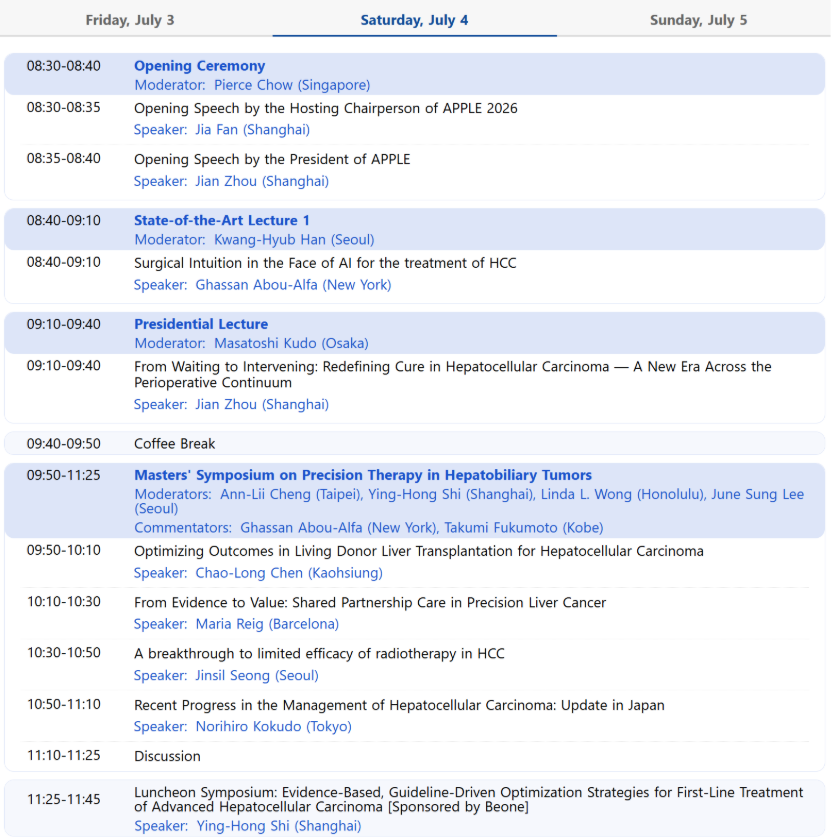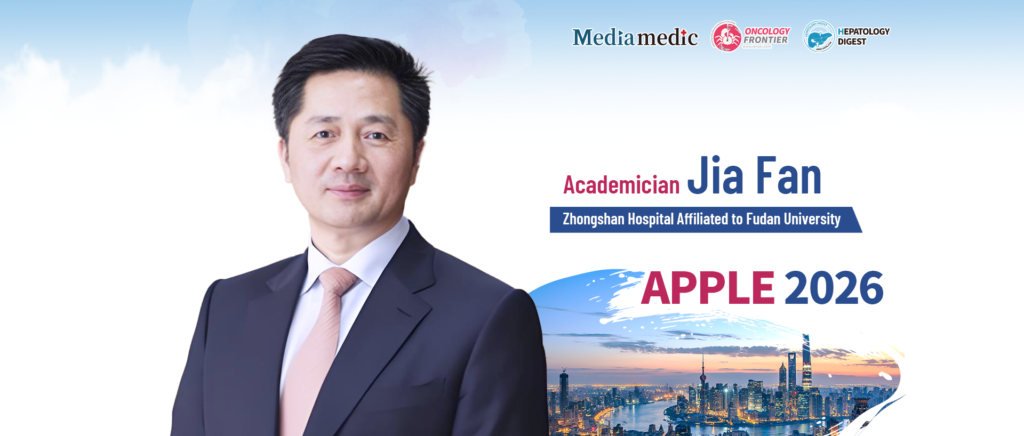

Editor's Note: From July 3–5, 2026, the 16th Asia-Pacific Primary Liver Cancer Expert Meeting (APPLE 2026) will be held in Shanghai. Initiated by the Asia-Pacific Primary Liver Cancer Expert Association (APPLE), supported by the Shanghai Xinxin Medical Technology Development Foundation, and hosted by Zhongshan Hospital, Fudan University, the meeting will focus on the theme "Frontiers in the Diagnosis and Treatment of Primary Liver Cancer in the Era of Artificial Intelligence." Bringing together leading liver cancer experts from the Asia-Pacific region, Europe, and North America, APPLE 2026 will explore emerging strategies for liver cancer prevention and treatment. Following previous editions in 2012 and 2022, this marks the third time APPLE has been hosted in Shanghai, highlighting China's remarkable progress in healthcare, scientific research, and innovation over the past decade. Ahead of the meeting, Oncology Frontier spoke with Congress President Academician Jia Fan of Zhongshan Hospital, Fudan University, who reflected on APPLE's evolution, discussed the changing role of Chinese liver cancer specialists on the global stage, and shared his vision for how artificial intelligence (AI) will transform liver cancer care. Stay tuned for this landmark event. Oncology Frontier: APPLE returns to Shanghai for the third time, reflecting the evolution of liver cancer care across the Asia-Pacific region. Looking back over APPLE’s 16-year history, how has the role of Chinese liver cancer specialists evolved on the APPLE stage, and what does this transformation represent regarding China’s progress in liver cancer research and clinical practice?
Academician Jia Fan:
As we all know, approximately 80% of liver cancer-related deaths worldwide occur in the Asia-Pacific region. Strengthening liver cancer prevention and treatment across this region is therefore critical to improving global health.
In 2010, liver cancer research organizations from China, Japan, and South Korea jointly initiated the APPLE Meeting, laying the foundation for what would become the Asia-Pacific Primary Liver Cancer Expert Association. During the fourth APPLE Meeting in 2013, the APPLE Alliance was officially established, creating a dedicated academic platform for regional collaboration, information sharing, and consensus building in liver cancer management.
As one of APPLE’s founding core members, China has both the responsibility and the obligation to contribute to liver cancer prevention and treatment across the Asia-Pacific region and beyond.
In July 2012, the APPLE Meeting was held in Shanghai for the first time, hosted by the Liver Cancer Institute of Zhongshan Hospital, Fudan University. Nearly 500 delegates from across the Asia-Pacific region attended, establishing APPLE’s strong international academic reputation. Ten years later, despite the challenges posed by the COVID-19 pandemic, APPLE 2022 again took place in Shanghai, attracting more than 600 registered participants from not only the Asia-Pacific region but also Europe and North America, including Denmark, Italy, and the United States, demonstrating the steadily growing international influence of APPLE.
Today, APPLE returns to Shanghai for a third time, with Academician Jian Zhou and myself serving as Congress Presidents. This reflects not only international recognition of China’s achievements in liver cancer prevention and control, but also the country’s remarkable advances in healthcare, scientific research, and economic development.
Across these three meetings, we have witnessed China’s transformation from a learner to a core contributor in the global liver cancer community. Sixteen years ago, Chinese investigators primarily came to learn from international colleagues. Today, they play increasingly influential roles on the world stage. This evolution mirrors China’s progression from following international advances, to standing alongside global leaders, and now, in many areas, helping lead the field.
Today, Chinese experts are not only deeply involved in developing international consensus statements but are also taking leading roles in major global research initiatives. In 2017, I was invited by The Lancet to serve as an initiating author and Chair of the Lancet Commission on Liver Cancer. Together with Academician Jian Zhou from China, Professor Masatoshi Kudo from Japan, and 51 renowned experts from ten countries and regions, we developed a comprehensive global strategy and action plan covering liver cancer prevention through treatment. This represented the first major global disease report led by Chinese investigators in The Lancet‘s more than 200-year history.
Looking ahead, we will continue to uphold APPLE’s mission of promoting scientific management of liver cancer, advancing academic exchange, building consensus, integrating research with clinical practice and industry, and continuously improving liver cancer education and patient care throughout the Asia-Pacific region, while contributing to global efforts against liver cancer.
Oncology Frontier: Tokens and artificial intelligence have become defining technological themes of 2026. APPLE 2026 has chosen “Frontiers in the Diagnosis and Treatment of Primary Liver Cancer in the Era of Artificial Intelligence” as its central theme. As we enter the Fourth Industrial Revolution, how can Chinese investigators leverage AI to lead innovation in liver cancer management across the Asia-Pacific region and globally?
Academician Jia Fan:
By selecting “Frontiers in the Diagnosis and Treatment of Primary Liver Cancer in the Era of Artificial Intelligence” as the theme of APPLE 2026, we are actively embracing the opportunities presented by the Fourth Industrial Revolution.
From the emergence of ChatGPT and large language models to AI-driven advances throughout the life sciences, artificial intelligence is fundamentally reshaping modern healthcare. APPLE 2026 has placed AI at the forefront by organizing dedicated sessions covering AI applications in liver cancer screening, diagnosis, surgery, systemic therapy, and precision medicine. These discussions will not only broaden clinicians’ understanding of AI but also establish a stronger foundation for its practical implementation.
To accelerate AI adoption, our surgical team has collaborated with the Fudan University Institute of Intelligent Robotics to develop technologies integrating three-dimensional liver anatomical reconstruction with real-time laparoscopic and robotic surgical imaging. Before surgery, we construct digital twin models of the liver and its vascular structures. During surgery, AI performs real-time image matching and intelligent monitoring, providing navigation guidance that enables complete tumor resection while preserving healthy liver tissue.
Beyond surgery, we have developed AI agents based on our academician-led clinical team to support comprehensive liver cancer management. These systems provide liver disease education and preliminary screening for the public while enabling physicians to instantly retrieve diagnostic and treatment pathways. They also help visualize clinical decision-making for complex cases, improving patient management and accelerating the education of younger physicians.
Our team is also developing AI-assisted systems for early liver cancer screening, treatment recommendation, and prognostic assessment, with the goal of optimizing healthcare resource allocation and benefiting more patients.
Looking ahead, I believe AI offers even broader opportunities in liver cancer care.
In screening, deep-learning algorithms analyzing ultrasound, CT, and MRI images can substantially improve the early detection of liver cancer and identify small lesions with greater precision.
In diagnosis, AI-assisted pathology combined with multimodal data integration may significantly enhance preoperative diagnostic accuracy and staging assessment.
In drug development, AI can accelerate target discovery, compound screening, and clinical trial design, thereby shortening the development timeline for novel therapeutics.
In addition, AI has tremendous potential to support prognostic modeling, personalized treatment recommendations, and dynamic postoperative recurrence risk assessment throughout the entire continuum of patient management.
Ultimately, I encourage everyone to actively embrace the development of artificial intelligence. Together, we should strive to contribute new “China Solutions” during the Fourth Industrial Revolution and continue driving innovation in liver cancer diagnosis and treatment throughout the Asia-Pacific region and around the world.
APPLE 2026 Key Information
Online registration closes on July 1, 2026.
The meeting will be held from July 3–5, 2026 (registration on July 3 and departure on July 5).
Venue: InterContinental Shanghai Expo, 1188 Xueye Road, Pudong New Area, Shanghai, China.
Congress Website: https://APPLE2026.medcircle.cn
Contact: Ms. Han | +86 13269296751
Email: apple2026_support@163.com
The main scientific program is available through the congress website, along with the complete meeting schedule.