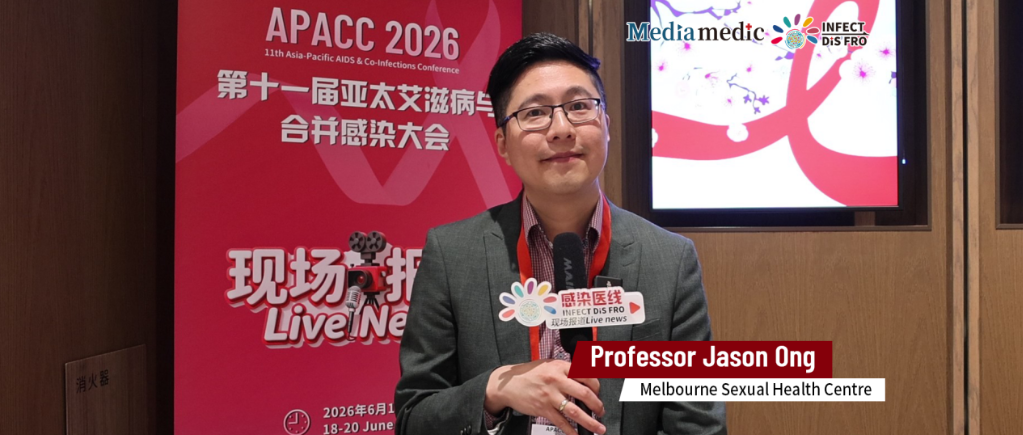

Editor's Note: The 2026 Asia-Pacific AIDS and Co-infections Conference (APACC 2026) was successfully held in Tokyo, Japan. Focusing on cutting-edge practices and technological innovations in the prevention and control of HIV and sexually transmitted infections, the conference gathered global experts in the field to explore pathways for optimizing public health services. Our journal specially invited Professor Jason Ong from the Melbourne Sexual Health Centre in Australia for an in-depth interview. Professor Jason Ong discussed two core topics: the community co-created intervention model for improving the accessibility of HIV pre-exposure prophylaxis (PrEP), and the application prospects and implementation barriers of AI technology in the whole-process management of HIV/sexually transmitted infections (STIs). Combined with findings from local clinical trials in Australia and reflections on the adaptability of regional promotion in the Asia-Pacific, he shared practical experience and forward-looking insights on the innovation of prevention and control models, providing professional references for the optimization of HIV prevention and control strategies.
Infectious Disease Frontier: In your PrEP STAT randomized controlled trial in Australia, what were the respective impacts of the free same-day PrEP starter pack on PrEP initiation, continuation, and discontinuation rates? Could you share the key findings and their implications?
Prof. Jason Ong: Thank you for your interest in the PrEP STAT trial. First and foremost, it should be noted that the intervention protocol of this study was co-developed with the community. We adopted a “crowdsourcing” methodology to generate solutions to improve PrEP access for overseas-born gay and bisexual men, then refined and optimized the program through a “designathon” event. The core intervention tool of this trial—the “Love Pack”—was ultimately developed through this process.
The Love Pack is presented as a tote bag containing a one-month supply of PrEP medication and a postcard printed with community-endorsed medication encouragement messages. A “pay it forward” mechanism is also in place: after receiving the free PrEP supplies, recipients may voluntarily donate funds to support the next user.
During trial implementation, once a clinic physician confirms that an individual can benefit from PrEP, the Love Pack is immediately given to the patient, enabling medication initiation on the day of the visit. Under Australia’s traditional clinical workflow, users must first obtain a paper prescription and then collect the medication at a pharmacy. Even if the pharmacy is only a 10-minute walk from the clinic, same-day immediate initiation may not be achievable for some. We launched this trial precisely to verify the real-world effectiveness of this community co-created intervention.
The core trial results demonstrate remarkable efficacy of the intervention. As the program was co-designed by the target community—with refined packaging and medication guidance tailored by and for the community itself—it is more readily accepted by the target population. The study ultimately found that subjects who received the Love Pack had a higher PrEP initiation rate and initiated medication more rapidly.
Infectious Disease Frontier: In your view, what is the key mechanism behind the effectiveness of the “PrEP STAT Pack” intervention — is it “free access,” “same-day initiation,” or the “packaging simplification” itself? What adaptations might be needed to scale up this model in low- and middle-income countries in Asia?
Prof. Jason Ong: All three factors contribute to the intervention’s effect, with free provision exerting the most significant impact. In Australia, people not covered by Medicare must bear PrEP costs out of pocket. In contrast, this intervention provides completely free PrEP medication to subjects in a single clinic visit, serving as powerful driver of uptake . A large-scale study we previously conducted across 16 Asia-Pacific countries (PrEP APPEAL) also confirmed that free supply can significantly increase population willingness to use PrEP, indicating that cost reduction is a core driver of PrEP uptake.
The same-day initiation model also plays a critical role. From a behavioral economics perspective, streamlining processes and minimizing steps and barriers can effectively boost the target population’s willingness to take action. Under the traditional care model, users must first obtain a paper prescription and then visit a pharmacy to collect medication. Even with a pharmacy just a 10-minute walk from the clinic, this adds an extra step. By dispensing medication directly during a single clinic visit, this intervention greatly lowers the threshold for PrEP initiation and effectively improves initiation efficiency.
In comparison, the impact of packaging design is very limited. We conducted an accompanying qualitative study to evaluate the actual role of packaging. Results showed that some subjects were confused by why there were the postcard messages and they did not improve their likelihood to use PrEP. So, with our trial results combined with qualitative interview findings, it is confirmed that free provision and same-day initiation are the core driving factors behind the intervention’s effectiveness.
This study has also directly advanced the optimization of Australia’s local PrEP policy: the Australian government is investing 52 million Australian dollars over the next four years to provide PrEP coverage for people without Medicare. Non-Australian citizens and non-permanent residents are now eligible for this new coverage scheme, and the trial findings have effectively driven innovation in the local public health supply model for PrEP.
Infectious Disease Frontier: In your second presentation, you will discuss how AI can transform HIV/STI services. Specifically for the full continuum of PrEP care — including initiation, adherence monitoring, and discontinuation risk prediction — what are the most mature or most promising applications of AI at this point?
Prof. Jason Ong: AI technology holds broad application prospects. Currently, the most mature AI application in the PrEP field is to provide a more accurate HIV infection risk assessment. Our research has found that the general public often cannot accurately judge their own HIV infection risk independently, while existing AI tools can precisely calculate an individual’s probability of HIV infection in the coming year, thereby guiding high-risk groups to actively consider PrEP as a prevention strategy. Such technologies are already mature and ready for use.
The next highly promising development direction for AI is chatbots. Users can learn about PrEP-related knowledge through AI virtual dialogue interfaces, and these chatbots can integrate risk assessment functions and help users locate nearby PrEP service providers. Such applications are gradually being rolled out and offer extremely high application value. Their core advantage is breaking the service limitations of offline clinics: on one hand, they effectively help people avoid the stigma associated with visiting sexual health clinics in person; on the other hand, they enable 24/7 round-the-clock services, allowing users to seek consultation and access professional information at any time.
In summary, precise risk assessment and AI chatbots represent the two most landmark breakthrough applications of AI in PrEP management today. More innovative AI application scenarios will emerge in this field in the coming years.
Infectious Disease Frontier: Moving from clinical trials to real-world implementation, what are the key barriers to scaling up AI in HIV/STI services (such as data privacy, algorithmic bias, clinical trust, and infrastructure)? In your opinion, what issues should be prioritized for resolution?
Prof. Jason Ong: The AI industry is developing rapidly, yet a critical issue persists: communities and clinical populations are not deeply involved in tool research and development. The prevailing model is that technical teams develop tools independently and then promote them for external adoption, an approach that struggles to build user trust.
Clinicians, researchers and community members must participate in the entire lifecycle of AI tool development and implementation, and fully understand the tools’ development logic and data sources, before they can truly endorse and adopt related products. Lack of trust is the core barrier to current AI implementation, and it is also the top priority that requires urgent resolution.
The second key issue is data privacy and information confidentiality. Users generally have concerns about personal data leakage, which directly impacts tool acceptance. In addition, AI carries the potential risk of outputting incorrect information and misleading users. Various AI governance frameworks are currently focusing on regulating this issue to mitigate related safety hazards.