
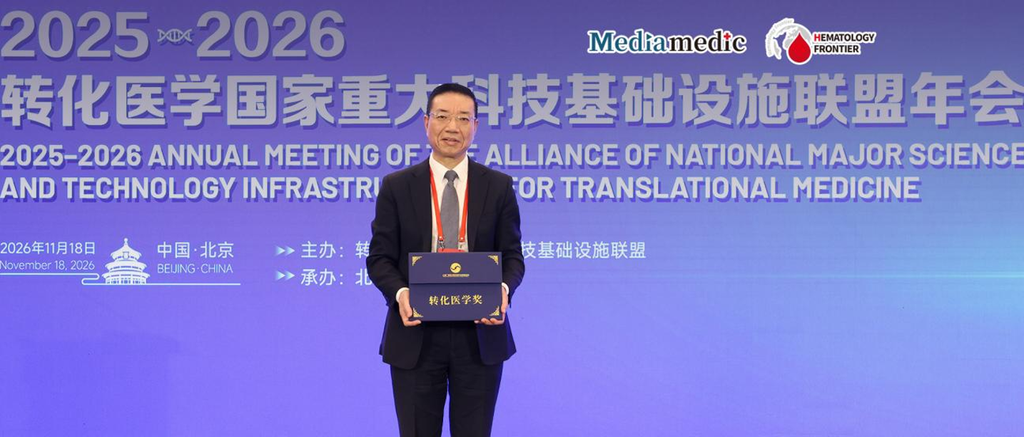
Editor's Note: On November 18, 2026, the 2025–2026 Annual Conference of the National Major Scientific and Technological Infrastructure Alliance for Translational Medicine was held in Beijing. The conference was organized by the National Major Scientific and Technological Infrastructure Alliance for Translational Medicine and hosted by Peking Union Medical College Hospital. Marking the 10th anniversary of the Alliance, the conference reviewed a decade of collaborative innovation, focused on the bidirectional translation between basic research and clinical practice driven by clinical needs, and explored new pathways for the high-quality development of translational medicine.Academician Chen Zhu, Vice Chairman of the Standing Committee of the 13th National People’s Congress and Chief Technical Scientist of the National Science and Technology Major Project for the Prevention and Treatment of Four Major Chronic Diseases, attended the conference alongside leaders from the National Health Commission, the National Development and Reform Commission, and other relevant government departments, as well as leading academicians, experts, and scholars in translational medicine from China and abroad. The 9th Translational Medicine Awards were announced and presented at the conference. Among the distinguished recipients, Professor He Huang of The First Affiliated Hospital, Zhejiang University School of Medicine, received the 9th Outstanding Contribution Award in Translational Medicine in recognition of his sustained innovation and major breakthroughs in hematopoietic stem cell transplantation and cellular immunotherapy, as well as the translation of these achievements into clinical practice. He also delivered a major academic presentation at the conference.

A Moment of Recognition
Professor He Huang Receives the 9th Outstanding Contribution Award in Translational Medicine
A major highlight of the Alliance’s annual conference, the 9th Translational Medicine Awards Ceremony was held in a solemn yet celebratory atmosphere. The ceremony was hosted by Dr. Weizhu Zhao, Vice President of Ruijin Hospital, Shanghai Jiao Tong University School of Medicine. Academician Saijuan Chen, Lifetime Professor at Ruijin Hospital, Shanghai Jiao Tong University School of Medicine, and Director of the National Major Scientific and Technological Infrastructure for Translational Medicine (Shanghai), delivered the award citation.
This year’s awards included the International Collaboration Award, the Outstanding Contribution Award, and the Innovation Award. Professor He Huang of The First Affiliated Hospital, Zhejiang University School of Medicine, and Professor Guoying Huang, former President of Children’s Hospital of Fudan University, jointly received the 9th Outstanding Contribution Award in Translational Medicine. Academician Yupeng Zhao and Academician Saijuan Chen presented the awards.
In her award citation, Academician Saijuan Chen stated: “Professor He Huang has continued to achieve breakthroughs in hematopoietic stem cell transplantation, cellular immunotherapy, and their clinical translation, bringing new treatment opportunities to patients.” This recognition fully acknowledges Professor He Huang’s longstanding commitment to clinical practice and scientific research, his sustained innovation in these fields, and his achievements in translating research findings into clinical applications. It also reflects the positive progress made in China’s hematology field in addressing major clinical needs and advancing medical innovation and clinical application.
Academic Presentation
Innovation and Clinical Translation in Cellular Immunotherapy
At the subsequent Translational Medicine Forum, Professor He Huang delivered a special presentation entitled “Innovation and Clinical Translation in Cellular Immunotherapy.” He noted that relapse and refractory disease in hematologic malignancies, including leukemia, lymphoma, and multiple myeloma, remain major challenges in clinical treatment.
Since the 1990s, his team has conducted research on hematopoietic stem cell transplantation, focusing on key issues such as unrelated donor sources, optimization of transplantation techniques, and post-transplant relapse. Their related achievements received the Second Prize of the National Science and Technology Progress Award twice, in 2003 and 2015, and helped bring techniques such as haploidentical hematopoietic stem cell transplantation into clinical practice.
With the development of CAR-T cell therapy, new treatment options have emerged for patients with relapsed or refractory hematologic malignancies. However, clinical application still faces several challenges, including the need to improve the cytotoxic function and persistence of CAR-T cells, the high cost of individualized manufacturing, and the relatively limited range of therapeutic targets.
To address these challenges, Professor He Huang’s team has investigated fundamental mechanisms and explored how mitochondrial regulation, iron metabolism and ferroptosis, and KLF2-related transcriptional regulation affect CAR-T cell function, exhaustion, and memory formation. The team has also examined the relationships between the gut microbiome, its metabolites, CAR-T treatment efficacy, and cytokine release syndrome (CRS. Building on these mechanistic investigations, the team has continued to advance the development of novel cellular therapy products, including induced pluripotent stem cell (iPSC)-derived CD70 CAR-T/CAR-NK cells, BiTE-secreting CAR-T cells targeting myeloid leukemia, and CAR-T products with enhanced cellular function through targeted PD-1 knockout.
In addition, for patients with multiple myeloma who relapse after BCMA CAR-T therapy, the team has explored a bispecific nanobody strategy targeting the neoantigen GPRC5D. For T-cell malignancies, the team has developed universal CD7-targeted CAR-T cells through multiplex gene editing. It has also explored a new strategy to enhance CAR-T cell metabolic function and antitumor activity by incorporating IL-10 into the CAR molecule. Related research has been published in journals including Nature, Cell Research, The Lancet Haematology, and JAMA Oncology, continuously advancing mechanistic innovation and product translation in CAR-T cell therapy.
At the clinical application level, Professor He Huang’s team has further explored how integrating different treatment strategies can overcome the limitations of individual therapies. For patients with newly diagnosed Philadelphia chromosome-positive acute lymphoblastic leukemia (Ph-positive ALL), the team has investigated targeted therapy combined with CAR-T treatment, followed by maintenance with targeted agents, as a potential treatment pathway that does not rely on conventional chemotherapy or transplantation. The study showed a two-year disease-free survival rate of 92%.
To address the potential for severe myelosuppression following CD7 CAR-T therapy, the team innovatively explored a treatment strategy in which donor-derived CD7 CAR-T cells were used as a bridge to hematopoietic stem cell transplantation from the same donor. The related research was published in The New England Journal of Medicine (NEJM), providing a new therapeutic approach for patients with relapsed or refractory leukemia. The team has also extended cellular immunotherapy into the field of autoimmune diseases. Given the joint involvement of B cells and plasma cells in the pathogenesis of systemic lupus erythematosus (SLE), the team has explored dual-target CD19/BCMA CAR-T therapy. The related research was published in Nature Medicine and featured on the journal’s cover.
Professor He Huang emphasized that the essence of translational medicine lies in establishing a complete pathway that begins with clinical problems, proceeds through basic mechanistic research and the development of new products, and ultimately returns to clinical validation and application. While continuously advancing technological innovation, his team has also actively pursued international academic exchanges, clinical research collaborations, and patient services, with the aim of making innovative therapies accessible to more patients. He stressed that the team will continue to focus on clinical needs and public health, promoting the innovative development and coordinated application of technologies such as hematopoietic stem cell transplantation and cellular immunotherapy.
Exclusive Interview
Deepening Translational Research in Hematology: Reflections on a Decade of Progress
In an exclusive interview with Oncology Frontier – Hematology Frontier following the conference, Professor He Huang drew on his experience as a clinical expert, hospital administrator, and participant in the development of the National Major Scientific and Technological Infrastructure for Translational Medicine. He shared his observations on the development of translational medicine in China over the past decade and his thoughts on driving research innovation through clinical needs and strengthening collaboration among clinical medicine, research, and industry.
Discussing the award and the development of translational medicine in China over the past decade, Professor He Huang said that receiving the 9th Outstanding Contribution Award in Translational Medicine was recognition of the collective efforts of his hematology team over many years. Over the past decade, with increasing national attention and support for the translation of clinical medical research, translational medicine initiatives in China have continued to advance, and significant progress has been made in precision diagnosis and treatment in hematology.
Hematopoietic stem cell transplantation, cellular immunotherapy, antibody-based drugs, and small-molecule targeted therapies have continued to evolve, providing new treatment options for various hematologic malignancies. In his view, an important goal of translational medicine is to bring scientific and technological advances into the treatment of difficult clinical conditions at an earlier stage, thereby improving patient outcomes and benefiting more patients.
Regarding how to effectively bridge the gap between scientific research and clinical application, Professor He Huang emphasized: “An important closed loop in translational medicine begins with a clinical problem, proceeds to mechanistic research, and ultimately leads to the development of a new product that is validated in clinical practice and delivers greater benefits to patients.”
Throughout this process, clinicians need to work closely with basic research teams to investigate clinical problems using scientific methods and identify potential solutions. At the same time, collaboration with industry must be strengthened to help turn research findings into mature products. After product development, clinical teams and pharmaceutical companies must work together to conduct clinical validation. With support from national policies and translational platforms, these innovations can then be advanced toward clinical application.
Drawing on his team’s research conducted with the support of Liangzhu Laboratory and its collaborations with biotechnology companies, Professor He Huang further pointed out that close collaboration among clinical medicine, scientific research, and industry is a fundamental basis for bringing innovations into clinical practice. In recent years, the rapid development of cellular immunotherapy in China has depended on national support, the continued efforts of researchers, active participation from enterprises, and the collective contributions of clinical teams.
China has a large patient population and substantial clinical needs, providing an important foundation for the development of translational medicine. Looking ahead, the team will continue to focus on clinical needs and promote the transition of more new technologies from research into practical application, bringing greater benefits to patients.
Conclusion
A decade of dedication and collaboration has laid the foundation for continued innovation and translation. From mechanistic discoveries in basic research to breakthroughs in innovative technology development and the ongoing optimization of clinical treatment strategies, translational medicine is continually helping bring medical and technological advances into clinical practice, ensuring that scientific innovation responds to real clinical needs and benefits patients.
Professor He Huang’s receipt of the 9th Outstanding Contribution Award in Translational Medicine recognizes his longstanding commitment to clinical care and research in hematologic diseases, as well as his sustained efforts to translate innovative achievements into clinical applications. It also highlights the continued efforts of China’s hematology community to pursue innovation and breakthroughs guided by clinical needs.
As the Alliance enters a new chapter following its 10th anniversary, it is hoped that greater efforts will be made to unite stakeholders across clinical medicine, research, and industry, deepen collaborative innovation, and bring more original achievements from the laboratory to the clinic—turning scientific breakthroughs into tangible benefits for patients and injecting sustained momentum into the high-quality development of translational medicine in China and the advancement of public health.