Editor's Note: The 2026 Congress of the European Society for Medical Oncology (ESMO) featured several important advances in urothelial carcinoma research, with Nectin-4-targeted therapy continuing to attract considerable attention. A total of 34 studies involving enfortumab vedotin were presented. The phase III EV-302 study established the important role of enfortumab vedotin-based combination therapy as first-line treatment for locally advanced or metastatic urothelial carcinoma (la/mUC).At this year’s ESMO Congress, exploratory subgroup analyses of EV-302 examining disease characteristics and patients with comorbidities, together with long-term follow-up results from EV-103, provided additional evidence for first-line clinical decision-making. These findings offer insights from two complementary perspectives: treatment benefit across patients with different clinical characteristics and the durability of long-term treatment outcomes.
EV-302 Reinforces the First-Line Treatment Position, with Sustained Long-Term Survival Benefit
For patients with la/mUC, first-line treatment is important not only for early disease control but also for long-term survival and subsequent treatment options. The phase III EV-302 study demonstrated that enfortumab vedotin-based combination therapy significantly improved progression-free survival (PFS) and overall survival (OS) compared with platinum-based chemotherapy, establishing the important role of this combination regimen in the first-line setting. With longer follow-up, the long-term survival data have further strengthened this evidence base.
As of October 6, 2025, the median follow-up in EV-302 had reached 42.8 months. Median OS was 33.6 months in the enfortumab vedotin-based combination group, significantly longer than the 15.9 months observed in the platinum-based chemotherapy group (HR=0.53, 95% CI: 0.45–0.63). The 42-month OS rates were 44.0% and 24.6%, respectively. In the Asian subgroup, the previously reported complete response (CR) rate reached 41.1%, further demonstrating the potential of this regimen to induce tumor responses. Meanwhile, long-term follow-up revealed no new safety signals.
Of particular interest, among patients in the enfortumab vedotin-based combination group who ultimately achieved CR, 66.2% had initially achieved a partial response (PR) at their first response assessment and subsequently converted to CR after a median of five additional treatment cycles. This suggests that some patients may achieve deeper responses with continued treatment. It also reminds clinicians to assess treatment response dynamically, taking into account disease evolution, overall benefit, and tolerability, rather than prematurely determining the ultimate efficacy based on a single early assessment.
ESMO 2026 Updates: Expanding Evidence Across Benefiting Populations and Strengthening the Basis for Long-Term Efficacy
EV-302 established the evidence base for enfortumab vedotin-based combination therapy in the first-line setting. However, several important clinical questions remain: Do patients with different clinical characteristics derive similar benefits? Do comorbidities influence treatment selection? And can the efficacy of this regimen be sustained over long-term follow-up?
The two exploratory EV-302 subgroup analyses and the updated long-term follow-up results from EV-103 presented at this year’s ESMO Congress provide additional evidence in three key areas.
1. Across Different Disease Characteristics, Enfortumab Vedotin-Based Combination Therapy Demonstrates OS Benefit in Multiple Subgroups
ESMO abstract 4760P reported an exploratory analysis of treatment outcomes among patients with different disease-related characteristics in the EV-302 study.
The results showed that OS benefit was observed with enfortumab vedotin-based combination therapy regardless of whether the primary tumor originated in the upper or lower urinary tract, or whether patients had visceral or liver metastases.
Among patients with liver metastases, median OS was 19.1 months in the enfortumab vedotin-based combination group, compared with 10.1 months in the platinum-based chemotherapy group (HR=0.54). Among patients without liver metastases, the corresponding median OS was 41.3 months and 18.3 months, respectively (HR=0.53).
Objective response rates (ORRs) across the subgroups also consistently favored enfortumab vedotin-based combination therapy.
These exploratory analyses broaden our understanding of the patient populations that may benefit from this regimen, suggesting that its efficacy advantage is not restricted to any single disease characteristic.
2. Older Patients and Those with Comorbidities May Also Derive Benefit from Enfortumab Vedotin-Based Combination Therapy
In clinical practice, advanced age, renal impairment, and other comorbidities can complicate treatment decisions. ESMO abstract 4761P provided further analyses of treatment outcomes among older patients and those with comorbidities in EV-302.
Among patients aged ≥75 years, median OS was 24.4 months in the enfortumab vedotin-based combination group, compared with 11.6 months in the platinum-based chemotherapy group (HR=0.59). Among patients with renal impairment, the corresponding median OS was 25.6 months and 13.3 months, respectively (HR=0.55).
Analyses of patients with diabetes and those with a BMI ≥30 kg/m² also showed survival trends favoring enfortumab vedotin-based combination therapy.
These findings suggest that patients of advanced age or with comorbidities should still be evaluated individually, taking into account their specific disease status, physical condition, and potential safety risks. Age or the presence of comorbidities alone should not automatically exclude enfortumab vedotin-based combination therapy as a treatment option.
3. Updated Long-Term Follow-Up Provides Additional Outcome Evidence for Patients Ineligible for Cisplatin
In addition to the EV-302 subgroup analyses, ESMO abstract 4740RO reported updated long-term follow-up results from cohorts DE/A/K of the EV-103 study. These findings provide a longer-term assessment of treatment outcomes in patients with la/mUC who are ineligible for cisplatin-based chemotherapy.
The median follow-up in this analysis reached 64.2 months. Median OS was 27.7 months, while the five-year and seven-year OS rates were 33.0% and 28.2%, respectively.
The long-term follow-up results indicate that some patients can achieve durable survival benefit following first-line treatment involving enfortumab vedotin. These findings provide additional evidence for understanding long-term outcomes with this treatment approach in patients who are ineligible for cisplatin.
Overall, the EV-302 exploratory subgroup analyses based on disease characteristics and comorbidities have enriched the evidence regarding treatment benefit across different clinical populations, while the long-term follow-up from EV-103 provides an extended perspective on the durability of treatment efficacy.
Expert Perspective
Seizing the First-Line Treatment Window and Optimizing Clinical Decisions with Long-Term Benefit as the Goal
First-line treatment represents a critical window for patients with la/mUC to achieve long-term benefit. The extended follow-up from EV-302 further reinforces the long-term survival benefit of enfortumab vedotin-based combination therapy, while the response-conversion analysis suggests that some patients may continue to achieve deeper responses during treatment.
The exploratory analyses of clinically complex patient subgroups and the long-term follow-up from EV-103 presented at this year’s ESMO Congress further enrich the evidence of benefit across patients with different clinical characteristics. They also provide new clinical references for standardized assessment, individualized management, and continued treatment.
Conclusion
From the establishment of the first-line evidence base by EV-302, through exploratory subgroup findings in patients with different disease characteristics and comorbidities, to the long-term follow-up data from EV-103, this year’s ESMO Congress has further expanded the body of evidence supporting enfortumab vedotin-based combination therapy as first-line treatment for la/mUC.
For clinicians, the key is not only to recognize the efficacy advantage demonstrated in the overall population but also to conduct standardized assessments and provide ongoing management based on individual patient characteristics. By seizing the first-line treatment window, the goal is to help patients achieve deeper and more durable responses and, ultimately, greater long-term survival benefit.

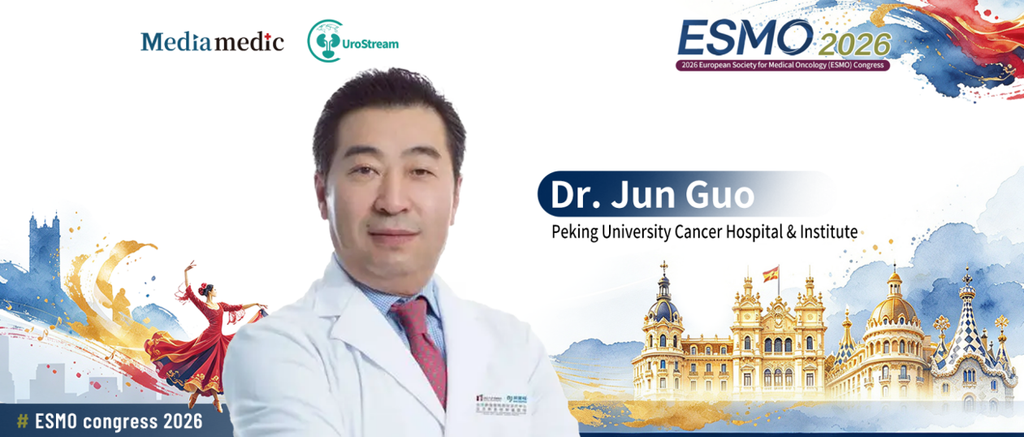
Professor Jun Guo