Editor's Note: In recent years, the combination of antibody-drug conjugates (ADCs) and immunotherapy has transformed the treatment landscape for locally advanced or metastatic urothelial carcinoma (la/mUC). However, for patients who are ineligible for cisplatin, improving tumor response rates, prolonging disease control, and maintaining treatment tolerability and quality of life remain important clinical challenges. At the 2026 European Society for Medical Oncology (ESMO) Congress, a study of first-line treatment with a regimen combining China's homegrown TROP2 ADC sacituzumab tirumotecan and immunotherapy in la/mUC was presented in a Rapid Oral session [1]. Updated data showed a confirmed objective response rate (ORR) of 68%, a median duration of response (mDOR) of 19.4 months, and a median progression-free survival (mPFS) of 11.2 months. Effective and durable tumor responses were observed regardless of TROP2 or PD-L1 expression levels, providing important evidence to inform clinical treatment decisions. Oncology Frontier – UroStream invited Professor Dingwei Ye and Professor Xiaojie Bian of Fudan University Shanghai Cancer Center to discuss the study design, efficacy and safety findings, and the development of Chinese-originated ADCs in genitourinary oncology, with the aim of providing insights for clinical practice.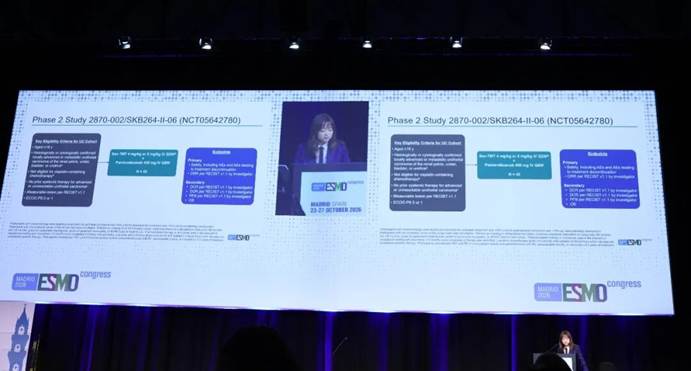
Clearing the Path: Exploring TROP2 ADCs to Address Unmet Needs in la/mUC
Oncology Frontier – UroStream: In recent years, the combination of ADCs and immunotherapy has transformed the first-line treatment landscape for advanced urothelial carcinoma. In light of current research developments, what unmet clinical needs remain in first-line treatment of advanced urothelial carcinoma? For patients who are ineligible for cisplatin, in which areas do new treatment strategies need to make further progress?
Professor Dingwei Ye: In recent years, significant progress has been made with ADC-based combination regimens. ADCs such as disitamab vedotin and enfortumab vedotin have driven a redefinition of the standard of care for first-line treatment of advanced urothelial carcinoma, and related combination regimens have been incorporated into the Chinese Society of Clinical Oncology (CSCO) guidelines for urothelial carcinoma [2]. For clinicians, our focus is no longer limited to treatment accessibility. We are increasingly concerned with selecting the most appropriate regimen for each patient to achieve better tumor control, prolong survival, and improve quality of life.
However, advances in treatment do not mean that all clinical needs have been adequately addressed. Some patients with advanced urothelial carcinoma do not achieve a satisfactory initial response, while others respond to treatment but still need longer-lasting responses. Sequential treatment following disease progression and the selection of the most appropriate regimen among available options also require further investigation. In addition, the effective management of adverse events and patients’ ability to remain on treatment are equally important factors influencing their ultimate survival benefit.
For patients with advanced urothelial carcinoma who are unsuitable for cisplatin, individualized treatment is particularly important because they may have impaired renal function, poor performance status, or other comorbidities. ADCs with different targets, payloads, and linker designs offer new directions for optimizing the treatment of advanced urothelial carcinoma. Moving forward, we hope that more comprehensive clinical evidence will clarify the appropriate patient populations, treatment timing, and combination strategies for these agents, thereby progressively improving whole-course management of advanced urothelial carcinoma.
Oncology Frontier – UroStream: To address these unmet clinical needs, your team conducted the phase II 2870-002/SKB264-II-06 study of sacituzumab tirumotecan plus pembrolizumab in patients with previously untreated, locally advanced or metastatic urothelial carcinoma who were ineligible for cisplatin. How was the study designed to address the treatment needs of this population? What evidence and clinical considerations supported the progression from earlier monotherapy studies of sacituzumab tirumotecan in advanced urothelial carcinoma to the current immunotherapy combination strategy?
Professor Xiaojie Bian: Patients with advanced urothelial carcinoma frequently present with urinary tract obstruction, hematuria, and impaired renal function. In previous clinical practice, patients who were ineligible for cisplatin generally had to switch to carboplatin-based regimens, but the overall treatment benefit was quite limited. With the emergence of next-generation ADCs and the development of combination strategies, these patients now have additional treatment options.
ADCs achieve targeted delivery to tumor cells through the coordinated action of the antibody, linker, and cytotoxic payload. Their metabolic pathways differ from those of conventional platinum-based chemotherapy: they are metabolized by the liver rather than the kidneys. This mechanism has important clinical implications for patients with urothelial carcinoma and impaired renal function. It may help avoid dose reductions or treatment discontinuation due to renal impairment and other related concerns, allowing patients to receive adequate doses of anticancer treatment and offering new hope to this population.
In response to current clinical needs, we have also been considering how to provide better treatment for patients with impaired renal function. TROP2 is highly expressed in more than 80% of urothelial carcinomas, providing a strong molecular rationale for targeted therapy. As a TROP2 ADC developed in China, sacituzumab tirumotecan incorporates a bifunctional linker and a belotecan-derived topoisomerase I inhibitor payload. Its payload mechanism differs from that of MMAE-based ADCs, offering a new therapeutic approach. Against this background, we initiated an investigation of sacituzumab tirumotecan plus pembrolizumab as first-line treatment to evaluate its efficacy and safety in patients with previously untreated, locally advanced or metastatic urothelial carcinoma who were unsuitable for cisplatin. The study also explored immunotherapy combination dosing strategies at two dose levels of 4 mg/kg and 5 mg/kg, and conducted subgroup analyses according to TROP2 and PD-L1 expression levels.
Preclinical studies and clinical data from previously treated patients with la/mUC have demonstrated the promising antitumor activity of sacituzumab tirumotecan. The ORR was 29.9% and median OS was 12.3 months in the 4 mg/kg cohort, while the ORR was 32.7% and median OS was 12.1 months in the 5 mg/kg cohort. Responses were also observed across subgroups with different levels of TROP2 expression. These findings supported further investigation of sacituzumab tirumotecan in combination with immunotherapy, moving its use into the first-line setting for advanced disease. The combination produced a further increase in the overall ORR, demonstrating encouraging signals of tumor response and disease control. Its efficacy was also comparable to that of currently available ADC-immunotherapy combinations, further expanding clinical treatment options and potentially bringing meaningful survival benefits to more patients with advanced urothelial carcinoma.
Navigating the Waves: Demonstrating the Strength of Sacituzumab Tirumotecan Plus Immunotherapy
Oncology Frontier – UroStream: Updated data from the study were presented at this year’s ESMO Congress, with a median follow-up of 22.8 months. The ORR was 68%, mDOR was 19.4 months, and mPFS was 11.2 months, while median overall survival (OS) had not yet been reached. How would you interpret these efficacy findings? In addition, exploratory analyses showed consistent antitumor activity across subgroups with different levels of TROP2 and PD-L1 expression. What implications do these findings have for identifying patients who may benefit from this treatment?
Professor Xiaojie Bian: It was a great honor to represent the research team in presenting our latest findings at the ESMO Congress. This was a small, exploratory study, and encouraging efficacy signals had already been observed in the earlier analysis. The updated results showed that, with the median follow-up extended to 22.8 months, the confirmed ORR remained at 68%, mDOR reached 19.4 months, and mPFS was 11.2 months. Median OS had not yet been reached. Among patients who responded to treatment, the median duration of response exceeded one and a half years. Together with the mPFS of 11.2 months, these findings indicate encouraging response durability, particularly among patients who achieve a response to treatment. Most patients remain alive, and the OS data are not yet mature. We look forward to further follow-up to comprehensively evaluate the long-term survival benefit of sacituzumab tirumotecan plus pembrolizumab. Overall, patients’ quality of life also remained manageable.
The exploratory biomarker analyses have also provided important insights. Among patients with TROP2 H-scores below and above the median, the ORRs were 72% and 68%, respectively, with a disease control rate of 89% in both groups. Among patients with PD-L1 CPS values of less than 10 and 10 or higher, the ORRs were 72% and 50%, respectively. Tumor responses were not restricted by TROP2 or PD-L1 expression levels. This suggests that, if the combination is introduced into clinical practice in the future, patient selection based on these biomarkers may not be necessary. Such an approach could lower the threshold for real-world use and broaden the population of patients who may benefit.
Most ADCs previously approved in urothelial carcinoma carry MMAE-class toxins, and patients’ quality of life can be adversely affected by events such as neurotoxicity. In contrast, sacituzumab tirumotecan carries a topoisomerase I inhibitor payload. Its adverse-event profile differs from that of MMAE-based ADCs, potentially reducing adverse events such as peripheral neuropathy. In clinical practice, physicians should consider the findings of this study and pay particular attention to hematologic toxicity, oral mucositis, and gastrointestinal adverse events, ensuring appropriate monitoring and management.
Oncology Frontier – UroStream: Safety is an important dimension in assessing the benefits of combination treatment. For patients who are ineligible for cisplatin, treatment tolerability and adverse-event management are particularly important. In this study, the incidence of grade 3–4 treatment-related adverse events was 63%, and 8% of patients discontinued sacituzumab tirumotecan because of treatment-related adverse events. Could you discuss the safety profile of this study and share any practical experience in managing adverse events?
Professor Xiaojie Bian: The study showed an incidence of grade 3–4 treatment-related adverse events exceeding 60%, broadly consistent with the findings reported for comparable ADCs. Therefore, alongside monitoring the antitumor activity of the drug during treatment, it is essential to prioritize the early identification and proactive management of adverse events to help patients remain on therapy.
In terms of the adverse-event profile, hematologic toxicity and oral mucositis deserve particular attention. Anemia occurred relatively frequently. In addition to considering the potential myelosuppressive effects of topoisomerase I inhibitors, oral mucositis may also limit patients’ ability to eat orally, potentially leading to nutritional anemia. Accordingly, patient education should be provided before treatment, and oral symptoms, food intake, and nutritional status should be assessed promptly throughout treatment.
Overall, established clinical management pathways are available for these adverse events. For hematologic toxicity, regular blood count monitoring and active pharmacologic interventions can help patients recover to a level at which treatment can be tolerated. For oral mucositis, basic oral care should be reinforced. Encouraging patients to hold ice chips in their mouths or use protective agents can effectively reduce drug absorption through the oral mucosa. Through continuous monitoring, timely intervention, and ongoing follow-up, we can seek to improve treatment tolerability as much as possible and minimize the impact of adverse events on patients’ quality of life and treatment continuity.
Oncology Frontier – UroStream: Considering the efficacy and safety findings of this study, what clinical benefits do you believe the sacituzumab tirumotecan-immunotherapy combination could bring to patients with advanced urothelial carcinoma in China? In addition, a global phase III study of sacituzumab tirumotecan-based combination therapy has been initiated to investigate bladder-preserving treatment in muscle-invasive bladder cancer (MIBC). How do you view the significance of extending its development into earlier disease stages?
Professor Dingwei Ye: For patients with advanced urothelial carcinoma who are ineligible for cisplatin, first-line sacituzumab tirumotecan plus immunotherapy has demonstrated encouraging efficacy. The ORR was 68%, mDOR was 19.4 months, and mPFS was 11.2 months. These findings suggest that the regimen may offer patients the possibility of deep responses and durable tumor control, while providing a rationale for the use of TROP2 ADCs in combination with immunotherapy as first-line treatment for advanced urothelial carcinoma.
From a clinical perspective, we hope that new treatment strategies will address the limitations of existing therapies and provide more appropriate and effective options for patients with urothelial carcinoma who have different disease characteristics, treatment needs, and tolerability profiles. Overall, the exploration of sacituzumab tirumotecan plus immunotherapy in the first-line setting for advanced disease further enriches ADC-immunotherapy strategies and offers a promising new approach for patients with advanced urothelial carcinoma in China.
In clinical practice, the potential value of sacituzumab tirumotecan is not limited to the treatment of advanced urothelial carcinoma; its development is also extending into earlier disease stages. The global phase III Trofuse-055 study has been initiated to evaluate the potential of sacituzumab tirumotecan in combination with pembrolizumab and chemoradiotherapy in MIBC, exploring whether this treatment approach can improve disease control while offering patients the possibility of bladder preservation.
The trimodality therapy (TMT) approach, centered on maximal transurethral resection of bladder tumor (TURBT) followed by concurrent chemoradiotherapy, has provided a bladder-preserving option for patients with MIBC. However, some patients still face the risks of residual local disease, recurrence, or distant metastasis, and may even require salvage cystectomy. The Trofuse-055 study aims to investigate whether intensified systemic treatment can complement local therapy, achieving durable tumor control while preserving bladder function and quality of life. We look forward to this study providing high-quality evidence to optimize bladder-preserving treatment pathways and establishing an evidence-based foundation for the expansion of Chinese-originated drugs into earlier disease stages.
Going Global: Continued Innovation in Chinese-Originated ADCs for Genitourinary Oncology
Oncology Frontier – UroStream: From early investigations in second-line and later-line treatment of advanced urothelial carcinoma, to the advancement of the global registrational phase III study (Trofuse-031), and the encouraging survival data in metastatic castration-resistant prostate cancer (mCRPC), sacituzumab tirumotecan has demonstrated the innovation potential of Chinese-originated drugs in genitourinary oncology. In light of the genitourinary oncology research presented at this year’s congress, how do you view the potential impact of these investigations on future clinical practice, and what role can Chinese innovation play in advancing treatment in this field?
Professor Dingwei Ye: Research on sacituzumab tirumotecan in genitourinary oncology reflects a strategy of progressively expanding its development in response to clinical needs. This includes investigating its use across different lines of treatment, as well as exploring its potential in different disease stages and tumor types.
The global multicenter phase III Trofuse-031 study aims to evaluate the efficacy and safety of sacituzumab tirumotecan monotherapy compared with investigator’s choice of non-platinum chemotherapy in previously treated patients with la/mUC. The study may provide high-level evidence to inform clinical practice.
In patients with previously treated mCRPC, sacituzumab tirumotecan plus pembrolizumab has also demonstrated encouraging efficacy. The ORR among patients with measurable disease was 47.4%, and the median duration of response was 24.7 months. In the overall population, median radiographic progression-free survival (rPFS) was 13.1 months and median OS was 22.8 months. These findings have opened up a new avenue for ADC-immunotherapy combinations in patients with mCRPC whose disease has progressed following novel endocrine therapy.
At this year’s ESMO Congress, multiple studies of Chinese-originated therapies were featured in oral presentations and poster sessions, demonstrating the strength of China’s research and development and clinical research capabilities in genitourinary oncology. To further strengthen China’s international influence in this field, continued efforts are needed in two areas.
First, innovation should be driven by genuine clinical needs, with differentiated approaches to target selection, payload and linker design, and the exploration of combination strategies with complementary mechanisms of action. Second, rigorously designed randomized controlled trials and international collaborations are needed to answer key questions, including whether new regimens can improve survival, quality of life, and long-term safety. Research into biomarkers and mechanisms of resistance should also be further deepened.
Ultimately, the value of Chinese-originated innovation must be reflected in patient benefit. We hope that high-quality clinical research will translate encouraging signals from early investigations into robust clinical evidence, support guideline updates and optimize clinical practice, allowing Chinese innovation to benefit patients both in China and around the world.

Professor Dingwei Ye

Professor Xiaojie Bian