

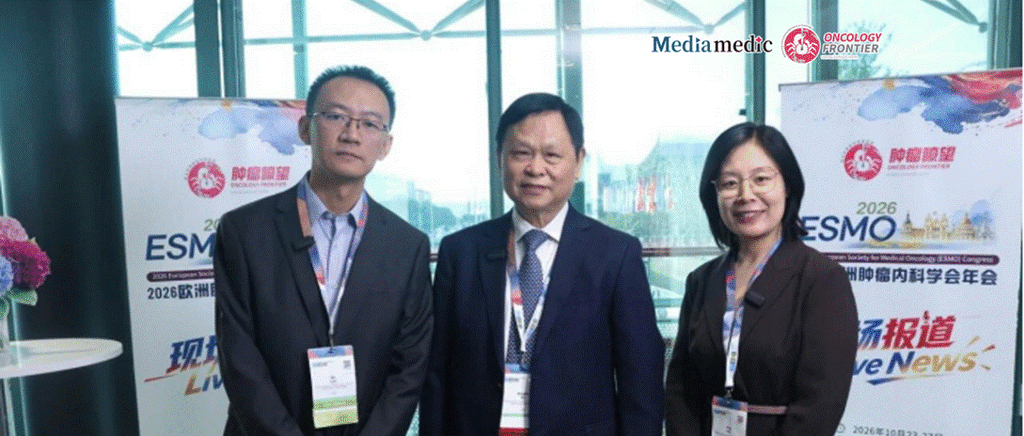
Editor's Note: At the 2026 ESMO Congress, Academician Xu Binghe’s team from the National Cancer Center/National Cancer Institute, Cancer Hospital, Chinese Academy of Medical Sciences, achieved a historic milestone in Chinese breast cancer research: three original Phase III studies were selected for Late-Breaking Abstract (LBA) oral presentations at the congress and published simultaneously in three leading medical journals—JAMA, The Lancet, and The New England Journal of Medicine (NEJM). The three studies were HORIZON-Breast06 (trastuzumab rezetecan, HER2-low advanced breast cancer), PANKU-Breast01 (iza-bren, HR-positive/HER2-negative advanced breast cancer), and HEALER (anetumab combined with albumin-bound docetaxel as first-line treatment for HER2-positive advanced breast cancer). All three achieved their anticipated positive results and have the potential to establish new treatment standards in their respective breast cancer subtypes. The simultaneous selection of three studies from the same research team for ESMO LBA presentations, alongside publication in three leading medical journals, is unprecedented in the field of breast cancer in China and rare internationally. This achievement marks China's growing emergence as a global leader in the development of innovative breast cancer therapies.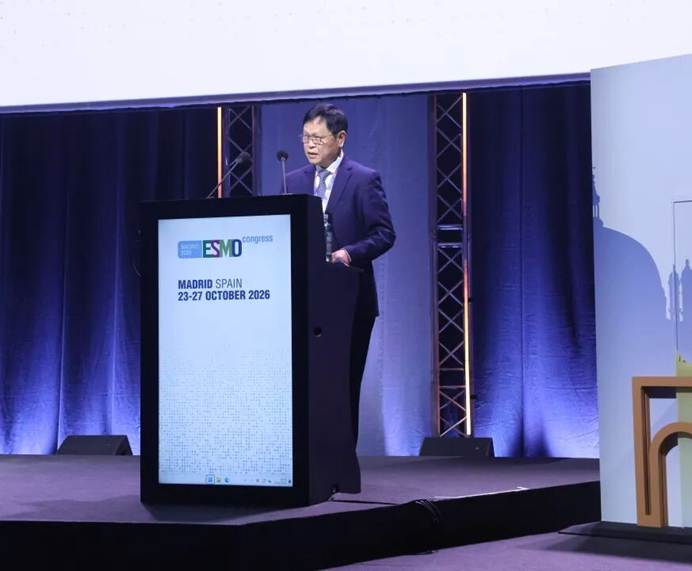
- JAMA: Phase III HORIZON-Breast06 Study of a China-Developed HER2 ADC in HER2-Low Advanced Breast Cancer
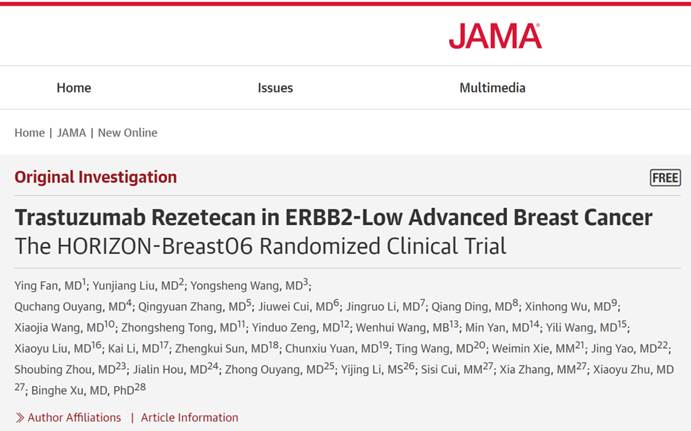
Presenter/First Author: Professor Ying Fan
Corresponding Author: Academician Binghe Xu
Professor Ying Fan: At this year’s ESMO Congress, we presented the findings of the HORIZON-Breast06 study, which were published simultaneously in JAMA. This was a randomized, open-label, multicenter Phase III clinical trial led by Academician Binghe Xu. It aimed to compare the efficacy and safety of trastuzumab rezetecan (SHR-A1811), a China-developed HER2 antibody-drug conjugate (ADC), with investigator’s choice of chemotherapy in patients with HER2-low advanced breast cancer.
The study enrolled patients with centrally confirmed HER2-low (IHC 1+ or IHC 2+/ISH-negative), unresectable locally recurrent or metastatic breast cancer, including both HR-positive and HR-negative patients. Patients with HR-positive disease had previously received endocrine therapy and therefore had endocrine-resistant disease. The primary endpoint was progression-free survival (PFS) assessed by blinded independent central review (BICR), evaluated separately in patients who had not received chemotherapy in the advanced-disease setting (chemo-naive population) and in the overall intention-to-treat (ITT) population. Key secondary endpoints included overall survival (OS) in the ITT and chemo-naive populations, as well as BICR-assessed PFS in patients who had received one prior line of chemotherapy.
The study met its primary endpoint. (1) In the chemo-naive population, median PFS in the SHR-A1811 group was prolonged by nearly 10 months compared with the chemotherapy group, with a significant 75% reduction in the risk of disease progression or death (16.6 vs. 6.8 months; HR, 0.25; 95% CI, 0.19–0.33; P<0.001). (2) A consistent and significant PFS benefit favoring SHR-A1811 was also observed in the ITT population (16.4 vs. 6.8 months; HR, 0.27; 95% CI, 0.21–0.34; P<0.001).
Subgroup analyses demonstrated a consistent trend toward benefit, with the PFS advantage of SHR-A1811 maintained regardless of HR status, HER2 expression level, prior CDK4/6 inhibitor use, or the presence of visceral metastases. Particularly noteworthy were the results in the HR-negative subgroup, which historically included patients classified as having advanced triple-negative breast cancer (TNBC). Median PFS in this subgroup reached 16.5 months (16.5 vs. 6.8 months; HR, 0.34; 95% CI, 0.22–0.54), representing a particularly impressive result compared with previously reported outcomes in the same treatment setting.
With regard to tumor response, the objective response rate (ORR) was nearly doubled in both the ITT population (75.5% vs. 41.2%) and the chemo-naive population (76.0% vs. 43.3%). The clinical benefit rate (CBR) also improved substantially (ITT population: 82.7% vs. 50.0%; chemo-naive population: 83.1% vs. 51.3%), as did the median duration of response (DoR) (ITT population: 15.0 vs. 6.8 months; chemo-naive population: 15.3 vs. 6.9 months).
Regarding safety, the most common grade ≥3 treatment-related adverse events (TRAEs) in the SHR-A1811 group were hematologic toxicities, including neutropenia (65.2%), leukopenia (56.5%), anemia (42.8%), and thrombocytopenia (35.9%). Most could be managed with standard interventions. As this regimen has already received approval in China, considerable clinical experience has been accumulated in managing these adverse events, and their management is relatively well established. Among adverse events of special interest, the incidence of interstitial lung disease (ILD) with SHR-A1811 was only 2.5%, including 1.1% of grade ≥3 cases. Overall, the adverse-event profile was well characterized and manageable.
In summary, the Phase III HORIZON-Breast06 study demonstrated for the first time that patients with HER2-low breast cancer, including both HR-positive and HR-negative disease, could benefit from trastuzumab rezetecan, whether they had not previously received chemotherapy or had received one prior line of chemotherapy in the advanced-disease setting. The findings have the potential to provide a more effective treatment option for patients with HER2-low breast cancer. Accordingly, the study was accepted for publication in JAMA and published simultaneously during the ESMO Congress.
02. The Lancet: Phase III PANKU-Breast01 Study of a First-in-Class EGFR×HER3 Bispecific ADC in HR-Positive/HER2-Negative Advanced Breast Cancer
Presenter/Joint First Author: Professor Bo Lan
Corresponding Author: Academician Binghe Xu
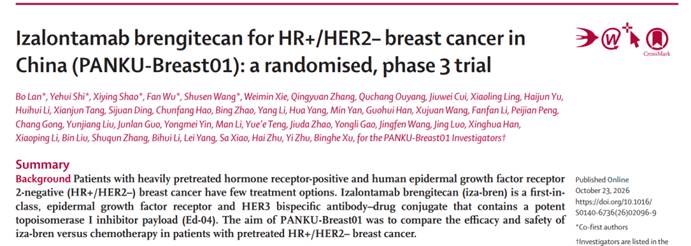
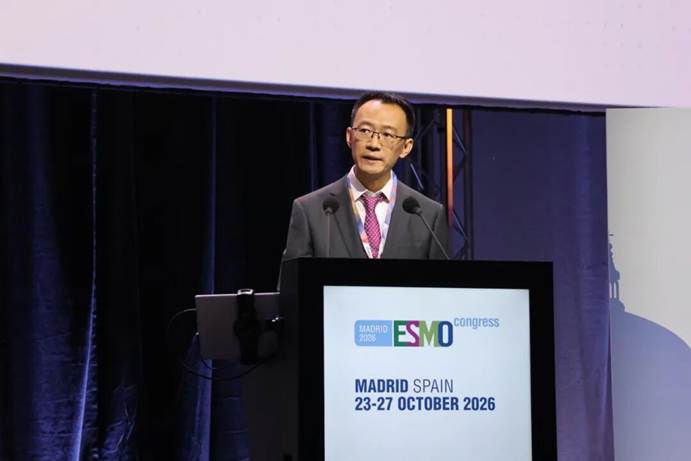
Professor Bo Lan: At this year’s ESMO Congress, we presented the findings of the PANKU-Breast01 study, which were published simultaneously in The Lancet. This randomized, open-label, multicenter Phase III clinical trial was led by Academician Binghe Xu. It aimed to compare the efficacy and safety of iza-bren (BL-B01D1), the world’s first-in-class EGFR×HER3 bispecific antibody-drug conjugate (ADC), with investigator’s choice of chemotherapy in previously treated patients with HR-positive/HER2-negative advanced breast cancer.
The study enrolled patients with unresectable locally advanced or metastatic HR-positive/HER2-negative breast cancer who had previously received endocrine therapy and one to two lines of chemotherapy. The primary endpoint was PFS assessed by BICR.
The study met its primary endpoint. According to BICR assessment, median PFS in the iza-bren group was more than twice that in the chemotherapy group, with a significant 59% reduction in the risk of disease progression or death (8.2 vs. 4.0 months; HR, 0.41; 95% CI, 0.33–0.53; P<0.0001). Subgroup analyses demonstrated a consistent trend toward benefit. When patients were stratified by HER2 expression status, a PFS benefit was observed in all three subgroups: HER2 IHC 0, IHC 1+, and IHC 2+/ISH-negative.
With regard to tumor response, the confirmed ORR was 40.5% versus 20.2%, while median DoR was 6.9 versus 4.2 months, representing approximately a twofold improvement in response rate. Regarding safety, the most common treatment-related adverse events associated with iza-bren were hematologic toxicities. Its adverse-event profile was predictable and manageable. The incidence of ILD was only 1.1%, with all cases classified as grade 1–2. No new safety signals were identified.
In summary, the Phase III PANKU-Breast01 study demonstrated for the first time that patients with HR-positive/HER2-negative advanced breast cancer who had previously received endocrine therapy and one to two lines of chemotherapy could derive significant benefit from treatment with the EGFR×HER3 bispecific ADC iza-bren. Unlike single-target ADCs directed against HER2 or TROP2, iza-bren employs a dual-target EGFR×HER3 design, providing a completely new mechanism of action and Phase III clinical evidence to support its use in later-line treatment for this patient population. Accordingly, the study was accepted for publication in The Lancet and published simultaneously during the ESMO Congress.
It is understood that, in the more than 200 years since The Lancet was founded, iza-bren is the first innovative Chinese drug in the breast cancer field to be published in the journal’s main edition. It has the potential to usher in a new era of bispecific ADC therapy for HR-positive/HER2-negative breast cancer.
03. NEJM: Phase III HEALER Study of a China-Developed HER2 Bispecific Antibody Combined with Albumin-Bound Docetaxel in HER2-Positive Advanced Breast Cancer
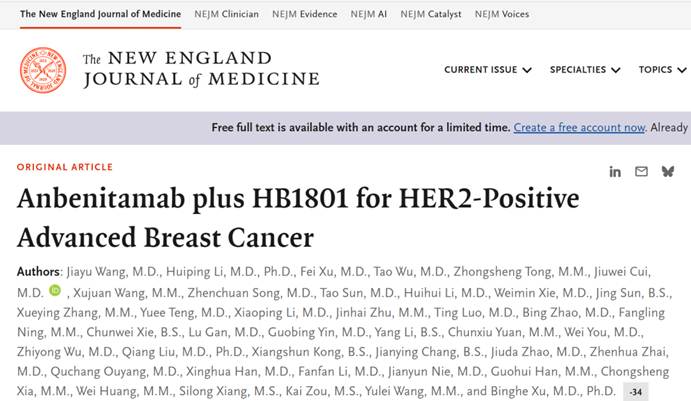
First Authors: Professor Jiayu Wang et al.
Presenter/Corresponding Author: Academician Binghe Xu
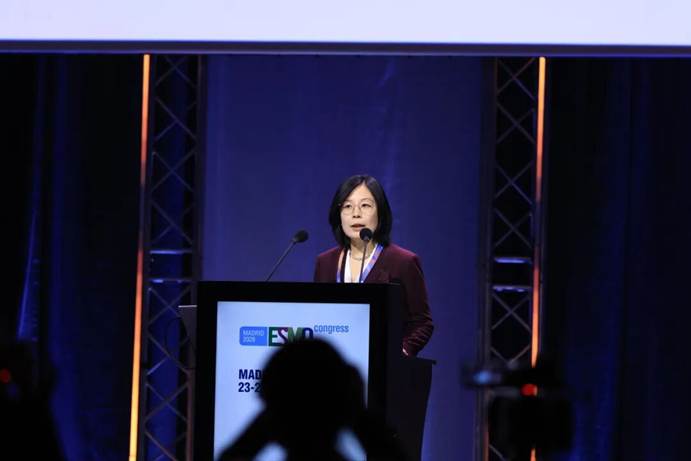
Academician Binghe Xu: The third LBA study we presented at the ESMO Congress, which was also published simultaneously in The New England Journal of Medicine (NEJM), was HEALER. This randomized, open-label, multicenter Phase III clinical trial aimed to compare the efficacy and safety of the HER2 bispecific antibody anetumab (KN026) combined with albumin-bound docetaxel (HB1801) against the standard THP regimen (trastuzumab plus pertuzumab plus docetaxel) as first-line treatment for HER2-positive advanced breast cancer.
As we know, the dual-targeted trastuzumab–pertuzumab THP regimen has dominated first-line treatment for HER2-positive advanced breast cancer for many years. Numerous Phase III clinical trials of new agents have attempted to challenge the THP regimen, but few have succeeded. The DB-09 study of T-DXd combined with pertuzumab was the first Phase III trial to successfully challenge the THP regimen. Our HEALER study was the first to investigate the value of combining a HER2 bispecific antibody with an albumin-bound taxane formulation of docetaxel in the first-line setting. The primary endpoint was PFS assessed by blinded independent central review (BICR).
The study met its primary endpoint. At the prespecified interim analysis, median PFS was significantly longer in the anetumab plus HB1801 group than in the THP group, with a significant 54% reduction in the risk of disease progression or death (not reached vs. 14.3 months; HR, 0.46; 95% CI, 0.37–0.56; P<0.0001). Investigator-assessed PFS also showed a consistent benefit (HR, 0.52; 95% CI, 0.43–0.64).
Regarding tumor response, the BICR-confirmed ORR was 87.6% versus 73.4%, while median DoR was not reached versus 16.6 months. Although the OS data were still immature, the anetumab group had already demonstrated a trend toward improved OS. In terms of safety, the incidence of grade ≥3 TRAEs was 36.9% in the anetumab group and 25.3% in the THP group. The most common event was neutropenia (13.1% vs. 8.4%). There was one treatment-related death in the anetumab group and two in the THP group. No new safety signals were identified.
In summary, this is the first Phase III clinical trial worldwide to demonstrate that a HER2-targeted bispecific antibody combined with chemotherapy is superior to the standard THP regimen. The findings have the potential to change first-line treatment practice for HER2-positive advanced breast cancer. Accordingly, the study was accepted for publication in The New England Journal of Medicine and published simultaneously during the ESMO Congress. It is also the first original NEJM research paper in the field of breast cancer from China. In a commentary on the study, Professor SM Swain of Georgetown University’s Lombardi Comprehensive Cancer Center in the United States noted:
“Compared with antibody-drug conjugates, anetumab binds to two HER2 epitopes within a single molecular structure and does not require a cytotoxic payload. It can promote immune-mediated antitumor activity and has a more favorable toxicity profile. The use of albumin-bound docetaxel further enhances this regimen, as it does not require the premedication with glucocorticoids needed for other taxane agents.”
Making History: Three Original Studies from One Research Team Published Simultaneously in Three Leading Medical Journals—A Milestone for Innovative Breast Cancer Drug Development in China
Academician Binghe Xu: This year, three studies from our team were selected for oral presentation at the ESMO Congress, and all three were LBAs. Two of our studies were featured in the congress’s high-profile session on the first afternoon, while the study presented in the closing session on the following day also came from our team. This clearly demonstrates the high level of attention these studies received from the congress organizers. It is rare for a single research team to have three studies selected as LBAs at the same congress.
Furthermore, the three studies covered multiple breast cancer subtypes, and all achieved their anticipated results, establishing new treatment standards and options in their respective fields. For example, in HER2-low breast cancer, SHR-A1811 is the first ADC developed in China with the potential to establish a new treatment standard, an achievement that has received recognition from international peers. In the field of bispecific antibodies, the China-developed bispecific ADC iza-bren achieved success in HR-positive/HER2-negative breast cancer. It is the first-in-class EGFR×HER3 bispecific agent in the breast cancer field.
Moreover, all three studies came from the same research team. They were selected for oral presentation at an international congress and published simultaneously in the leading medical journals JAMA, The Lancet, and NEJM. This has no precedent in the field of breast cancer in China and may also be unprecedented internationally. In addition, in the more than 200 years since the founding of The New England Journal of Medicine in 1812 and The Lancet in 1823, these journals have, for the first time, published original research findings on innovative Chinese drugs and original clinical research in the field of breast cancer. I believe this represents a milestone in Chinese breast cancer research.