
Editor's Note: The 2026 Congress of the European Society for Medical Oncology (ESMO) was held in Madrid, Spain. The EPIC-TC study (NCT07235566), initiated by Professor Yu Wang's team at Fudan University Shanghai Cancer Center, was selected for the Rapid Oral session and presented on October 23 as Abstract 4211RO. The study focuses on patients with EGFR-positive, unresectable anaplastic thyroid carcinoma (ATC) and poorly differentiated thyroid carcinoma (PDTC), investigating the efficacy and safety of the EGFR-targeted antibody-drug conjugate (ADC) vicetumotug vedotin combined with the PD-1 inhibitor putrelizumab. Its selection for the Rapid Oral session reflects the congress's interest in research on these rare malignancies. However, the study remains a single-center, single-arm Phase II trial, and the data presented represent preliminary findings at a prespecified data cutoff.This investigation is part of a broader, ongoing effort rather than an isolated initiative. The Department of Head and Neck Surgery at Fudan University Shanghai Cancer Center has long relied on a multidisciplinary thyroid cancer team to integrate pathological review, molecular testing, clinical trial screening, systemic treatment, and local therapies. The team previously published its experience in individualized treatment of 95 patients with locally advanced or metastatic ATC/PDTC treated between 2019 and 2023 in the European Thyroid Journal. This work provided the clinical questions and practical foundation for the current prospective study. To discuss the challenges of these diseases, the study design, clinical implications, safety considerations, and future directions, Oncology Frontier interviewed Professor Yu Wang.
Question 1
Why should ATC and PDTC not be grouped together with thyroid cancers that generally have a favorable prognosis?
Professor Yu Wang: The public often equates thyroid cancer with differentiated thyroid carcinoma, which generally has a favorable prognosis. However, ATC and PDTC are entirely different diseases. ATC is highly undifferentiated, with rapid local and systemic progression. Its historical median survival is usually less than six months. Tumors in the neck may also invade the trachea, esophagus, or major blood vessels within a short period. Therefore, diagnosis, staging, molecular testing, and treatment decisions must all be made with extreme urgency. The biological behavior of PDTC lies between that of differentiated thyroid carcinoma and ATC. Its clinical course is more heterogeneous, but it is also prone to local recurrence and distant metastasis. Treatment experience with common differentiated thyroid carcinomas cannot simply be applied to these patients.
Current treatment strategies prioritize multidisciplinary assessment and the early completion of molecular profiling. For patients with BRAF V600E-mutant ATC, combined BRAF/MEK inhibition has provided an important treatment option. Some patients with RET or NTRK fusions may also be eligible for corresponding selective targeted therapies. Patients whose tumors can be completely resected with curative intent require appropriate integration of surgery and radiotherapy. However, for patients without clearly actionable driver alterations, those with rapidly progressing disease, or those whose tumors are initially unresectable, broad-spectrum and effective systemic treatment options remain inadequate. Participation in clinical trials is therefore particularly important.
Our center’s treatment approach has consistently focused on “controlling the disease as quickly as possible while reassessing the opportunity for curative local treatment.” In a single-center retrospective study published by our team in the European Thyroid Journal, 95 patients were included, comprising 34 with PDTC and 61 with ATC. Median OS was 19.7 months for PDTC and 9.5 months for ATC. Twelve patients underwent surgery following neoadjuvant systemic therapy. The 1-year OS rates in the groups receiving neoadjuvant therapy followed by surgery, systemic therapy alone, and supportive care were 83.3%, 51.2%, and 5.7%, respectively.
These findings suggest that integrating systemic and local treatments warrants further investigation. However, retrospective cohorts are subject to substantial patient-selection and treatment-allocation biases. These results cannot directly establish a causal survival benefit from any particular treatment strategy.
Question 2
Why was an EGFR-targeted ADC combined with a PD-1 inhibitor selected?
Professor Yu Wang: In this setting, EGFR is primarily regarded as a “surface address” that allows the ADC to recognize tumor cells and deliver its payload, rather than as a requirement for the tumor to harbor an EGFR driver mutation. Previous pathological studies have suggested that some ATCs exhibit EGFR protein expression or EGFR gene polysomy, providing a biological rationale for using EGFR to deliver cytotoxic payloads. However, the testing methods, positivity thresholds, and patient populations have varied across studies. The relationship between EGFR expression and clinical benefit still needs to be validated.
Vicetumotug vedotin consists of a humanized anti-EGFR IgG1 antibody, a cleavable linker, and the microtubule inhibitor monomethyl auristatin E (MMAE). After binding to EGFR and undergoing internalization, the drug releases MMAE, resulting in mitotic arrest and tumor cell death. Putrelizumab blocks PD-1 signaling to restore the antitumor activity of T cells. Whether ADC-induced tumor cell damage can further enhance the immune response provides the biological rationale for this combination. However, the present study did not directly investigate the mechanism of immune synergy. Therefore, the possibility of complementary activity should not be presented as a synergistic effect that has already been established.
Vicetumotug vedotin, both as monotherapy and in combination with putrelizumab, has demonstrated clinical activity in EGFR-positive recurrent or metastatic nasopharyngeal carcinoma. These findings provide preliminary support for the dosing strategy and combination approach. Nevertheless, the biological characteristics, prior treatment histories, and risk profiles of different tumor types are not the same. Data from nasopharyngeal carcinoma cannot be directly extrapolated to ATC or PDTC.
Question 3
How was EPIC-TC designed, and what findings were disclosed during the Rapid Oral session?
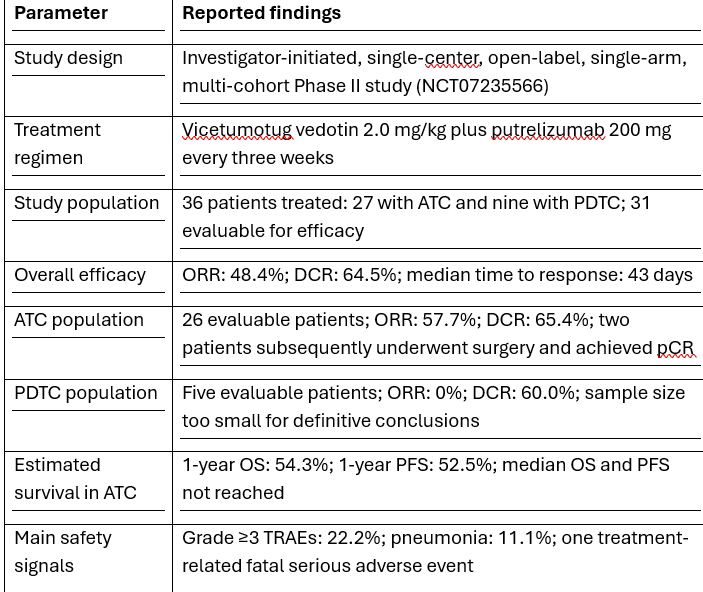
Professor Yu Wang: EPIC-TC is an investigator-initiated, single-center, open-label, single-arm, multi-cohort Phase II study. Eligible adult patients had pathologically confirmed ATC or PDTC in the recurrent or metastatic setting, with disease unsuitable for curative resection. They were required to have at least one measurable lesion according to RECIST 1.1, an ECOG performance status of 0–1, and EGFR expression in more than 10% of tumor cells by immunohistochemistry. Patients with BRAF V600E-mutant and BRAF wild-type disease were assigned to two separate cohorts, but received the same treatment: vicetumotug vedotin at 2.0 mg/kg combined with putrelizumab at 200 mg, administered every three weeks until disease progression or unacceptable toxicity. The primary endpoint was objective response rate (ORR), while secondary endpoints included disease control rate (DCR), time to response, and safety.
As of September 17, 2026, a total of 36 patients had received treatment, including 27 with ATC and nine with PDTC. Among them, 31 were evaluable for efficacy. The median patient age was 63 years; 75.0% had T4 disease, 80.6% had distant metastases, and 69.4% had BRAF V600E wild-type disease. These characteristics indicate a population with substantial disease burden and an urgent unmet clinical need.
Among the 31 evaluable patients, the overall ORR was 48.4% (95% CI, 30.2%–66.9%), and the DCR was 64.5% (95% CI, 45.4%–80.8%). The median time to response was 43 days. Among the 26 evaluable patients with ATC, the ORR was 57.7% and the DCR was 65.4%. Two patients subsequently underwent surgery after achieving radiographic responses, and both achieved pathological complete response (pCR) in the primary tumor and lateral cervical lesions.
It is particularly important to emphasize that only five patients with PDTC were evaluable in the current subgroup analysis. No objective responses were observed, and the DCR was 60.0%. Therefore, the main efficacy signal from this study comes from the ATC population, and no definitive conclusion can currently be drawn regarding efficacy in PDTC.
The ORRs in the BRAF V600E-mutant and wild-type groups were 54.5% and 45.0%, respectively, while the corresponding DCRs were 72.7% and 60.0%. Given the very small sample sizes in these subgroups, these figures should be regarded only as exploratory observations. They do not establish that efficacy is independent of BRAF status, nor can they be used to determine which subgroup derives greater benefit.
Question 4
How should the two cases of pathological complete response and the survival curves be interpreted?
Professor Yu Wang: For ATC with extensive local invasion, systemic treatment that reduces tumor burden within a relatively short period may indeed provide some patients with an opportunity to be reassessed for surgery or radiotherapy. In this study, two patients underwent surgery after treatment and achieved pCR. This demonstrates the clinical value of exploring a strategy in which local treatment options are dynamically reassessed following systemic therapy. The findings are consistent with the approach we have adopted in our previous multidisciplinary clinical practice.
However, these two cases represent individual outcomes in a highly selected patient population. They cannot be used to estimate the overall conversion-to-surgery rate, nor should they be interpreted as meaning that every patient with unresectable disease can undergo surgery after receiving the same regimen. Eligibility for conversion surgery must still be determined through a comprehensive assessment of post-treatment anatomical relationships, control of distant lesions, invasion of the trachea and blood vessels, the patient’s overall condition, and surgical risks. This decision requires joint evaluation by specialists in head and neck surgery, medical oncology, radiation oncology, radiology, and pathology.
Among the 26 evaluable patients with ATC, the estimated 1-year OS rate was 54.3%, and the 1-year PFS rate was 52.5%. Median OS and median PFS had not yet been reached.
“Not reached” means that, at the data cutoff, fewer than half of the patients had experienced a death or disease progression event. It does not mean that all patients were still alive or that none had experienced disease progression. Given the limited follow-up duration and small sample size, the survival data remain immature and require continued follow-up.
Question 5
Which safety signals must be clearly reported, and what are the priorities for further research?
Professor Yu Wang: Among the 36 patients included in the safety population, most treatment-related adverse events were grade 1–2. The more common events included fatigue, alopecia, increased thyroid-stimulating hormone (TSH), decreased appetite, and anemia. The incidence of grade ≥3 treatment-related adverse events (TRAEs) was 22.2%, and three patients required a dose reduction of vicetumotug vedotin to 1.5 mg/kg. The incidence of pneumonia was 11.1%, including 2.8% of grade ≥3 cases. The study also recorded one treatment-related fatal serious adverse event following the initial treatment. This information must be fully disclosed. The overall risk should not be simplistically characterized as “mild” or as involving “no serious problems” merely because most adverse events were low grade.
ATC itself frequently invades the trachea, esophagus, and major blood vessels. Patients may simultaneously face risks involving the airway, bleeding, infection, and nutritional status. Before initiating systemic treatment, clinicians must assess invasion of vital organs and potential complications. Even when treatment leads to rapid tumor shrinkage, close monitoring is required for local necrosis, fistula formation, hemorrhage, and infection. Previous studies and real-world experience with other targeted therapies, with or without immunotherapy, have also reported fatal adverse events, including tracheal fistula and bleeding, associated with rapid tumor regression. The safety profile of immunotherapy and risks arising from the disease itself are often intertwined. Individualized management therefore requires frequent imaging assessments, airway evaluation, laboratory monitoring, and multidisciplinary collaboration.
The next stage should first focus on completing patient enrollment and extending follow-up, with particular attention to the duration of response, long-term PFS and OS, outcomes following conversion surgery, and perioperative risks. Second, further research is needed to determine whether the intensity and heterogeneity of EGFR expression, other molecular alterations, and the immune microenvironment can help identify patient populations most likely to benefit. Given the small number of patients with PDTC and the absence of objective responses so far, this subgroup should be expanded and evaluated cautiously. Finally, multicenter studies and appropriately designed controlled trials will be needed to validate efficacy and safety and clarify the clinical positioning of this regimen relative to existing BRAF/MEK therapy, other selective targeted therapies, multikinase inhibitors, radiotherapy, and surgery.
Conclusion
The value of the EPIC-TC study lies in providing a systemic treatment approach worthy of further investigation for patients with EGFR-positive, initially unresectable ATC. It also reinforces the importance of rapid molecular testing and the dynamic integration of systemic and local treatments.
At this stage, the most appropriate conclusion is that this combination regimen has demonstrated preliminary antitumor activity in ATC, with responses occurring relatively quickly and showing potential clinical significance. At the same time, the safety signals require serious attention. Evidence in PDTC remains clearly insufficient. These findings cannot yet replace current standard treatments or guarantee clinical benefit for individual patients. The clinical positioning of this regimen will need to be determined through more complete data and further studies.
Study Disclosure
This was an investigator-initiated trial (IIT). Lepu Biopharma provided the investigational drugs free of charge to enrolled participants but did not provide financial support to the investigators or study sponsor for conducting the trial. The results presented are based on data available as of September 17, 2026, and do not constitute treatment recommendations or guarantees of efficacy.
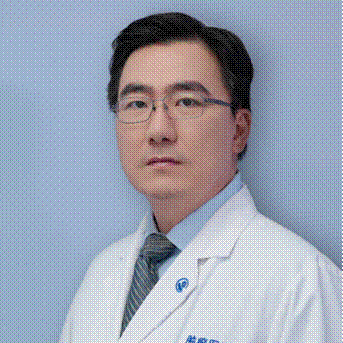
Professor Yu Wang